Like the title says. Each less than 4 bucks. What a cheap way to beat the blahs.
Showing posts with label textile. Show all posts
15.1.10
19.7.09
Hic transit Burgundia
.

Millefleurs armorial tapestry with the arms of
the Duchy of Burgundy (detail), Brussels, 1466.
Wool, silk, gold and silver thread,
3.96 m x 6.87 m.
the Duchy of Burgundy (detail), Brussels, 1466.
Wool, silk, gold and silver thread,
3.96 m x 6.87 m.
In Switzerland, ancient, dentally challenged peasants in funny be-antennaed berets still grin ungainly grains at the mention of the battles of Grandson and Murten (1476). "We sure taught him a lesson", they say and laugh. "He" is Charles -- Charles the Bold, as they say the English, though Charles le Téméraire would perhaps be better translated into English as Charles the Rash.
This was a nickname he acquired on account of his violent, unpredictable nature and his inclination to treat his enemies with undue and unchivalrous harshness. The sum total of Charles' achievements was to destroy, in a series of disastrous campaigns, the state his ancestors had built over centuries, Burgundy. They had made it one of the most powerful and richest states in fifteenth century Europe; certainly its most cultured: home of the Flemish oil on wood, tapestry, and the isorythmic motet. He frittered it all on pointless wars which, had he even won them, would have served him nothing. His life ended fittingly: some time after his death, his body was discovered and pulled, naked, disfigured and frozen, out of a marsh outside Nancy, his last siege, as disastrous as all the others.
His father, Philip the Good, had commissioned the above tapestry in 1466 as part of an eight-piece chambre-de-verdure, which dispensed entirely with the depiction of human or animal figures, writes Hali.
Instead, all eight hangings had a ground composed of flowering plants on which the arms of the Duke of Burgundy seemed to float. The escutcheon is surmounted by the jousting helm, which, with its nine bars, indicates ducal rank. Attached to the latter is its cover, the formerly purple lining displaying Philip's personal emblem, a fire steel with fire stone and flames. This emblem is also seen in a larger format in all four corners of the tapestry. Towering above the helmet, the rest is a carved and guilded fleur-de-lis. Laid around the escutcheon is the collar of the Order of the Golden Fleece, the insignia of the chivalric order that Philip founded in 1430. It is one of twenty five such collars that the Burgundian court jeweler made for members of the order, the links in the chain being fashioned like a fire steel. An enormous variety of naturalistically rendered plants are interwoven in the millefleurs ground, but the overall effect is of balance and rhythm.
Philip's son, Charles, reveled in lavish displays and insisted on carrying his state treasury around with him on all his wars. This is how the chambre-de-verdure fell into Swiss hands; and how this piece has come to reside in the Bern Historisches Museum. We know that it was still hanging over the choir stalls at the Bern cathedral shortly before Reformation, but it had been divided into horizontal strips, evidently to make it fit its location.
The remaining seven millefleurs from chambre-de-verdure have been lost.
In honor of this grievous loss, and the loss of the Duchy of Burgundy, and of Charles's ignominious, but fully deserved, death, let us listen in silence to Antoine Busnois' Missa L'Homme Armé.
25.6.09
Çintamęty
.
Right at the formation of the Polish national state, the indoctrination began: in 1920 both Semadenis -- husband and wife -- then still boyfriend and girlfriend -- wrote their Baccalauréat thesis on the subject: Does Poland belong to Western European civilization or Central European civilization? They both answered correctly (and passed): Western. In their case it's no surprise: they were Lutherans of German and Swiss origins. How else could they answer? But the answer was de rigeur for all, it would seem, not only recent immigrants form the West.
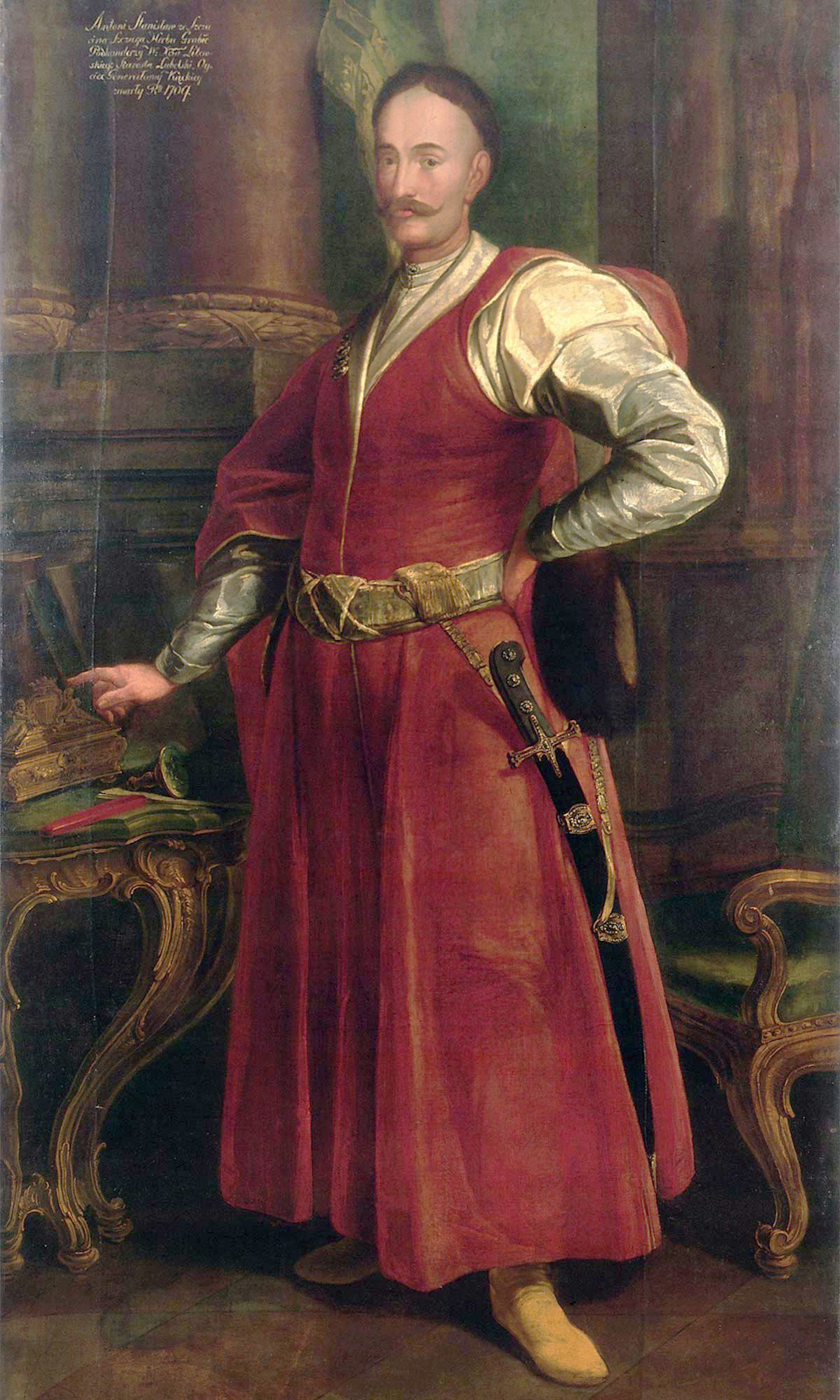
The indoctrination job has been done well in Poland: formerly close ties of Poland to the East -- Turkey in particular -- have been programatically wiped out from Polish collective memory. Yet the proof of the connection lies everywhere; at the linguistic level the most basic items bear Turkish names: pierogi (the national dish); palto (coat: can't live without one); torba (bag); wisnia (national fruit). The national dress -- kontusz -- was defended in the 18th century against the effeminate French fashion as truly Polish; it was, of course, Turkish (by way of Hungary). As was the hairstyle, the obligatory drooping mustache and the saber. (The saber is still obligatory: I own one).
Simply put, the Polish eternally western nature is -- a fraud. But never mind that: why waste my time fighting the nation-building indoctrination in Poland? All nation building indoctrination is equally stupid, whether in Poland or in India or Lapland; and I could never fight it all: who am I, a lone voice, against a sea of nonsense? Let them do their foolishness as they please.
But digging up layers of Turkishness in Poland is fun. It's not unlike archeology.
Here is one of my more entertaining recent digs:
Last November I passed through Kęty, or Kąty, in Upper Silesia. The name -- literally "corners" -- used to carry the connotation of "boonies" or "sticks", which Kęty was and still is. No offense: I am partial to sticks. Now, Kęty's coat of arms, proudly displayed at all city entrances, looks like this.
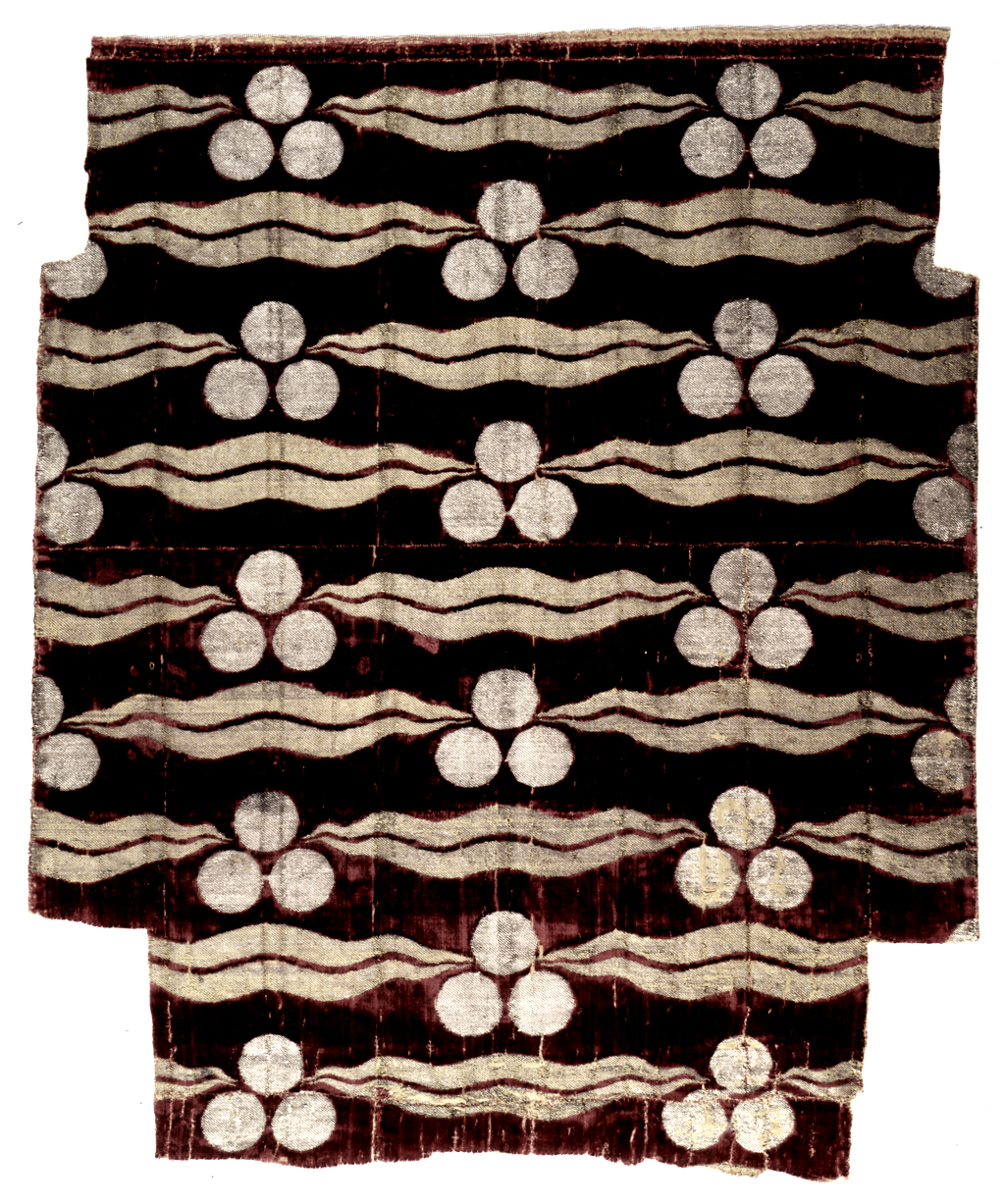
I laughed out loud. The right field is pure Chintamani (Çintamani), of course: three balls in pyramidal arrangement and two wavy lines. (Here is an example).
Chintamani was one of the principal elements of Turkish figurative design -- in textiles, in Iznik pottery, wall tiles, etc. It's origin lies in a banner the Ottoman rulers had adopted: three balls of Timur-e-Lang plus two stripes of Rustam's tiger-skin.
A friend who was traveling with me dug up the facts: sometime in the thirteenth century a prince of Silesia hunted somewhere in the sticks and finding an eagle's nest with three eggs in it close by a stream, decided to found a town there. (And why not). Hence the three balls (eggs) and two stripes (stream).
Hence, not Turkish but Polish?
Well, the source of the coat of arms may not be Turkish; but it is hard to believe that whoever drew this coat of arms -- with that particular arrangement of balls, and the two parallel wavy lines (in other coats of arms streams are represented with three lines) had not seen the Chintamani. I am sure he did. Perhaps he even owned a Turkish chintamani velvet.
Taken in a charge on a Turkish camp, of course.
A word about Chintamani:
It was just Rustam's two tiger stripes until Timur suddenly turned up: check out this link: you will see a portrait of Osman I, the founder of the Turkish state in Anatolia wearing a half-Chintamani, as it were: a tiger-stripe pattern kurta, gold on blue1. No balls.
Now, here is the thing: Osman predated Timur; at his time the Turks had not yet had the opportunity to learn the -- er -- shall we say -- burning significance of the three balls.
Now look at the illustration at the top of this post. Ipek, Imperial Ottoman Silks and Velvets calls it "a striking pattern in an unusual color combination". One wonders if the editors had seen the Osman portrait.
1 By the way, the word kurta lives in Polish as "kurtka", i.e. "small kurta", i.e. "jacket", and has nothing to do with German kurtz, though no doubt, the Semadenis' Baccalauréat thesis would have had you believe otherwise.
I should also mention here, I suppose, that the name Semadeni is originally Italian, or rather, to be precise, Savoyard, not Swiss; so much for the native Swiss Germanness of the Semadenis, I suppose.
Pair of sleeves (kolluk), 16th century, Topkapi.
Right at the formation of the Polish national state, the indoctrination began: in 1920 both Semadenis -- husband and wife -- then still boyfriend and girlfriend -- wrote their Baccalauréat thesis on the subject: Does Poland belong to Western European civilization or Central European civilization? They both answered correctly (and passed): Western. In their case it's no surprise: they were Lutherans of German and Swiss origins. How else could they answer? But the answer was de rigeur for all, it would seem, not only recent immigrants form the West.
The indoctrination job has been done well in Poland: formerly close ties of Poland to the East -- Turkey in particular -- have been programatically wiped out from Polish collective memory. Yet the proof of the connection lies everywhere; at the linguistic level the most basic items bear Turkish names: pierogi (the national dish); palto (coat: can't live without one); torba (bag); wisnia (national fruit). The national dress -- kontusz -- was defended in the 18th century against the effeminate French fashion as truly Polish; it was, of course, Turkish (by way of Hungary). As was the hairstyle, the obligatory drooping mustache and the saber. (The saber is still obligatory: I own one).
Simply put, the Polish eternally western nature is -- a fraud. But never mind that: why waste my time fighting the nation-building indoctrination in Poland? All nation building indoctrination is equally stupid, whether in Poland or in India or Lapland; and I could never fight it all: who am I, a lone voice, against a sea of nonsense? Let them do their foolishness as they please.
But digging up layers of Turkishness in Poland is fun. It's not unlike archeology.
Here is one of my more entertaining recent digs:
Last November I passed through Kęty, or Kąty, in Upper Silesia. The name -- literally "corners" -- used to carry the connotation of "boonies" or "sticks", which Kęty was and still is. No offense: I am partial to sticks. Now, Kęty's coat of arms, proudly displayed at all city entrances, looks like this.
I laughed out loud. The right field is pure Chintamani (Çintamani), of course: three balls in pyramidal arrangement and two wavy lines. (Here is an example).
Chintamani was one of the principal elements of Turkish figurative design -- in textiles, in Iznik pottery, wall tiles, etc. It's origin lies in a banner the Ottoman rulers had adopted: three balls of Timur-e-Lang plus two stripes of Rustam's tiger-skin.
A friend who was traveling with me dug up the facts: sometime in the thirteenth century a prince of Silesia hunted somewhere in the sticks and finding an eagle's nest with three eggs in it close by a stream, decided to found a town there. (And why not). Hence the three balls (eggs) and two stripes (stream).
Hence, not Turkish but Polish?
Well, the source of the coat of arms may not be Turkish; but it is hard to believe that whoever drew this coat of arms -- with that particular arrangement of balls, and the two parallel wavy lines (in other coats of arms streams are represented with three lines) had not seen the Chintamani. I am sure he did. Perhaps he even owned a Turkish chintamani velvet.
Taken in a charge on a Turkish camp, of course.
*
A word about Chintamani:
It was just Rustam's two tiger stripes until Timur suddenly turned up: check out this link: you will see a portrait of Osman I, the founder of the Turkish state in Anatolia wearing a half-Chintamani, as it were: a tiger-stripe pattern kurta, gold on blue1. No balls.
Now, here is the thing: Osman predated Timur; at his time the Turks had not yet had the opportunity to learn the -- er -- shall we say -- burning significance of the three balls.
Now look at the illustration at the top of this post. Ipek, Imperial Ottoman Silks and Velvets calls it "a striking pattern in an unusual color combination". One wonders if the editors had seen the Osman portrait.
_____________
1 By the way, the word kurta lives in Polish as "kurtka", i.e. "small kurta", i.e. "jacket", and has nothing to do with German kurtz, though no doubt, the Semadenis' Baccalauréat thesis would have had you believe otherwise.
I should also mention here, I suppose, that the name Semadeni is originally Italian, or rather, to be precise, Savoyard, not Swiss; so much for the native Swiss Germanness of the Semadenis, I suppose.
24.6.09
Bursa velvets
16th century, Turkish. Made in Bursa. Gulbenkian collection, Lisbon.
The persistent idea is of staggered rows of circles. Some circles morph into carnations and some -- into thistles. And others into flower arrangements. The pattern works -- but one wonders where it derives from.
Some patterns have a superimposed frame (a la Sanguszko carpet -- Heaven's Gate?). The frame, when present, seems always asymmetrical: it cuts through the circles differently at bottom than at top, suggesting that the design was directional -- to be hung one way but not the other.
One wonders why and hopes the museum got it right.


The circles can sometimes be arranged in neat rows, too. Here they seem to incorporate the idea of the chintamani pattern (of which more anon):

A great number of these was once exported to Poland; many workshops in Bursa (and later in Istanbul) existed solely for the purpose of production against Polish orders. Polish merchants in Bursa had a special tax dispensation, allowing them a lower export duty on their shipments to Poland (the Sultan being kind to his best customers). The National Museum in Cracow has a large collection of these makaty (Polish: wall hangings; from Arabic: maq'ad, a small sitting carpet).
But the influx of New World gold into Europe in the sixteenth century, and the subsequent price revolution, allowed Europeans -- including Poles -- to offer very high prices for these velvets; prices which Turkish nobles could not match. To prevent the draining of Bursa velvets out of the Empire, the Ottoman government then banned their export. One of the consequences of this decision was that Italian weavers began to make fake Bursas (many in Chintamani pattern) for export to Poland.
The persistent idea is of staggered rows of circles. Some circles morph into carnations and some -- into thistles. And others into flower arrangements. The pattern works -- but one wonders where it derives from.
Some patterns have a superimposed frame (a la Sanguszko carpet -- Heaven's Gate?). The frame, when present, seems always asymmetrical: it cuts through the circles differently at bottom than at top, suggesting that the design was directional -- to be hung one way but not the other.
One wonders why and hopes the museum got it right.


The circles can sometimes be arranged in neat rows, too. Here they seem to incorporate the idea of the chintamani pattern (of which more anon):

A great number of these was once exported to Poland; many workshops in Bursa (and later in Istanbul) existed solely for the purpose of production against Polish orders. Polish merchants in Bursa had a special tax dispensation, allowing them a lower export duty on their shipments to Poland (the Sultan being kind to his best customers). The National Museum in Cracow has a large collection of these makaty (Polish: wall hangings; from Arabic: maq'ad, a small sitting carpet).
But the influx of New World gold into Europe in the sixteenth century, and the subsequent price revolution, allowed Europeans -- including Poles -- to offer very high prices for these velvets; prices which Turkish nobles could not match. To prevent the draining of Bursa velvets out of the Empire, the Ottoman government then banned their export. One of the consequences of this decision was that Italian weavers began to make fake Bursas (many in Chintamani pattern) for export to Poland.
21.6.09
The Sanguszko

Not a Sanguszko, actually
Last night I froze speechless before a huge (four by six meters) Iranian carpet produced by Miri.
Miri has been making modern recreations of traditional pieces of incredible color and quality -- (absolutely the smallest knots I have ever seen). On account of their workmanship and beauty, some of their pieces have been bought by museums. Yet, their catalog (and website) do not show any of their work, God (the Merciful, the Compassionate) only knows why. (But they do show their good looking chief designer, who is very much worth seeing). Try to get your hands on the promo catalog of their closest competitor too, though -- Woven Legends -- the reproductions in it are fantastic.
*
Last night, in a deep pomegranate field minuscule red lions and leopards bit into the necks of helplessly thrashing deer; angels floated in pairs while playing lyres; dragons intertwined with peacocks; and men raced on horseback with their swords up-raised. The carpet, I was told, was a kind of... Sanguszko.
I did a double take: a -- who?
(Out of that name, like out of a madeleine dipped in tea, an image of an old aunt floated up before my eyes).
*
The title of Princes, which the family Sanguszko claim, we are told by no less authority than New York Times, is Polish.
It isn't.
It's Lithuanian.
The Sanguszko are descended from Fiodor, brother of Jagiello, the Grand Duke of Lithuania (he later became king of Poland; and in time fathered Wladyslaw Warnenczyk, him of the Madeira fame); and through Fiodor, they descend from Gedymin, one of the greatest heroes of the Lithuanian heroic age.
(There were no princely titles in Poland just as there were no court ranks: in Poland which was a Res Publica -- with an elective king -- all nobles ("citizens") were equal, including my folk. But in Lithuania there were two sorts of princes -- Lithuanian -- those descended from the Grand Dukes, i.e. cousins of the royal house; and Ruthenian -- descendants of Rurik, the founder of the Ruthenian state, and, Russians say, Russia. (Ukrainians disagree). My folk in time came to call themselves counts -- which made them liars. But the Sanguszko are the real thing: blood royal; a off-shoot of the Gedymin tree. In time, they polonized and called themselves Polish, but their roots, and title, were 100% Lithuanian).
*
Sometime early in the last century the Sanguszkos have deposited a carpet with the New York Met. There it was seen by millions and by the virtue of the fact became quite famous while the Sanguszkos frolicked all over the world (last time I checked, in Sao Paolo, Brasil). Then, in 1994, the last Sanguszko living decided to put the carpet up for sale. (One familiar with the ways of Polish noblemen might enjoy imagining an astronomical gambling debt incurred overnight). As the Met could not raise the money fast enough -- the sum of 4 million bucks was reported -- the carpet went to the Miho Museum of Art. ("Globalization").
Where it may not be seen, of course. (Hey, what are museums for).
*
The carpet is Safavid -- it was made in Kerman, in the 16th century. It is considered the finest example of a group of about sixteen similar carpets dispersed across the world. They are distinguished by their extremely fine workmanship -- it is said that the pattern can be made out on the reverse -- and color; and their figural patterns (rather than the usual geometric and vegetal). There is an interesting paper1 trying to make out the meaning of the pattern and figures. The carpet represents the heavens seen from earth; the border that runs around it is the heaven's first gate; the medallion in the middle, the second; and the small circle in the center: the third and highest (behind which stands the veiled Throne of God). (It is a kind of perspective, don't you see). The dragons entwined about it are Chinese in origin: the yin-and-yang, but in Persian they are also a pun (mobram -- "entwined", but also "inevitable"). Yet, the symbol is Zoroastrian (eternal struggle between Light and Darkness). The felines devouring the horses represent the fate of those who do not follow the path (gor -- "onager" but also "infidel"). The tigers are black with gold stripes -- the reverse of facts on earth -- because these are heavenly tigers. The central medallion and the two escutcheons are geometric representations of the Shamanist two-headed Sun Bird. The strange birds -- swans on crane's legs -- are souls of the faithful waiting to be born.
Etc.
These figural carpets were made during a short period in the 16th century and may have gone out of production on account of the revival of Shi'ite orthodoxy under Shah Tahmasp (of coffee-renouncing, atelier-dispersing fame). The paper goes on to argue that certain kinds of geometric patterns and designs popular in later eras may derive from them, being, as it were, coded allusions.
Fascinating stuff. Possibly untrue, too, but makes one want to see the Sanguszko all the same -- doesn't it? Sadly I am unable to find a reproduction to show you. (I can always go to my friendly local carpet dealer to take a look myself... But I'd like to show it to you, too, so if you find a photo, do send it to me for posting).
(The carpet above is not a Sanguszko, it belongs to a category known as Royal Hunting Carpets, which were made at about the same time).
*
How did this Kerman get into Sanguszko hands?
Why, through a heroic deed of arms, of course. At the battle of Chocim (Khotim), 1621, the second of the four which fought there -- Chocim is quite literally a swinging sort of place. It was among the many carpets the Commonwealth cavalry took from the Turks. The Commonwealth Cavalry charging the Turkish camp in order to seize Persian carpets is a bit of an East European tradition. Perhaps the Sanguszkos, who took part in the charge in 1621, took this one at the division of spoils on account of its pattern -- it includes the motif of a man charging on horseback with a sword up-raised. (You can see a similar figure in the carpet above). And he looks a lot like Pogon, the Sanguszkos' coat of arms.
1 Schuyler van R. Cammann, "Cosmic Symbolism on Carpets from the Sanguszko Group", in Studies in Art and Literature of the Near East, New York, 1974.
2.6.09
Speaking of Mamluks
.

Edmund de Unger explained why Mamluks were his favorite oriental carpet pattern: "however long you stare at them, he said, you always see something new, you are never bored". But neither does the eye tire, I'd like to add: the patterns are complex, but regular and calm, and the color scheme is subtle.
This is a modern Mamluk, a copy of a sixteenth century original. It was woven by Woven Legends.
Speaking of Mamluks, here is one (click to enlarge):

Edmund de Unger explained why Mamluks were his favorite oriental carpet pattern: "however long you stare at them, he said, you always see something new, you are never bored". But neither does the eye tire, I'd like to add: the patterns are complex, but regular and calm, and the color scheme is subtle.
This is a modern Mamluk, a copy of a sixteenth century original. It was woven by Woven Legends.
1.6.09
A few words about carpets
.


1. Edmund de Unger, the owner of this miniature [which is a leaf of Shah Thamasp’s Shah Nama, read about the book here, read the book here, see pages from various manuscript editions here], was born into a Hungarian aristocratic family. His father was an Oriental carpet collector and young Edmund's first drawings as a child were not dogs, houses and human stick figures but – carpet patterns.
2. His father’s collection died a dramatic death: during the 1945 fighting for Budapest, Russians buried their dead wrapped in them. One couldn’t very well object: they were, after all, war heroes. And, surely, a hand-woven carpet, rich, thick, and laboriously made, makes a fitting shroud for a hero.
3. After the communist take-over, young Unger fled to the UK where for a time he served as a gentleman’s gentleman (literally) while studying for a barrister’s degree. He then joined British imperial foreign service and it is there that he caught the luster-ware bug. It all went from there. Though it was probably inevitable: a collector is born a collector, Unger says, what he collects is a matter of accident – stamps, bottle caps, Old Masters, carpets.
(Though, this not the case with me: my collections are not collections at all. They are just assemblies of beautiful object of every category and description, since they do not follow any scheme at all -- no category, no period, no genre. Clearly, I am not a collector in the same sense as Unger. Nor in another: I do not care if my possessions are authentic; only whether they are beautiful).
(Still, I do understand something of de Unger’s pleasure: he recalls fondly falling asleep deliciously in his friend's house while counting his friend’s Qing pieces. It has happened to me).
4. Asked his favorite oriental carpet design he says without hesitation "Mamluk", because, no matter how many times one stares at one, he says, one always discovers something new. I understand this, too: I, too, am slave to complexity. (Says who complexity is not a source of pleasure?)
(Just wait. There is a really nice Mamluk coming up).
5. I found the interview in the most recent issue of Hali ("carpets, textiles and Islamic arts" -- where has this beauty been all my life?). There I also found other treasures; like the advertisement, by Azer Ilme, a carpet weaving and marketing company of Azerbaijan (see some of their offerings here), that they have managed to reproduce a Shehi Safi carpet (last examples of this beauty-wonder were made in the 16th century, back when Azeris still spoke an Iranian dialect); and an article on the paracas carpets of Peru.
6. These last are as weird a story as you'll ever hear. They date to sometime between the 1st Century BC and 4th century AD - roughly the time of Imperial Rome. They were used to wrap the dead who were then buried in elaborate cave necropolises in the Paracas peninsula, Peru. One Julio Tello discovered these necropolises in the early 1900´s when he noticed very strange -- and beautiful -- carpets for sale in the markets of Lima and followed the grave robbers to their source. The colors of the surviving carpets have been beautifully preserved in the dry darkness of the graves; we know nothing about the civilization that made them, or why they made them, or what the designs mean, but they look as if they had been dyed and woven yesterday.
And they do look weird: just look.

7. And thus it is seen that the Russians, wrapping their war dead in Persian carpets, were simply re-discovering what the people of Paracas had known long before them: that a carpet makes a fitting shroud for the dead. I should make a note of it: I too want to be buried in a richly woven carpet.
(All this for a mere afternoon at the library. Can you imagine? And they say reading does not have a future).
8. On a later day at the library I discover that burying the dead wrapped in carpets was an ancient Scythian custom. The oldest extant Old World carpet -- dating to 4th century BC -- comes from a Siberian Scythian burial in Pazyryk, a high cold plateau in the back of beyond, where the borders of China, Mongolia, Russia and Kazakhstan meet. (This was discovered only lately, but confirmed a story from Herodotus that the Scythians buried their dead at a special site several weeks' ride east into the steppe; well, guess what, the old man did not lie: they really did). (Read all about it, and especially the Ice Maiden, a tattooed woman buried with weapons, horses, and a chariot, here).
Now, this touches me deeply: I am supposedly of Scythian descent.
2. His father’s collection died a dramatic death: during the 1945 fighting for Budapest, Russians buried their dead wrapped in them. One couldn’t very well object: they were, after all, war heroes. And, surely, a hand-woven carpet, rich, thick, and laboriously made, makes a fitting shroud for a hero.
3. After the communist take-over, young Unger fled to the UK where for a time he served as a gentleman’s gentleman (literally) while studying for a barrister’s degree. He then joined British imperial foreign service and it is there that he caught the luster-ware bug. It all went from there. Though it was probably inevitable: a collector is born a collector, Unger says, what he collects is a matter of accident – stamps, bottle caps, Old Masters, carpets.
(Though, this not the case with me: my collections are not collections at all. They are just assemblies of beautiful object of every category and description, since they do not follow any scheme at all -- no category, no period, no genre. Clearly, I am not a collector in the same sense as Unger. Nor in another: I do not care if my possessions are authentic; only whether they are beautiful).
(Still, I do understand something of de Unger’s pleasure: he recalls fondly falling asleep deliciously in his friend's house while counting his friend’s Qing pieces. It has happened to me).
4. Asked his favorite oriental carpet design he says without hesitation "Mamluk", because, no matter how many times one stares at one, he says, one always discovers something new. I understand this, too: I, too, am slave to complexity. (Says who complexity is not a source of pleasure?)
(Just wait. There is a really nice Mamluk coming up).
5. I found the interview in the most recent issue of Hali ("carpets, textiles and Islamic arts" -- where has this beauty been all my life?). There I also found other treasures; like the advertisement, by Azer Ilme, a carpet weaving and marketing company of Azerbaijan (see some of their offerings here), that they have managed to reproduce a Shehi Safi carpet (last examples of this beauty-wonder were made in the 16th century, back when Azeris still spoke an Iranian dialect); and an article on the paracas carpets of Peru.
6. These last are as weird a story as you'll ever hear. They date to sometime between the 1st Century BC and 4th century AD - roughly the time of Imperial Rome. They were used to wrap the dead who were then buried in elaborate cave necropolises in the Paracas peninsula, Peru. One Julio Tello discovered these necropolises in the early 1900´s when he noticed very strange -- and beautiful -- carpets for sale in the markets of Lima and followed the grave robbers to their source. The colors of the surviving carpets have been beautifully preserved in the dry darkness of the graves; we know nothing about the civilization that made them, or why they made them, or what the designs mean, but they look as if they had been dyed and woven yesterday.
And they do look weird: just look.

7. And thus it is seen that the Russians, wrapping their war dead in Persian carpets, were simply re-discovering what the people of Paracas had known long before them: that a carpet makes a fitting shroud for the dead. I should make a note of it: I too want to be buried in a richly woven carpet.
(All this for a mere afternoon at the library. Can you imagine? And they say reading does not have a future).
*
8. On a later day at the library I discover that burying the dead wrapped in carpets was an ancient Scythian custom. The oldest extant Old World carpet -- dating to 4th century BC -- comes from a Siberian Scythian burial in Pazyryk, a high cold plateau in the back of beyond, where the borders of China, Mongolia, Russia and Kazakhstan meet. (This was discovered only lately, but confirmed a story from Herodotus that the Scythians buried their dead at a special site several weeks' ride east into the steppe; well, guess what, the old man did not lie: they really did). (Read all about it, and especially the Ice Maiden, a tattooed woman buried with weapons, horses, and a chariot, here).
Now, this touches me deeply: I am supposedly of Scythian descent.
16.5.09
Histoire de l'empereur de la Chine
This is Emperor Sailing, one of a series of tapestries made at the royal manufactory at Beauvais, after a designs by Guy Vernansal, Jean-Baptise Belin de Fontenay and Jean-Baptise Monnoyer.
Writes Christie's who sold this particular work in 2004 (to Chicago Art Institute, as it happens):
[The series is thought to represent] the Chinese emperors Shun Chih (reigned 1644 - 1661) and Kang Hsi (reigned from 1661 - 1721) and their Empresses. Many of the images are based on Johan Nieuhof's Legatio batavica ad magnum Tartatiae chamum sungteium, modernum sinae imperatorem of 1665, which derived from the visit of a delegation of the Dutch East India Company to China from 1655 - 1657. For the botanical details Athanasius Kircher's China Monumentis qua Sacris qua Profanis of 1667 seems to have served as inspiration. As its title 'Roi de Chine' implied, the series was meant to illustrate the Chinese Royal Court, but many influences from other Far Eastern countries are discernable. The artists were keen to incorporate as many 'documented' exotic objects as possible in these tapestries.Further discussion here.
Go here to zoom in on the remarkable detail.
Other tapestries from the series survive: here is one at the Getty (The Empress Sailing). The connection of these tapestries with Joachim Bouvet's book Histoire de l'empereur de la Chine, presentée au roy, 1699, printed by Meyndert Uytwerf, Paris, 1699 (and reprinted in Tientsin in 1940) is not clear; but Bouvet's connection with Louis XIV is clear: he was originally dispatched by His Most Christian Majesty with books and scientific instruments to the court of Kang-hsi as an envoy; he then served there as the emperor's tutor; and eventually became Kang-hsi's emissary to France.
One could say that one great difference between Louis XIV and the fellows like Steiner and Eco was that His Majesty, being a greater man, was interested in places outside of Europe. And how could he not be: on the opposite end of the globe there was someone like him, his double, perhaps his mirror image, a king of wisdom, virtue, art and gloire.
On precisely the other side of the world there existed his equal. There was one. How extra-ordinary.
12.5.09
A piece of Chinese embroidery

The Gulbenkian is an extraordinary collection: it is all, without exception, incredibly beautiful. M. Calouste was not merely very rich, and immensely knowledgeable about what he collected (and he collected an extraordinary range of stuff -- his range was certainly broader than George Steiner's), but he also had impeccable taste: he did not buy a single second-rate item.
This piece of embroidery is one of the most extraordinary items in the Gulbenkian. As far as I know it may be unique -- there may literally not be another item like this in the world. (Although the Kantha embroidery is similar in style and can on occasion come close in technical attainment).
This perhaps explains the difficulty the museum has with attribution; it used to be marked as "Canton, China (?), early 19th century", reflecting perhaps its similarity to the yueh techniques (not mentioned in the English wikipedia entry on Chinese embroidery); and the Chineseness of the phoenixes; but I notice it has now been re-attributed to "Japanese, 19th century", presumably on its mindboggling obsession with technical virtuosity, the extraordinary color scheme -- gorgeous without being gaudy, and perhaps also on the geometrical arrangement, balanced rather than symmetrical.
I will try to find out what occasioned this re-attribution, but personally doubt it. While the Chinese have had a history of making embroidered wall-hangings, a tradition of free-standing embroidery, and a history of Imperial embroidering workshops, the Japanese had none of these. Further, no piece of Japanese embroidery which I have ever seen I looks remotely similar in technique, using, as it does very thin thread to produce smooth, flat images easily mistaken for print.
But I am prepared to be surprised.
The cloth is about 6 feet x 4 feet; uses several different embroidering techniques in several different thicknesses of silk; and seems by and large missed by most visitors.
Here are some close-ups of the work. Note that it is embroidered all over, the background having been embroidered in a subtle, barely perceptible pattern of spirals.
PS. The high cultural status of embroidery in China is reflected by the fact that the great Ming Dynasty scholar-painters Wen Zhengming, Dong Qichang and Shen Zhou had all been famous in their lifetimes as great embroiderers.
10.5.09
What remains
At the Medeiros-Almedia this morning I happened to glance down and notice a Tekke Turkman. It looked more or less like this:

Tekke were Turkmen nomads, famous for their horses. Their carpets all feature the pattern of flattened roughly octagonal ellipsoids arranged in four parallel rows running the length of the piece. Sometimes they alternate with 8-pointed stars.
A recent issue of Hali magazine started out by asking where the abstract patterns seen in Persian carpets might come from and argued rather well that these ellipsoids, known in Turkish as göl, may derive from the bronze talismans of BMAC.
B-what? you might well ask.
BMAC, it turns out, stands for the Bactria-Margiana Archeological Complex, which was an advanced, settled, agricultural, possibly literary bronze-age civilization on the Oxus. It thrived between 2200 and 1700 B.C. but was subsequently lost. It was unearthed by a Russian archeologist, Victor Sarianidi, in the 70's and 80's and represents a discovery similar in scale, antiquity and mystery to the Mohenjo-Daro find on the Indus. The news of this new discovery did not begin to filter into the West until the fall of the Soviet Empire.
BMAC talismans were widely produced and it has been suggested that they may have been worn as magical protection. The author of the Hali article thinks the göl may be representations of these amulets.
If so, they represent a cultural survival from BMAC. Other remnants of the BMAC may include the Vedic soma cult, several aspects of Zoroastrianism, including the architectonic arrangement of the Zoroastrian temples of fire, and small figurines including the figure of "Scarface" -- snake-scaled man with a vicious gush across his right cheek -- like this one, in the Louvre:

"Scarfaces", says the Louvre, are
To me, the most interesting aspect of Scarface is that only four complete specimen of him survive while there are hundreds of thousands of Tekke Turkmen carpets. What survives seems so unpredictable. (What will remain behind when we are gone? Golden arches?)
And another thing: how much one can see by simply looking down; most people, when they do look down -- if they look down -- see only a worn-out carpet; but if you look carefully, it turns out that there lies at your feet a great civilization dead three thousand years!

Tekke were Turkmen nomads, famous for their horses. Their carpets all feature the pattern of flattened roughly octagonal ellipsoids arranged in four parallel rows running the length of the piece. Sometimes they alternate with 8-pointed stars.
A recent issue of Hali magazine started out by asking where the abstract patterns seen in Persian carpets might come from and argued rather well that these ellipsoids, known in Turkish as göl, may derive from the bronze talismans of BMAC.
B-what? you might well ask.
BMAC, it turns out, stands for the Bactria-Margiana Archeological Complex, which was an advanced, settled, agricultural, possibly literary bronze-age civilization on the Oxus. It thrived between 2200 and 1700 B.C. but was subsequently lost. It was unearthed by a Russian archeologist, Victor Sarianidi, in the 70's and 80's and represents a discovery similar in scale, antiquity and mystery to the Mohenjo-Daro find on the Indus. The news of this new discovery did not begin to filter into the West until the fall of the Soviet Empire.
BMAC talismans were widely produced and it has been suggested that they may have been worn as magical protection. The author of the Hali article thinks the göl may be representations of these amulets.
If so, they represent a cultural survival from BMAC. Other remnants of the BMAC may include the Vedic soma cult, several aspects of Zoroastrianism, including the architectonic arrangement of the Zoroastrian temples of fire, and small figurines including the figure of "Scarface" -- snake-scaled man with a vicious gush across his right cheek -- like this one, in the Louvre:

"Scarfaces", says the Louvre, are
anthropomorphic dragon-snakes belonging to the mythology of central Asia, where they incarnated the hostile forces of the underworld. Their power was controlled not by killing them but by reducing them to silence by a slash across the right cheek. Thus dominated, they could become benevolent.No source given for this interesting report. (Here is the Louvre's write up for you to make up your mind).
To me, the most interesting aspect of Scarface is that only four complete specimen of him survive while there are hundreds of thousands of Tekke Turkmen carpets. What survives seems so unpredictable. (What will remain behind when we are gone? Golden arches?)
And another thing: how much one can see by simply looking down; most people, when they do look down -- if they look down -- see only a worn-out carpet; but if you look carefully, it turns out that there lies at your feet a great civilization dead three thousand years!
Subscribe to:
Posts (Atom)