Showing posts with label Seven Against Thebes. Show all posts

15.2.10

Seven Against Thebes (15)

.

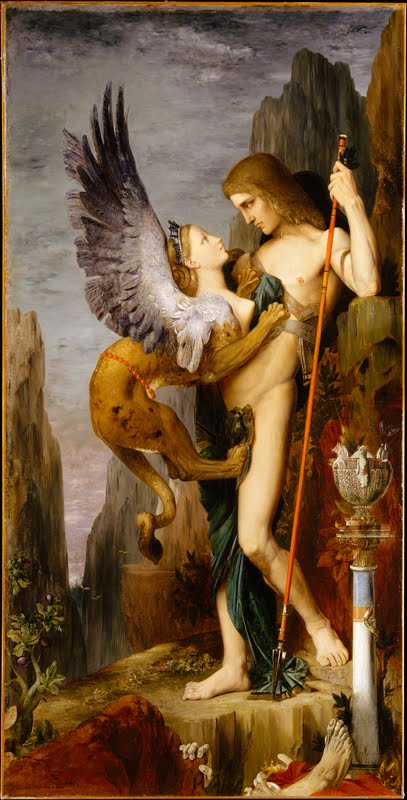
Gustave Moreau


THE TWO FACES OF THE SPHINX


Many mysteries surround this strange beast. First: where lay its origins? Does it come from distant peoples, or is he the product of the imagination of Greece and Crete? What kind of beliefs were associated with it? And what does the name “sphinx” mean? We can try to answer some of these questions already.

During the Mycenaean era many foreign sailors visited Egypt. After returning home they told about the wonders they have seen there, especially her great buildings and statues. Nothing like it existed at the time anywhere else on earth. They also reported:

“Near the pyramids there is a great rock, tall, long, reddish in color. The Egyptians expended great labor to carve it in the shape of a reclining lion with the head of a man. His expression is mysterious: he projects divine calm, but he also wears a gentle human smirk, part-sad, part-ironic. The priests say that this is one of the forms assumed by the god of the sun, Ra; it guards the great road west, along which both the sun and the dead depart for the land of mists. Egyptians are much enamored of this creature; and often place many statues of it in long rows on both sides of avenues heading up to important temples. They sometimes say it represents the pharaoh, who combines the power and courage of the lion, king of all animals, with the wisdom of man. These statues are placed at entrances to temples in order to prevent evil spirits from approaching the seats of gods.”

A modern scholar might also add:

The great sphinx near the pyramids was carved on the orders of Pharaoh Khafre, who ruled around the year 2600 B.C. Its dimensions are truly impressive: it is 57 meters long and 20 meters high. It was originally an effigy of the ruler himself, but later became associated with one of the deities of the sun. It was several times buried by the desert sand, even in the times of the pharaohs. There are papyri of two Egyptian kings who ruled around 1400 B.C. in which they report – speaking very poetically – how the sphinx appeared to them in their dreams and asked them to be dug up from the sand and promised them that if they do, they will become pharaohs (both were mere princes at the time of their dreams).

The Egyptian sphinx was nearly always represented with the face of a man; and with the face of a woman only when it represented the principal wife of a pharaoh. Sphinxes with heads of eagles or rams were also sometimes carved. All these sphinxes, regardless of their style, were always considered as good, protective spirits. They were called in Egyptian shespankh, which could be interpreted as “a living statue” and it would seem that the Greek word sphinx is a corrupt form of the Egyptian.

Yet, in Greek, sphinx is feminine. And indeed, on Mycenaean artifacts we see a very different representation of this creature. It is a lion, but with the head of a young woman, and it is – winged! Sphinxes, sometimes appearing in twos, are a frequent element of Mycenaean decoration on gems, seals, vases and tablets of ivory and gold. In the ruins of Mycenae a plaster head of a woman was found; it was of natural size and painted; there are indications that it was part of a larger statue – quite possibly a sphinx. This is all the more interesting because there survive no other examples of large free-standing statuary from those times.

Perhaps, because it was frequently represented as decoration on utilitarian objects, the sphinx did not represent special religious significance on Crete and in the Mycenaean world; and perhaps it was considered auspicious, just as it was in Egypt.

But why was the Mycenaean sphinx represented with a woman’s head and a pair of wings? Further, the Mycenaean sphinx usually wears a special kind of flat head-gear, perhaps a diadem, which is never seen on any Egyptian monuments. For these reasons, the figure of Mycenaean sphinx would seem to have been borrowed not from Egypt but from some other country with which the Mycenaeans might have had close contact. Syria is usually mentioned. It was there that the Egyptian sphinx was transformed and assumed the shape which was to rule forever in Greek art and imagination from Mycenaean times to the end of antiquity.

But this is not the end of the mysteries of the sphinx. We have seen that this creature usually represented good. Yet, we all know the somber myth which represents the sphinx as a bloodthirsty monster, a demon hostile to men. The myth is very ancient, Mycenaean in origin, perhaps even older.

This sphinx did not roam all of Greece. It was associated with only one location. Interestingly, it is not some distant, wild and mountainous land, but a land which in Mycenaean times was densely populated and belonged to the richest. The myth places the sphinx in the vicinity of Thebes! It tells that the monster has selected a rock along the narrow path which lead along the shore of lake Copais from Haliartus to Thebes. The name of this rock was Phicyon. So, some say, perhaps that’s the origin of the monster’s Greek name? Perhaps it was later transformed in the likeness of the verb sfingo, which means “I choke, kill”? But if so, then why does the myth ascribe this particular appearance to the monster associated elsewhere with auspicious forces? Perhaps this bloodthirsty demon was originally nothing but an image of death, which often is represented as a winged monster carrying off its victims’ souls?

Thus, whatever explanation one accepts, it only leads to new questions. The sphinx is a truly mysterious being, not only in legend.

The Theban sphinx attacked and kidnapped young men only (it was, after all, a female monster) but not only in the vicinity of the rock of Phicyon. Sometimes it appeared unexpectedly within the city, too, in broad daylight, in the midst of a crowd. It toyed with its victims, posing first simple riddles and promising:

“If you do not solve the riddle, you will die! But if you solve it, I will kill myself!”

But no one was able to answer even the simplest questions: fear paralyzed the victim’s minds. Within a few short years dozens, perhaps hundreds of young men, died.

Looking at the shield of Polyneices, Adrastus understood well why he’d chosen the sphinx for his emblem. The story of his father’s, Oedipus, famous exploit was famed across all Mycenaean lands. Traveling singers told it frequently by the megaron fireside on long autumn and winter evenings:

Oedipus was a young man, unknown to anyone in Beotia. He walked along the mountain path towards the seven-gated Thebes. He knew that the monstrous sphinx roamed in these parts and he hoped to meet it because Thebans had advertised it across all Mycenaean lands that whoever would kill the monster would receive a great reward: he will be raised to the royal throne, empty now following the tragic death of king Laius, and will marry the queen, his widow.

A lion with a girl’s head barred Oedipus’ path. It said:

“Guess what this is: it is an earthly being; it has four, two and three legs; it is weakest when it uses all four, but strongest when it uses only two!”

Fear did not dim the mind of Oedipus. He replied without hesitation:

“This is quite simple: man!”

And seizing his spear, he leapt at the monster. Others said later than the monster killed itself by jumping into the lake of its own volition.

Oedipus received the reward promised by Thebans. He became king on Cadmea and husband to the beautiful queen, Iocasta. But it was soon to prove that the young man defeated the sphinx to his own tragic detriment, his and his country’s. And this would seem to present another mystery: did Oedipus really defeat the sphinx, or was the monster defeated because it wanted to be defeated – defeated by Oedipus?

13.2.10

Seven Against Thebes (14)

.

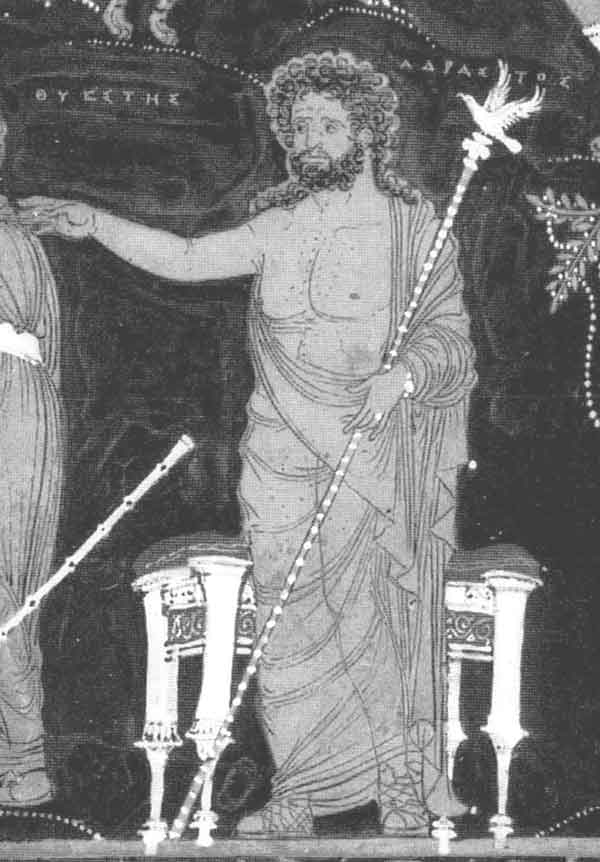
Adrastus King of Argos and Sicyon, Dareios Painter Vase

>
ORACLES AND GUESTS IN THE HOUSE OF ADRASTUS


But let us return to the conversation at Simmias’ bed-side.

Theocritus continued to defend the idea of the protective spirit of Socrates with great enthusiasm. This was understandable: he himself passed for an expert on the business of auguries and oracles. And his opponent, Galaxidoros, did not deny in the least that the future can be guessed at; he merely ridiculed certain naïve ways of understanding how this could be done through signs.

“By themselves”, he continued, “they are trivial; they are but inconclusive evidence by which the powers that be announce their intentions, events barely in the course of shaping themselves, barely approaching the door of the present. But there should not be anything surprising in this; the soothsayer’s art is not supernatural. After all, the cries of sea birds, or tiny clouds in the sky, announce to the sailor the approaching storm.”

From the very beginnings of the human race, and in all parts of the world, things have been that way: there was a certain fear of the future; but also a curiosity; and the impression that the good and evil forces around us can be recognized through certain subtle signs; and if only one could identify and understand these subtle signs… Hence the belief in oracles; and hence great respect for those who could recognize these signs – whether from the flight of birds, or their entrails, or from dreams, or even from – sneezes. It has always been so with all peoples. But what surprises us about Greeks is that in their case these beliefs and practices have coexisted with a critical, inquiring, even contrary mind. It has so often happened among Greeks that within one man one found great intellectual, critical, rational talents and the superstitious belief that gods reveal their intentions and desires through signs or even inner voices. Even Plato himself said that auguries are a bond of friendship between men and gods! Powerful states were sending official embassies to consult the oracle of Apollo in Delphi regarding the most crucial matters of state business. Every town maintained official soothsayers, whose opinions were consulted before any decisions. In every country of Greece there were shrines dedicated to gods and heroes where pilgrims went because there, by diverse methods, future was said to be regularly revealed. Especially many such oracles were found in Beotia, the land in which Thebes was located, and soothsayers like Theocritus enjoyed here particular popularity.

But if the plotters took seriously the soothsaying skills of Theocritus, why did none of them turn to him with the question:

“Will the expedition be successful? Will our friends in Kithairon arrive here safely? Will we be able to liberate our fatherland together?”

These questions must have been foremost in everyone’s mind at Simmias bedside: after all, the turn events were to take that day would influence not only the history of their city, but perhaps also determine whether they themselves lived or died. They thought about it constantly – about it and perhaps about nothing else; and only covered their tension with their pretended curiosity regarding the status of sneezes as potential omens. Perhaps they were simply too afraid to ask, reasoning that whatever happens, it is better not to know in advance, since it is in any case already too late to go back?

Yet another consideration may have worried them, though no one would have mentioned it: the first expedition of seven against Thebes ended in disaster and it had been preceded by very evil omens which, nevertheless, the leader of the expedition chose to ignore. Of course, he could have pointed to other auguries which in fact commanded him to wage war. All of this was reported in various versions in the myths, and drama and poetry presented it ever more colorfully. But if one assumes that behind all the legendary tales there lie indeed some real events from the Mycenaean Era, then one might assume that the first scene of the drama happened more or less like this:


That night, the night on which everything began, Adrastus slept poorly; it was muggy, from somewhere far away wafted in the threatening growls of thunder. The prince kept waking; and whenever he did, the old worry came to him: those strange words whose meaning he was unable to penetrate. They said: you will marry one daughter to a lion, the other – to a boar!

Oracles always spoke the language of metaphor; the art of understanding them lay not in taking the answer verbally, but in discovering the right key for interpretation. Therefore, in this case, does the oracle mean men whose names perhaps are derived from “lion” and “boar”? But there are many such names; besides, such an interpretation seemed much too straightforward. Or does the oracle concern men whose character will be market by the courage and fierceness typical of these animals?

Larissa, the city which Adrastus ruled, lay on a hill, at the edge of the fertile plane of Argos; in later times the city was to take on the name of the surrounding plane, and the name Larissa to become limited to its castle hill alone. Beautiful and fertile Argos lay in the north-east of Peloponnesus. In it there were many principalities, cities and castles, whose lords would have been glad to enter into a marriage alliance with the mighty house of Adrastus, but he was not interested. All his neighbors, the near as well as the far, were constantly at odds – over land, or cattle, or women. Alliances were constantly shifting; there were frequent bloody battles and treacherous raids. Yesterday’s enemies became friends for a day only to plunge their sword in today’s ally’s back tomorrow. Adrastus has done well in this small community; he was considered a very agile operator. But when the time came to marry off his daughters – two for now, the third not yet being of age – a new kind of trouble, one which he did not know how to handle, appeared. Whom to choose for sons in law? There were many candidates and therein lay danger: those rejected might band together and raid Larissan territory. And, besides, one will have to pay two dowries!

For these reasons, Adrastus turned to the Delphic oracle for advice but the advice he received appeared useless. Where was he supposed to look for a lion and boar, kings of wilderness, who might defend their father in law? The prince was very worried; human wits failed him; gods’ word was no help.

Adrastus slept alone, in a room upstairs. The house of the basileus of Larissa was not especially large; it hardly differed from those of some of his subjects. Downstairs was the great hall; it was called megaron. A fire burnt there permanently; at its side the householders ate their meals, made sacrifices to gods, and received guests. Small rooms next to it, and upstairs, served as bedrooms. They were furnished quite simply: animal skins, small stools, chests. One rose early and spent whole days out of doors – working in the fields, herding cattle, hunting, or raiding. But when the dark night descended, one sat at the megaron fireside for many hours, talking, telling ancient tales, and singing. Here was the center of family life on rainy or cold days.

Suddenly, some sort of strange noise woke Adrastus from the torment of half-sleep. He sat up, frightened. Was it armed men trying to break down the gate? Was it fighting? He could hear the clangor of swords against shields, yelling, and cursing. It was not an unusual thing in those days: an unexpected raid by pirates who’d arrived at the shore after dark; for this reason, cities were never built at the shore. Adrastus had repelled many such attacks; and had taken part in many: he was always prepared for a fight. But what frightened him now was the strange silence within the house. Why is no one up? What are the servants doing? Where are the women? Did gods put them all to sleep? Is this – treachery?

Adrastus jumped up, grabbed his sword and shield – weapons had to always be close to one’s side – and leapt downstairs, into the megaron. But the great hall was empty. Even the fire was very low: no one was tending to it. The prince ran outside. There he saw his people: the servants crowded at the gate; others stood on the wall, holding up torches. But no one seemed frightened; on the contrary, there were laughter and joyous cries.

When the prince ran up to the top of the gate, he saw below him two armed men. They faced each other, wearing helmets and chest plate and holding swords and shields at the ready; they looked like two wild animals readying to pounce on each other. Further away there stood their chariots and help. Adrastus saw this in an instant and immediately understood: these two princes had arrived at his gate simultaneously, hoping to find refuge from the approaching storm; then they quarreled over which one had the right to knock on the gate first.

But before he managed to call out to the men before, Adrastus saw something which filled his heart with pious fear and hope: the helmet of one of the men, the shorter one, was decorated with boar’s fangs; on the shield of the other was painted – a reclining lion!


Tydeus was short, stocky, and grim. He resembled a boar. He spoke rarely and tersely. He seemed a terrible barbarian; his speech had a foreign, rasping sound, and his weapons, too, differed from those normally worn by the knights of Mycenae, Tiryns, Thebes or Athens. In fact, he had come from very far away. His fatherland lay in the high and wild mountains which stretched west of Beotia all the way to he sea; it was called Aetolia.

But his descent was magnificent, royal. The cause of his exile was also famed; even before his arrival itinerant beggars and singers passing through Larissa had told the tale of the misfortune which came upon him by the will of gods and fate. These vagabonds told their stories to pay for the place at the megaron fire, a cup of wine, a piece of cake, a place to sleep in the stables at night: they brought the news and gossips, sometimes adding a bit from themselves to make it all more interesting and to earn a better welcome. But if there were no recent news worthy of telling, they retold old stories, singing tales of gods and heroes. Thus, by the time Tydeus retold his story by the megaron fireside, muttering reluctantly – “I killed a relative. Not intentionally. It was on a hunt” – the prince did not learn anything he hadn’t heard already. And he understood immediately, without any need to hear pleas or explanations, what the stranger wanted: pursued by his family, he hoped that perhaps at last here, beyond the sea, he might find a safe welcome and a host who might aid him in performing the sacred ritual of purification to clear him of the stain of innocent blood. And Adrastus was ready to do all this gladly. Here is a prince from a distant land, strong and brave, a son in law indicated by the oracle!

It was Tydeus who was surprised that night then. Despite his natural aloofness, he was unable to hide his surprise when he heard the words:

“Very well. I accept you in my household. I will purify you of your ritual pollution and then I shall return you to the throne in Aetolia which is rightfully yours, by force if I must. And I shall give you my daughter for wife.”

Adrastus then immediately turned to the young man sitting on the other side of the fire; tall and handsome, with regular facial features and lively eyes, he seemed the very opposite of Tydeus. The lord of Larissa said to him:

“As to you, Polyneices, I give my other daughter. And I shall return you to your throne, too. It is justly yours, I know, not your brother’s. I shall return you to your throne first because it will be on my way… because then, together, we shall all set out from your Thebes to Tydeus’ Aetolia!”

There was great pride in the words of the prince of Argos; at the same time, he felt indebted to the oracle, which until so very recently had worried him. How wise and omniscient, and how generous towards his house, is the God of Delphi! The fact that the princes are from far away, and that they are landless, is the best of all gifts he could have ever expected from fate. It will not be necessary to provide the daughters with large dowries: fat cattle and fiery battle stallions can now remain in his stables. Of course, while they remain by his side, the princes will receive land in lease and he will deny them nothing; but only until the time of the expedition comes.

Adrastus was not afraid of the coming war; on the contrary, he was looking forward to it with great joy. He loved adventure and battle, and above all – he loved war booty. And when Polyneices and Tydeus settle at last in their own ancestral palaces, he, Adrastus, will be counted among the most powerful of princes of Greece: three rich lands will be united in his clan: Larissa, Aetolia and Thebes; and Thebes, the famed, rich Thebes most of all!

Nothing that happened in the megaron of Adrastus’s house that night was somehow extraordinary. Exiles from far-away lands often knocked on the doors of powerful men. Usually they were received very hospitably, because this was required by ancient laws of gods and men. Of course, not every exile could count on receiving his host’s daughter in marriage; but this also happened sometimes, if one is to believe myths and epics. After all, marriages were usually contracted mainly with the view towards advancing family business and property. No one asked young girls their opinion; and the young men did not have to worry about the girl’s looks, as long as they were healthy and their dowries good. Love could always be found in some other way – with a war slave, for example.

The shield of Polyneices stood leaning against a wooden post. It was rectangular and very large. Every time more wood was thrown into the fire and the flames leapt up, the concave surface, covered with bronze plate, burnt with a dull red glow. One could then see clearly: the beast represented upon it had only the torso and paws of a lion, but its head was that of a young woman and out of its back there grew powerful bird wings. Thus in the glow of the fire, as the great marital and military plans were hatched in the darkness of the megaron, there lit up and died down by turns that mysterious beast: the Theban sphinx.

11.1.10

Seven Against Thebes (13)

.
PARKINSON’S LAW


Thanks to poetry and works of art, the Mycenaean Age lives on today in our imaginations as the springtime of our civilization, our first blushing youth. Adventures of daring heroes, loves which bound mortals and gods, mysterious oracles, great feats of arms, dangerous sea expeditions towards unknown lands where great treasures lay guarded by terrible monsters – such is the legendary stuff of those few centuries.

The decipherment of the clay tablets has revealed a new face of that age. Of course, even before the decipherment it was understood that poetic imagination must surely have lent a shining glow to what must have been a more prosaic truth. Yet, as soon as the script has spoken, we learned that the age which serves as the setting of practically every Greek myth was first and foremost an age of tireless pedantic bureaucratic activity: a vast army of bureaucrats controlled a strictly centralized economy through the manufacture of tons of accounting records. It turns out to make no difference whether one writes on paper or on clay; nor does the bookkeeping system make any difference. Indeed, considering their primitive level of material development we must admit that when it came to their efforts to record all details of their economic reality, Mycenaeans could easily compete with every other economic management to date.

And this despite the fact that the archives which have come down to our times must surely be but a small fragment of the great bureaucratic output of the vast state apparatus of command and control of the time. Yet even this is enough to create a rather depressing impression. It’s natural, of course, that the palace had to keep records of various categories of soil and a careful population census. The constant recounting of the contents of the state treasury – objects made of gold, silver, bronze, ivory, weapons and chariots – is also understandable. What is striking, though, is the meticulous record of every smallest vessel of olive oil or wine, of every measure of wheat: from whom it was received, to whom it was issued, how it was spent or used – for the needs of the king or the staff, or for divine sacrifice. The office also wished to know what at any one moment every one of its subjects is doing – and where; what work he was performing and the amounts – in goods or labor – still due from him.

Thus, we have before us several thousand short warehouse notes: lists, receipts, and commands of the sort: issue; send; receive; owes; there is. These short notes allow us to form a certain image of the state and its society. It’s only fragmentary, of course, and somewhat nebulous but some things are quite clear: both the political structure and the class and property relations were complex and inflexible; they do not recall in the least any of those idyllic freedoms which are so easy to imagine when we think of the mythical age.

There were in Greece at the time several centers of political power; all may have recognized the primacy of Mycenae, at least formally. At the head of each state stood a ruler titled wanax. In later Greek the original meaning of this word was changed: wanax (or rather, as one then began to pronounce it, anax) was merely a powerful lord, an aristocrat. In the Mycenaean times, wanax meant the first person of the kingdom, its king; he performed also priestly functions; his position was nearly divine. This is perhaps why so many heroes of the myths are considered to be sons of gods and why the title “son of Zeus” is used by Homer for every prince. Below the wanax there stood his highest official, lawagetas, which could be rendered as “leading the people”, the equivalent of our wojewoda. It seems that his political power may have been no smaller than that of the wanax; and in some instances he may have controlled the reins of power. The subsidiary princes controlling smaller divisions of land were called basileus. It was this title which in later centuries, after the fall of the Mycenaean world, assumed the meaning of “ruler” or “king”.

Rulers had by their side a team of warriors; these were called epeta. In addition to them, to courtiers and court ladies, and to the lower serving classes (who may have been slaves) there were also, in each palace, large numbers of artisans: smiths, goldsmiths, potters, cartwrights, even makers of incense. Above them was placed a large contingent of scribes noting scrupulously how many cloaks were left in storage, how many oarsmen ought to be sent to Pleuron, who, and in what amount, submitted spices for food, which chariot needed a new wheel. We must say one thing in their defense: as Mycenaeans did not possess coins and all pay was paid in kind, careful evidence of property was in order.

We will yet have the chance to speak of the great treasures of Mycenaean palaces, and where they came from; for now let us say that the basis of the economy lay in the production of grain, vine and olives as well as in animal husbandry. But what of the property relations? Sources are not clear on this and scholars are divided. It seems that the lands belonging to the king – and perhaps to the princes, also – were called temenos. The same word was used for the property of the gods. Some pieces of land seem to have been held in common by the communities; others were held privately; both kinds were often leased out. Every piece of land was of course evidenced in the state archive and weighed with heavy dues. It could not be leased without state permission.

Mycenaean bureaucracy was not unique in the world at the time. We see similar systems of government in Egypt, Syria and Mesopotamia. But comparison with the record of the clay tablets found in the Syrian city of Ugarit is instructive. Ugarit archives date to the same period (fourteenth-thirteenth centuries B.C.). Yet, in the Ugarit record we also find religious texts and fragments of poems as well as trade and tax records. But the Mycenaean record is nothing but pedantic, all-encompassing, merciless account-keeping.

It is often said that the Mycenaean world collapsed in the twelfth century as a result of the invasion of wild barbarians from the north, the Doric tribes. But it is interesting to try to imagine how these arrivals from the north managed to capture the massive Mycenaean fortresses. It is suggested that their victory was due to their superior weapons: the Dorians are supposed to have had iron while the Mycenaeans only bronze. This is not certain: there is no evidence that the Dorians used much iron; and in any case, iron weapons do not confer much advantage over bronze weapons, certainly not the sort that firearms offer over bows and arrows. Finally, neither iron swords, nor indeed numerical superiority would have been of much use against the Cyclopean walls of Mycenaean fortresses, had only those fortresses been manned by a people determined to defend themselves. Even later, in classical times, large and well armed armies often proved useless when faced with even minor fortifications: there was simply not enough useful siege machinery.

Given all this, another theory seems attractive: that Mycenaeans gave in to Dorians because their subjects were not interested in defending a state whose sole purpose was to record – control – collect. The greatest enemy of Mycenaean fortresses were not iron-clad Dorians down below but their own bureaucrats scratching out little symbols on their clay tablets inside.

Various aspects of bureaucracy are subject to the famous laws of Parkinson (summed up in Parkinson's Law: The Pursuit of Progress). The first of these concerns the self-sufficiency and alienation of the bureaucracy; other laws, proposed in a later work, present in great detail the mechanism and consequences of the growing tax burden. The basic problem, says Parkinson, lies in the fact that the bureaucracy is unable to understand that there is an objective upper limit to tax obligations. It is difficult to discover this limit through economic measurement because it is not a function of the level of income or productivity, but of certain inalienable features of human psychology. In some situations, given a certain tax burden, it simply becomes inefficient for the populace to continue working productively; its main object becomes finding methods to dodge its tax obligations. In such instances, the bureaucracy becomes a kind of cancerous growth, which functions very well for its own needs, flourishes and multiplies but – kills the organism which supports it.

Ancient history knows many examples of sudden collapses of great states and whole civilizations as a result of this disease. Perhaps the fall of the Roman Empire, bureaucratized to its very core, is the most famous example. Roman citizens welcomed their barbarian invaders with relief. Mycenaean archives allow us to guess that the destruction of the world which they served came in a similar manner.

If so, it would the first instance of the functioning of the laws of Parkinson on our continent.

9.1.10

Seven Against Thebes (12)

.
TABLETS FROM PALACE OFFICES

The first clay tablets covered with symbols were discovered in Knossos, on Crete, in the year 1900. Identical symbols were found on clay amphorae discovered in 1921 in the ruins on Theban Cadmea. The number of tablets dug up in Knossos rose every year: we now have more than four thousand: it was in fact the palace archive. But Crete was only one of the centers of Mycenaean civilization. The Mycenaeans captured it only around the year 1450 B.C., arriving from the mainland. Yet, there were hardly any examples of the script on the mainland; the only proof that the script was used there were inscriptions on the amphorae discovered in Thebes and later in Tiryns and Mycenae; and, of course, the tablet from Alcmene’s tomb.

But this all changed in 1939. In that year great excavations were began in Pylos, on the western shores of Peloponnese. In the Mycenaean period it was one of the more important castles; it was the seat of the old wise man Nestor, before whose wisdom even king Agamemnon, the commander of all the Greek armies at Troy, bowed his head in respect. Like in Knossos, a palace archive was found in Pylos. In the first year alone over six hundred clay tablets came to light. After World War II, excavations were resumed in 1952; and every year since then dozens, sometimes hundreds, of new clay tablets have come to light. Yet, in Mycenae, though it gave its name to the entire period, and though it was perhaps the most powerful of all the castles of its era, barely a few score tablets have been found. Nor has an archive been discovered in Tiryns. Perhaps this is not an accident: perhaps the richer centers have been pillaged more mercilessly by invaders?

What do the tablets look like? They are made of ordinary clay, in various shapes; some are rectangular, like the pages of a notebook, and covered with even lines of symbols which march, as in our own script, from left to right; others, long and narrow, look more like palm leaves. Sometimes the tablets were dried in the sun, though they were never fired. Nor was it necessary: even those unable to read the script can quickly figure out that most of the symbols represent nothing but rows of numbers, weights and measures. The tablets served a practical purpose: they were intended for the keeping of accounts and the maintenance of lists. Once they have fulfilled their role, they were mixed with water, erased, and reused. It was the cheapest and most readily available writing material. The tablets which survive to our times owe their survival to the great fires which raged in the palaces when their civilization collapsed, when the Mycenaean principalities fell and their states went into ruin.

One is free to speculate, perhaps, that those works, which were considered important and valuable, may have been recorded on a more expensive but less durable material – such as papyrus imported from Egypt (since Mycenaean trade contacts with Egypt, and the whole Middle East, were very close); but while in its country of origin, papyrus was preserved for millennia by dry air and desert sand, in the humid climate of Greece it rotted away quickly. Some texts, held to be especially valuable, were perhaps inscribed on bronze tablets; a practice also followed later by Greeks and Romans. But bronze has always been valuable and sought after and, following the fall of the Mycenaean world the conquerors probably ruthlessly melted down all bronze objects which they could lay their hands on; only those buried in the ground survived – as was the case with the tablet later found in Alcmene’s grave. This history was to repeat itself: when the Graeco-Roman world collapsed, most ancient bronzes were destroyed (and religious fanaticism aided the destruction): tablets and statues went into smelting furnaces to be reborn in new shapes. Even marble was not safe: masterpieces of sculpture were used as ordinary building materials.

But back to the humble clay tablets, of which we have by now thousands. As their number grew, efforts to decipher them became ever more intense. All sorts of hypotheses were proposed in order to break their secret. Some even followed in the footsteps of the Spartans, turning to Egyptian hieroglyphs for help, or Babylonian cuneiform. But these odd ideas proved fruitless. Most scholars turned in other directions. Egyptian hieroglyphs did play a certain role: the story of the decipherment of such a difficult, complicated script over a hundred years earlier inspired hope: why should the Mycenaean signs, so much simpler, resist decipherment?

First, scholars arrived at a general outline of the history of ancient scripts on Crete and on the Greek mainland. By about the year 2000 B.C. there already existed on Crete a hieroglyphic script: its signs represented objects and concepts and we know it only from short inscriptions on seals. Later a new, simpler script appeared, called now Linear A. Then, in the fifteenth century B.C. Mycenaeans conquered Crete and took over the script, adapting it significantly in the process. This is the script known as Linear B; it spread quickly across the Mycenaean world and survived until the end of the civilization in the twelfth century B.C. while the use of the earlier scripts has always been limited to Crete itself. Following the collapse of the Mycenaean civilization, the knowledge of Linear B script was lost forever. For several centuries, Greeks managed without any sort of script at all and only sometime in the ninth century B.C. they borrowed Phoenician alphabet, which became the basis of the Greek, which in turn gave basis to Latin, and therefore ours.

Even before the script was deciphered, much could be surmised about its nature. First, it was possible to distinguish a large number of signs which represented persons, animals, plants, weapons and vessels. There are several score such signs; we have mentioned them already. Their precise meaning is sometimes not clear as they are often very sketchy, simplified, symbolic representations; but it is quite clear that they are ideograms, that is, signs representing objects or concepts. It was also clear that some signs were used to represent numbers. Their discoverer, Arthur Evans, the excavator of Knossos, established their values by 1935: horizontal lines represented units, vertical lines – tens, circles – hundreds, circles with four spokes sticking out – thousands. There also existed signs representing fractions, weights, and measures. But the most critical is a set of over eighty symbols which are found in ever shifting combinations, like the letters of our own alphabet. But they could not simply represent vowels and consonants, because to do that job a much smaller number of signs would have been sufficient. The idea suggested itself therefore that this may have been a syllabary script. It was remembered that still in historical times the Greeks of Cyprus used a strange script, possibly a distant descendant of the Mycenaean, whose every sign represented a syllable: either a vowel or a consonant plus a vowel, for example a, i, to, ro, ka.

But these were all general observations; none addressed the heart of the problem: in order to decipher Linear B we first had to know what language it was used to transcribe. Only then one could try to propose phonetic values for different signs and, through the process of trial and error, arrive at some sort of result. And thus the crucial question arose: who were the Mycenaeans? What was the language in which all these thousands of tablets from Knossos and Pylos and all the inscriptions on the amphorae in Thebes and Mycenae and Tiryns were written?

The Greeks themselves considered the men of the Heroic Age as their own ancestors (if more courageous and capable). But in modern times completely different views on this matter arose. There were those who claimed that the civilization was Illyrian; this people, now extinct, did indeed occupy much of the Balkan Peninsula in antiquity. And though most scholars thought that the Mycenaeans had been Greeks, there was no proof of it as long as the script remained silent.

We don’t have the space here to present the whole laborious process of decipherment of Linear B. And though we should mention Alice Kober, an American scholar, who, in 1950, was the first to observe that certain groups of signs of the script appeared with a frequency suggesting the existence of inflection of nouns in the Mycenaean language, we won’t repeat the whole story: someone else has already told it much better: the close collaborator of the discoverer of the truth, John Chadwick, in his highly readable The Decipherment of Linear B. The actual discoverer of the mystery was a young architect, Michael Ventris. Both were English, but we’re allowed to mention that the mother of Michael Ventris was Polish.

In 1953 there appeared an article jointly penned by the two men; it summarized the main findings of the many years of their labor; asserted that the Mycenaean language was Greek; and provided a glossary of the phonetic value of the signs of Linear B. But Ventris did not live to see the publication of the definitive monograph – Documents in Mycenaean Greek – published in 1956: he died in a car accident that year, aged only thirty four.

Using the phonetic key provided by Ventris it is possible to decipher the tablets, though with an important proviso: the script had not been originally designed to fit the phonetic structure of the Greek language; and in fact, since it was borrowed from another language, it lacks some signs necessary to record certain sounds indispensable in Greek, such as the consonant l. As a result, practically all words recorded in it were distorted; and thus we find in the tablets the name Castor recorded in the script as Ka-to-ro, the word leukos as re-u-ko, pater as pa-te, Pylos as py-ro, sperma as pe-ma, krater as ka-ra-te-ra. These distortions are not too difficult to decipher, but in some cases it is quite difficult to figure out what Greek word was meant.

The second obstacle to decipherment is equally important: in the Mycenaean language there existed many words, some native, some borrowed, which in time dropped out of use and were no longer known in classical times; some others changed their meaning entirely. This, of course, should not surprise: gradual change lies in the nature of language: after all, we find fifteenth and sixteenth century texts in our own language difficult to read without use of dictionary or reference to footnotes. But Mycenaeans have left us neither footnotes nor dictionaries: any word whose meaning is not apparent from the context, or through its links with some classical Greek term, is for us, today, simply dead; it is only an empty sound. This is why the text of many of the tablets remains mysterious or doubtful.

But broadly speaking, it is possible to say that the Mycenaean archives have opened up; that they have spoken.

6.1.10

Seven Against Thebes (11)

THE MYTH OF SOCRATES’ DEATH

These last words of Polymnis have caused Simmias to lose all sense of time and place. The faces upon which he gazed seemed to him to be the faces of others, and their voices seemed to reach him from far away, bringing to his ears words from twenty years earlier.

Yes, it happened twenty years ago. The small, damp room was also full of young men. And on the bed there also sat an old man. He rubbed his ankles because only a moment ago chains had been removed from them by the government commissioners who also informed him at the same time that his sentence would be carried out that day. Xanthippe was still there, by his side, crying and whining. Socrates, while continuing to rub his ankles, spoke to those gathered somewhat brusquely: “Take her home, will you?” Someone indeed got up and took her and the children away. Only when the men were left alone in the Athenian prison cell could they begin serious conversation.

Simmias thought to himself, full of admiration, what a faithful friend Plato was. In one of his earlier dialogues he had written that it was Simmias and Cebes, also a Theban, who’d offered a great sum of money to save Socrates from execution. But just a few months ago Plato sent Simmias his new dialogue, Phaedo, representing the Athenian wise man’s last moments. Simmias noted that in this dialogue Plato assigned him a very noble role: he has him, immediately upon Xanthippe’s departure, go right to the heart of the matter and ask why Socrates was so eager to depart from this world. This question then begins a great discussion of the final things: what is death; is there such a thing as the soul; what happens to us when it parts from the body? Only sporadically is this conversation interrupted by the shy requests from the guard: would Socrates please try not to get too excited, or his body will warm and he will have to take the bitter poison two or three times more. But the old man has but one response to all these pleas: he waves his hand and orders that a great deal of poison should be prepared in advance. And then, with great interest, he launches upon the philosophical discussion, his last. He defends the view that death is a liberation, a passing into a better world. And who is his main opponent in this great debate? Who is trying to deprive the dying man of hope? Why, Simmias and his friend Cebes.

Simmias admired the subtlety of this idea very greatly, because he understood perfectly Plato’s intentions. After all – this is mentioned right in the first pages of the dialogue – both Simmias and Cebes had once been students of Philolaus, and Philolaus had played a leading role in the Pythagorean brotherhood. The existence of the soul, and her transmigration from one body to another following death, were among the brotherhood’s central tenets, which set out to link up various trends of mysticism with advances in mathematics.

But Philolaus was not an orthodox Pythagorean; he claimed that the soul was a kind of harmony. But the harmony of what? Of the various parts of the body? If so, then the soul would cease to exist the moment the body’s various elements were destroyed. A well tuned lyre is the necessary condition for the existence of an invisible, disembodied, beautiful, divine harmony of music. But if one breaks the lyre, and rips or cuts her strings, then this harmony dies, even though she is not herself material. It would be pure nonsense to claim that the harmony still exists into eternity, all of its own powers, only because she is so beautiful. Our body is like the lyre: it is made of various parts, and they remain in a state of certain mutual tension, or tuning, just like the lyre’s strings. When this tension changes, or weakens, such as, for example, when we are ill, its effect is immediately reflected in the state of the soul; and, though she be so very beautiful, and so different from tangible matter, she is irretrievably lost when the body’s constituting parts come apart.

Simmias read an argument like this in Phaedo – and it was supposedly his own! He smiled when he first read it; and he smiled now as he remembered it because Plato was being wittily contrary: everything he wrote was of course god’s own truth, everything that is except one detail: for Philolaus had never claimed that the soul was a harmony of the various parts of the body. So what was it a harmony of? This Philolaus revealed only to the select few, and Plato knew this well; and now, by compelling Simmias to make the argument, supposedly the argument of Philolaus, while in fact not at all, he paid homage to their shared secret.

It was in any case an excellent thought to take as Socrates’ opponents these two young men who’d become famous in their day for their own mystical inclinations.

Socrates died in May 399 B.C. It was then that this great debate about the immortality of the soul took place. Their teacher’s death scattered his friends and students. Their lives took different paths and they developed different kinds of philosophical views because their teacher had not presented them with ready-made solutions, but inculcated in them that which is most important in one’s intellectual life: how to search, how to ask questions, how to doubt.

During the twenty years which have passed since his death, Simmias traveled a great deal, saw many lands, learned many things, met many people. He also wrote a great deal. As if competing with Plato, he, too, composed philosophical dialogues. There were twenty three of them, but they were all short, each took up only one slim volume. (And all are now lost). You will recall that Simmias returned home to Thebes at the time when the plot against the tyrants and the foreign garrison, was ripening. The old man hosted the plotters in his house; they awaited the arrival of the plotters from Athens, but he -- the arrival of a guest from far away. Could that Pythagorean, who had sacrificed at the tomb of Lysis, be that man? he now asked himself.

But for the moment, Simmias did not occupy himself with thoughts of the mysterious foreigner. The Plato’s dialogue which he had just remembered would not let him rest. The wise man thought:

That meeting in Socrates’ cell has become a myth. It was no longer important what really happened. All future generations will see Socrates’ last hours with the eyes of Plato. Even I myself begin to believe that I said then what I am made to say in Phaedo. But, in fact, it was me who was the true eye-witness of the event because I was there while Plato – was not because he was sick! It was me who cried when Socrates lifted to his lips and drained the cup of poison. Apollodorus wailed then out-loud, but Socrates strode back and forth across the cell (so as to distribute the poison through the body more quickly) and spoke with a note of criticism:

“What sort of men are you? Did I not order the woman sent away so that we would not have to see such scenes? Besides, does not the moment of death deserve the dignity of respectful silence? Come on, then, calm down! Control yourselves a little!”

"So writes Plato, who only knows the story second-hand. Yet, I, thought Simmias to himself, seem ready to swear that this is how things happened and that such were indeed Socrates’ last words! But then what is truth – and what fantasy and poetry? And, in any case, what is needed more: faithful recording of facts? Or their presentation in a manner which makes them most memorable and which thereby gives them their own immortal life? I would dearly wish for such a fate for these meetings at my own bedside! Well, I may not measure up to Socrates, I suppose; nor am I yet awaiting my death. Yet, the fate of a large city, and of thousands of its citizens is being decided here, so perhaps these conversations of ours will rise one day to the stature of legend?

"Are there perhaps distinct degrees by which reality transforms itself into poetry and rises to immortality? Here is Plato who presented the last hours of Socrates somewhat faithfully, and yet – more beautifully. Then, long after all of Socrates’ students have died, someone else will take up the subject again and give it yet more color and more drama. Eventually, dramatists and poets will sing it – how much of the original events will be left by then? Perhaps no more than our names? Perhaps a thousand years from now Socrates will be worshiped as a demigod? One thing seems certain: scholars will argue as to the sort of person Socrates really was; what his true teaching was; and what were our actual arguments on the last day of his life. And no one will ever know for sure.

"In just this manner we worship the heroes of the Heroic Age; and yet, I am certain, they were once ordinary men; their only virtue may have been agility, or strength of arm; they became heroes only because of the passage of time – and the work of poets. For let us see it the other way around: just as the figure and death of Socrates seem to be gaining by degrees a certain strange glow right in front of our eyes, so it must have happened in the past, many centuries ago, when legends began to accrue around the works of some mortal men, until, in time, both they and their times became what they are to most of us today: part of a great epoch of superhuman beings.

"Someone whispered in my ear a moment ago that seven of our friends are already waiting in the wilds of Kithaiorn. We know that they are men no different from many of us: brave, yes, but subject to all the same laws of nature, and their success or failure depend entirely on the vagaries of fate, on accident. But the participants of the first expedition of seven against Thebes seem in our imagination god-like. And all of this merely because we are separated from them by the gulf of time, dozens and dozens of generations, of which each reverently received the stories from the one before, added a little more color to them, and passed them on to the one after. After all, that first expedition against Thebes predated even that against Troy! How many heroes of the Trojan War are praised as sons of the heroes of that earlier war!"


Simmias was right. The first expedition of seven against Thebes is mentioned several times in the Illiad as a great and important war in which the most important princes of their time participated. If one accepts that Troy was destroyed somewhat before the year 1200 B.C., then the first expedition would have had to take place around the year 1300 B.C. or even earlier, since it often happens in myths that distant events are pushed close together. And this is understandable: all those years in which nothing memorable happened seem to dissolve into thin air.

Simmias was also right in assuming that those distant times were not different from his: the same sort of ordinary men, ordinary concerns, ordinary works. Our decipherment of Linear B script showed this very plainly.


Commentary

In the 18th century the French have painted a great number of paintings representing Socrates' death. They are all uniformly awful, including the famous Davide: pompous, rhetorical, and stiff. Too much reverence for a subject can be very bad for the art.

4.1.10

Seven Against Thebes (10)

a.
BOOK TWO:
Auguries and Fate

The Theban poet Pindar, dignified and enigmatic, begins his Sixth Nemean Ode:

There is but one, one tribe of gods and men! Both we and they take our breath from the same mother. But the relative powers of our two branches of our single tribe are very different and they divide us. One is as nothing, while the other owns the bronze house of heaven, which lasts forever. Though on occasion we approach the immortals by the dint of great thought or strength of body, we never know to what end our fate drives us – drives us day and night.1


ON FORETELLING THE FUTURE
FROM DREAMS AND SNEEZINGS


Suddenly, the conversation at the house of Simmias (the one on the topic of Alcmene’s tomb) was interrupted by the a new arrival. It was the father of Caphisias and Epaminondas. An older man already, his name was Polymnis. He greeted the host and sat down next to him, on the bed, because the room was already very crowded. Then he turned to his son and their companions:

“I bring a request from Epaminondas; it is meant for you, Caphisias, but also all you present here. He wishes to ask you, that, unless you have some other urgent business, you may wait for him here because he wishes to introduce to you a certain foreigner. The foreigner is a worthy man and has arrived here with a noble mission. He was sent here by Italian Pythagoreans to offer sacrifices at the tomb of Lysis. He says that his journey here was occasioned by dreams and visions reported by many members of the confraternity. He has brought with him a considerable quantity of gold and he wishes to pay Epaminondas for all the costs which he incurred while supporting Lysis in his old age. But we neither wish nor ask to be aided in our poverty.”

Simmias’ face lit up and he cried:

“You speak of a worthy man and one who deservedly carries the name of a philosopher! But why did he not come to us directly himself?”

Polymnis explained:

“It seems that he spent the night at the tomb of Lysis. Then Epaminondas took him to bathe at the stream of Ismenos. Only now are they coming here, to your house. He’d spent the night by the tomb because he hopes to take the dead man’s remains with him to Italy and he wanted to see whether some deity might not appear to him and order him otherwise.”

Barely did Polymnis finish, when Galaxidorus, seated in the back of the room, piped up. He spoke with great passion:

“By Heracles! How difficult it is to find a man free from stupidity and superstition! Some fall prey to these diseases as a result of inexperience or weakness; while others wish to appear to be extraordinary men, favored by gods. This is why they wrap their lives in a nimbus of divinity, a cloud of mystery, and put dreams, visions, and other such nonsense above rational thought! One could, I suppose, forgive politicians when they do this sort of thing, appealing to auguries or oracles or omens, because they deal with the stupid, vulgar crowd; so they use superstition as a rein, to lead the masses where they please. But it is not worthy of philosophers to behave in this manner; why, it is against their very calling! After all, what is the promise of philosophy? That she will teach us that which is good and that which is useful; and that she will teach them rationally. But now, here, it would seem, philosophy, by turning to omens and dreams, looks to gods as the origin of all action and thereby disrespects reason. Here, she no longer values a well made logical argument, which is supposed to be her distinguishing characteristic, but interprets soothsayings and nightmares. Well, anyone at all can claim to be an expert in this sort of baloney, and more expert than a truly wise person, too. But if your Socrates had valued philosophical education, it was because he thought that simplicity and common sense were the noblest and the closest to the truth.”

Theocritus (a soothsayer, after all) interrupted him excitedly:

“How comes it, Galaxidorus? Have you, too, been convinced by Meletus that Socrates despised belief in gods? You know, perhaps, that this is precisely what he was accused of! Twenty years have passed since the court case of Socrates, and his lamentable death, but, surely, this business is still well remembered?”

Galaxidorus went on the defensive:

“Well, of course Socrates did not disregard gods altogether. The problem lay elsewhere: Pythagoras and his students have filled philosophy with visions, myths, and superstitions; then Empedocles blew it up full of some sort of Bacchic hysteria. It took Socrates to teach philosophy again how to look rationally at reality and to search for truth through logical analysis.”

“Very well”, Theocritus agreed, “but in such case, my dear, what do we make of the daemon, which Socrates considered his protective spirit? Is it a lie, then? One hears a lot about Pythagoras’s skill at soothsaying; but to me nothing seems quite so mysterious as the daemon of Socrates. Homer gives to Odysseus the goddess Athena as his companion in all his travels and adventures; in this same manner Divinity equipped Socrates, from his earliest youth, with the ability to foresee the future. It was his unfailing guide in life; it seemed to walk ahead of him and light the way in all difficult matters, which were beyond ordinary mind’s ability to conceive. But ask his companions, like Simmias here, about it and they will tell you more and better. I can only aver what has happened in my own presence. It happened in Athens, when I was visiting the soothsayer Euthyphron. One day – you, Simmias will remember this – Socrates was walking uphill, towards the house of Andocides, all along the way asking questions and jokingly perplexing Euthyphron. Then, suddenly, he stopped and became lost in thought. Then, he turned round and walked straight down the Trunkmakers’ Street and to those who’d gone ahead of him he cried: Follow me, I had a divine omen! Most followed him, myself included, since I always kept close to Euthyphron. But a few young men went on, ignoring Socrates’ warning, as if wanting to test the daemon’s warning. (The flautist Charillus was among them). When they arrived in the Graver’s Row, near the courthouse, their path was blocked by a huge flock of filthy pigs. There was no way to go on, and the pigs pushed on like mad. And it all ended with some of the men being knocked over by the pigs and others splattered by dirt. Charillus arrived home – we roomed together – covered in filth head to toe. Since then we always laughed whenever someone mentioned Socrates’ daemon, but we were quite impressed that the deity never left him and that she tried to warn him even in such trivial matters.”

Polymnis, the father of Caphisias, broke in:

“As for me, Galaxidorus, I have heard somewhere that the famous daemon of Socrates was no more than a sneeze, whether his or someone else’s. Now, if someone sneezed on his right, no matter whether it was forward or behind, he considered it a good omen and proceeded with whatever it was that he had intended. But a sneeze on the left would stop him from carrying out his original intention. His own sneeze, whenever he was about to commence some action, always encouraged him, but stopped him if he was already in its middle, since he considered it a warning... But... this seems odd to me. Because, if he really let himself be guided by sneezing, then why did he tell his friends that it was some sort of protective spirit which ordered him to do this or not to do that? This sort of boasting would have been alright with some young show-off, but not a worthy man who’d risen above the common rank thanks to his simplicity and honesty. It seems really odd that he should let himself be guided by some sort of a voice overheard accidentally or by someone’s sneezing. After all, Socrates showed great determination and energy because he based his actions on firm principles. For example, he remained in utter poverty his entire life out of principle – since so many would gladly have helped him out with greatest readiness. And he did not abandon his love of wisdom though so many tried to prevent or dissuade him. He did not yield to the pleas of his friends, who had so eagerly and handily prepared his escape. Truly, I do not believe that a man guided by mysterious voices and sneezing would have been capable of such principled life!”


1 Did you know? (1) Pindar's odes were intended to be performed by a choir and danced. (This is the origin of the term "foot" for a measure of poetry). Pindar is said to have composed both the music and the choreography as well as directed the performances. (2) Pindar's poetry earned him divine fame: nine hundred years after his death, the priest of Apollo at Delphi still intoned every night as he closed the temple doors: Let Pindar the poet go unto the supper of the gods.

Commentary

The magical procedures (sleeping by the tomb in expectation of a prophetic dream, bathing in a sacred stream, etc.) and the reasoning (what is the difference between a daemon and a sneezing?) are readily familiar to anyone who has spent any time in India. The classical Greek milieu reminds me of no other place on earth more.

30.12.09

Seven Against Thebes (9)

MYCENAE AND CADMEA

The Heroic Age ended abruptly, as we already noted, in the twelfth century B.C. Ancient scholars calculated this on the basis of the genealogies of ancient clans, and modern scholars arrive at a similar date, though they use different data and methods to make their calculations. Both ancient and modern scholars agree also that the cause of the fall of that age was not a natural cataclysm, but an invasion of tribes which in the twelfth century moved from the north of Greece all the way to the extreme south of the Peloponnesus, from where they even reached the island of Crete; and all along the way they destroyed all centers of civilization. These were Doric tribes. In Greek mythology, as we already mentioned, the invasion is known as the Return of the Heraclids, since Doric rulers claimed descent from Heracles. (This is why the king of Doric Spartans had the ashes of Alcmene, mother of Heracles, moved to his country).

But here the question which we had asked already returns: Greeks believed firmly that a great Heroic Age once took place; but what basis do we have to claim that it was the twelfth century which saw its destruction?

We owe an answer to this question to just one man: Heinrich Schliemann. In love with ancient Greek myths, especially those which had been immortalized by Homer, he devoted his life to proving that they weren’t a fantasy, but a reflection of actual facts. Beginning in 1870, over the course of thirty years, Schliemann conducted great excavations in places famed by great myths. He showed that in all those places there had once existed great palaces, full of treasures and objects of art, populated by rich and powerful men; the lifestyle of those times was totally different from that of the classical Greeks; and it all came abruptly to an end in the twelfth century.

The largest and most impressive palace of those times was in Mycenae. It is located in Peloponnesus, in a country known as Argolis. The rulers of Mycenae, the myths tell us, ruled over many surrounding countries; this is why we now call the Heroic Age "the Mycenaean Period". But besides Mycenae, many other centers flourished at the time; many are mentioned later in this book, but for now three must be named: Tiryns, in Argolis, clearly visible from Mycenae; then Pylos, on the Western coast of Peloponnesus; and Knossos, on Crete. True, magnificent palaces had been built in Knossos in earlier times, also, but it remained an important center in the Mycenaean period as well. Schliemann’s excavations – and those of his successors, since work has continued down to present time – allow us to propose the following rule: every locality in Greece which plays a role in mythology also preserves remains of a flourishing cultural center from the Mycenaean period.

The arriving Dorians destroyed Mycenaeans. All castles fell – even though the walls of many had been built of rocks so large that the succeeding generations refused to believe that they had been built by the hand of man; stories were told that they were built by Cyclops instead. The Mycenaean states collapsed. All major tombs were plundered by the raiders. All life in Greece returned to primitive, barbarian norms. No one built large palaces or castles anymore. The tradition of mural painting was broken off. The art of making fine gold, silver and bronze jewelry was lost. Several centuries of darkness had to pass before there arose the first stirrings of a new high culture, which in time we have come to call The Classical.

But the Dorians have not destroyed everything. Some remains of the Mycenaean glory have survived, both on the surface and underground; and the simple folk who’d lived in the simple huts at the feet of the grand castles, too, has survived. It is these people who have preserved from generation to generation the memory of the notable events of the ruling Mycenaean houses, which had fought each other for land, power and women. And the songs which had once been sung in the halls of the kings also proved more durable than stone or bronze; passed from mouth to mouth, they traveled down the centuries. Heroes grew to match gods, and fragments of Mycenaean history, wrapped in myth and poetry, became immortal, like pre-historical petrified plants.

In Thebes also the memory of the past remained alive – both thanks to legends and the castle’s remains. Walking towards the house of Simmias, the plotters passed the foot of the Cadmean hill. At that time there stood upon Cadmea many large new buildings, but people still pointed out fragments of some ancient walls and associated them with stories of the great events of the Heroic Age. Nowadays, it’s the other way around. Thebes is only a small town and its houses are packed closely on the entire top of the Cadmean hill. It’s difficult to excavate here: one would have to knock down half the town in order to get to the layers beneath. Only from time to time, when some digging work must be done, can one excavate a bit of the ancient ruins which run deep below the present street level.

Despite these difficulties, the Greek archeologist Antonios Keramopoulos, by digging whenever an opportunity presented itself, managed to excavate many-thousand-year old remains in the center of the city. Gradually, between 1906 and 1921 he uncovered a network of rooms, corridors and courtyards which had once been part of a large palace complex. The biggest of these rooms may have been a kind of throne room, while others, smaller, may have served as the apartments of the court ladies, as many small feminine decorations found throughout seem to suggest. There even remained small fragments of wall painting; it had portrayed women in long dresses advancing in a ceremonial procession, perhaps to offer a sacrifice to a deity. Similar paintings – in content and technique – had been found in the ruins of Mycenae and Tiryns. This alone suggests that the palace on Cadmea dates to the same period and that it is therefore Mycenaean. It’s also clear that the palace had been destroyed by a violent fire: there is a very thick layer of ashes on the palace floors.

At first, it was difficult to determine how large an area the complex had occupied. Keramoupulos himself suspected that all other traces of the palace had been wiped out from other sections of the hill by the subsequent construction, but, in 1937, another Greek archeologist, Spiridon Marinatos, determined on the basis of a series of small findings that the Mycenaean palace had once occupied the whole hilltop and even descended down its slope in a series of terraces. It was, in other words, in its time an impressive complex, one of the largest in the Greece of Heroic Age. Who built it? Who ruled here? Was the terrible fire the work of the same Dorians who destroyed other Mycenaean palaces of the time?

In connection with the last question, some doubts quickly arose. Certain evidence seemed to suggest that the fire predated the destruction of the Mycenaean world by some two hundred years. It seems to follow that, unless the great fire was an accident, then Cadmea was destroyed in one of the wars between Mycenaean princes. Did the ancient myths preserve tales of a war against Thebes? Yes: the myths tell the stories of two famous expeditions of seven princes against Thebes; of these, the second culminated in a capture of Cadmea. But we also find in the myths a story that the palace on Cadmea was once destroyed by the lightning of Zeus. In any case, both archeological data and the ancient myths told us that a great catastrophe touched Thebes at the peak of the Mycenaean age.

In 1921, the last year of his excavations, Keramopulos found, in one of the corridors, great amphorae, which had once been used to preserve oil and wine. Pottery is the most common object found in archeological excavations, but these amphorae became a cause of great excitement: over twenty of them featured inscriptions in some kind of a script. It was a strange script, quite unlike anything ever seen in later Greece, and no one was able to decipher it. But it was soon recalled that as early as 1900 the English archeologist Evans had found on Crete, in the palace of Knossos, hundreds of clay tablets covered with short inscriptions; their letters looked just like the letters now found in Thebes!

Since remains of this script had been found in two distant centers of the same civilization, the suspicion arose that the script was shared by all Mycenaeans; and since it was the Heroic Age, if we could only decipher the script would we not be able to learn the truth about the world in which the great myths had been born? Not everyone agreed. Some claimed that the script was really only known on Crete and that the Mycenaeans of the mainland did not know it at all; and the amphorae prove nothing because they had been brought to Thebes from Crete.

Was it possible to reject this claim? Yes, by quoting the story of the tablet from Alcmene’s tomb. The grave certainly dated to Mycenaean times and the bronze tablet was covered with a script which no one in Classical Greece could read; its letters appeared similar to Egyptian, which is why it was then dispatched for decipherment to Memphis. Now, looking at the clay tablets from Knossos, and the inscriptions on the amphorae of Thebes, it was easy to see how an unpracticed eye could mistake some of the letters for Egyptian hieroglyphs; after all some of the signs are really no more than drawings of objects: it is easy to make out heads of horses, pots of various shapes, an ear of wheat, the silhouette of a man, another of a woman, the horns of a goat, an arrow, a sword, a spear, a tripod, a chariot, a wheel – and many others. Of course, even their similarity to their Egyptian counterparts is only superficial; and most letters from Knossos and Thebes are either lines or combinations of lines; there are about eighty of them, and it is thanks to them that the script is called, somewhat prosaically, “linear B”. (The name “linear B” comes from the fact that on Crete there had once existed a similar script, older and more primitive; it is called “linear A”).

At any rate, it is easy to understand and forgive the Spartans, who, at a loss, turned for help to Egypt. But for us the tablet from Alcmene’s tomb is proof – an indirect proof, of course – that linear B was used during the Mycenaean period not only on Crete, but also on the mainland. Haliartus, where the supposed tomb of Alcmene had been located, was in the Mycenaean period a rich settlement, just like several other localities on the plane surrounding Lake Copais. It is not surprising that the memory of the tomb survived so many centuries following the fall of the Mycenaean world. In the whole of Greece ancient Mycenaean cults survived and many Mycenaean tombs were thought to be the burial places of famous heroes.

Several score years have passed since 1921, when Keramopulos discovered in Cadmea the famous amphorae with mysterious inscriptions. Today no one doubts that Mycenaeans had their own script because many fragments of it have since been discovered on the Greek mainland. What is more, we can now read linear B. The heroes have spoken. Are the texts of these ancient inscriptions in any way similar to what the Egyptian priest Chonouphis read in the tablet from Alcmene’s tomb?

28.12.09

Seven Against Thebes (8)

ATLANTIS

Simmias claimed to have gone to Egypt with Plato. Was this true, or did Simmias only say so in order to add bronze to his studies by claiming to have shared them with a very famous man? There are scholars who claim that Plato in fact never went to Egypt, even though the ancients took this for a fact. But it is certain that Plato was under a great impression of the great antiquity and durability of the Egyptian civilization; he often and openly expressed this humble admiration for it. But he did not believe that the most ancient civilization, the mother of them all, had its origin on the banks of the Nile. His views in this matter were far more interesting. He believed that great civilizations had arisen in other lands also, but that they then collapsed and disappeared without a trace as a result of natural disasters. Then, in their place, new civilizations arose, but without any connection to, or even awareness of what had gone before. According to him the greatness of the Egyptian civilization lay in its durability: in the fact that she has outlasted the rises and falls of all the others, herself remaining unchanged and untouched, like a rock in the middle of stormy sea.

Plato expressed this view, as was his habit, not directly, but through a dialogue which, he claimed, the Athenian Solon had had in the sixth century B.C. with a certain Egyptian priest. During his travels, Solon arrived at an Egyptian city in the Nile delta; it was called Sais and it was the site of worship of the goddess Neith. Local priests claimed that this goddess was known to the Greeks under the name of Athena; both were virgin goddesses, warlike, and represented with weapons in their hands: Athena had a helmet, a shield, and a spear while Neith held a spear and arrows. It’s pointless to argue whether these similarities were accidental: all that matters is that Athens had for centuries maintained close commercial relations with Sais; and for this reason alone, if none other, local priests gladly received Athenian guests and claimed common religious affiliation.

Solon took great interest in the antiquities of Egypt. He held many conversations with the priests, asking them about the origins of mankind; and he narrated to them ancient Greek myths. In the course of telling one, he mentioned that there had once been a great flood and that only two people survived it: Deucalion and Pyrrha; that all men alive today descend from those two; and that counting back the generations one could estimate when that great natural disaster took place. But these stories only elicited patronizing smiles from the Egyptian priests and someone said:

“Oh, Solon, Solon! You Greeks are such kids! There are no old men among you!”

Surprised, the Athenian asked:

“How must I understand your words?”

“You all have young souls because your souls do not contain any ancient views, grown out of a prehistorical tradition; nor do they contain any true knowledge hoary with great age. And why is this? Destruction has descended upon mankind many times before, and in many different ways. The greatest catastrophes came of water and fire, but there were thousands of other causes, too, less permanent in nature. Do you not tell the story of Phaeton, son of Helios, how he once drove his father’s chariot, but, unable to hold it in its proper path, set the whole earth on fire and was himself killed by Zeus’s lighting? So is the story told, as a myth, but the myth contains a kernel of truth, for only a small change in the trajectories of heavenly bodies is needed for fire to singe the surface of the earth; and such small changes of trajectories do happen, though eons apart. At such times, the residents of mountains and plateaus are more at risk than those who sit by the rivers and the sea. And for us, the Nile is then our salvation, as it is in other cases, too. But when gods purify the earth by flooding it with sea waters, then mountain shepherds have a chance to survive, while people in your coastal cities are carried off by rising rivers into the sea. In our own land, divine water never descends from heaven, but rises gradually and calmly from below; and this gives us time to protect ourselves. This is why in our land ancient institutions are preserved and all sorts of things of greatest antiquity.

“And thus whatever happens – with you, or with us, or with some other land known to us – whatever happens that is beautiful, or important, or lofty on some other account – all of that is recorded and preserved in our temples. As for your history, barely has one had the time to write it down when suddenly a flood descends from heavens, or some other natural disaster, like an ever-recurring disease – and what does it leave behind? Yes, at all times some small group of men survives, but these are invariably the least educated ones, unable to read. And so, your civilization is forever reborn; and you are like youth; you know nothing about the past of others, or even your own, because, well, you do not have it. All those myths of yours, Solon, and all your genealogies, well, they aren’t really much different from children’s fairy-tales.”

Then the priest began to tell Solon that that great flood, from which only Deucalion and Pyrrha escaped, was only the latest one and that before it waters have often flooded the earth. He then said that some ten thousand years ago the great goddess Athena-Neith created a great state with an ideal constitution and located it precisely where Solon called his home; only a thousand years later was the Egyptian state conceived by the will of the same goddess and based on the same political principles. That ancient Athenian state bravely resisted a great power which then, thousands of years ago, advanced upon Europe and Asia from the West, from the Atlantic. For there existed at that time, in the Atlantic, a great island, populated by a numerous and rich people. The ancient Athenians have pushed back their attacks and saved the peoples of the Mediterranean from Atlantid slavery. Later, a great natural disaster came, earthquakes and flooding. In the course of just one day and one night, the sea swallowed up Atlantis and the great armies of ancient Athenians disappeared in the bowels of the earth. A new epoch began and the memory of what happened had only survived in Egypt.

That story, which Solon was supposed to have heard from an Egyptian priest, served Plato as an introduction to a treatise on the creation of the universe; it was entitled Timaeus. Later, Plato returned to the subject once more, in his treatise Critias, in which he presented his ideas regarding the constitution of the ideal state using the examples of Atlantis and Athens before the flood.

All of this was of course only a poetic setting for a learned treatise. Yet, the myth of Atlantis, was not entirely free invention: it sprang up on the basis of certain facts. Greek sailors returning from the West reported with amazement the riches of the Atlantic provinces. Certain details of the story of Atlantis allow us to guess that news of the city of Tartessos, in southern Spain, had reached Greece; the city flourished between the years 1100 and 500 B.C. and then died out, perhaps due to a natural disaster; or perhaps some political catastrophe. Already Plato’s predecessors had magnified the story of Tartessos and had pushed it back in time.

Much has been written on this matter, much more perhaps than it deserves. But there is something in Plato’s myth of Atlantis which does deserve our attention: it reveals a very specific notion of human history, perhaps common to all Greeks of the time. We moderns tend to see history as a kind of straight line which constantly rises, every higher and steeper – despite temporary set backs – from the period of animal primitivism to ever fuller human command over the universe. But according to Plato, history should be seen as an oscillating wave, now rising, now falling in accordance with a certain ancient rhythm of changes in the universe: there have once been periods of greater civilization; times of downfall will certainly come; and then, in their wake, there will be new rebirths.

What kind of experiences could have given rise to this kind of view of history? To understand it, we must remember that one of the basic elements of all Greek education was ancient mythology, which recounted the story of the great Heroic Age. We already spoke about this: the present could not rise to the glory of that time: the people of that age had been more courageous, buildings, judging by their ruins, had been more impressive, and gods interacted with men nearly like equals. But that world collapsed, leaving no written record but only myths passed by word of mouth. Whole generations had lived in the wake of the fall like utter barbarians. The question naturally arose: perhaps before the Heroic Age there had once been another glorious period which had been ended by natural disasters of its own, whose only echoes are stories of floods and fires?

26.12.09

Seven Against Thebes (7)

.


THE ARCHPRIEST CHONOUPHIS DECIPHERS THE TABLET


Theocritus and his friends chatted about Alcmene’s tomb and waited for Leontiades and his men the leave the house of Simmias the philosopher – it was that very Leontiades who three years earlier had invited the Spartan garrison. Only after he'd gone did the plotters enter the house.

Simmias the philosopher sat upon his bed, lost in somber thought. It was unnecessary to ask: everyone could guess the answer: the pleas have had no result; Amphiteos was going to be executed. At length, after a long silence, Simmias shook off his thoughts. He looked at his guests and sighed:

“By gods, what sort of people were these who’d been here just before you arrived! They are wild beasts, not men! The old saying is right: there is nothing more odd or more disgusting than an old man in power. Even if one experienced no injustice directly himself, it is enough to see the intransigence to come to hate the regime, a regime which breaks the law, feels no responsibility before anyone, and does not even try to hear out rational arguments. Of course, young men often are like this, too, but age adds to it that special ossified inflexibility.”

One could say, in defense of Leontiades, that in his eyes Amphiteos was especially guilty. He was thought to have been the ring-leader of a previous attempt to overthrow the tyrants and their Spartan allies in Cadmea. In fact, the mastermind and animator of that plot had been young Pelopidas, long active in exile in Athens and now leading the seven plotters through the wilds of the Kithairon towards Thebes. But Leontiades did not know any of this.

Meanwhile, Simmias livened up, and, like a true philosopher, set aside oppressive thoughts. He said:

“Well, we must entrust this matter to the gods. Meanwhile, my dear Caphisias, what sort of a stranger was this who’d arrived in your house today?”

Simmias was of course part of the plot, but Caphisias preferred to remain circumspect:

“Who do you mean?”

“Why, Leontiades himself has just told me about it. He’d heard reports that a stranger had been seen at the tomb of Lysis; that he and his retinue had spent the night there; and that he slept on the ground, on a bed of tamarisk and willow. There were also, apparently, traces of some sacrifice of milk, by the remains of the fire. And at dawn he was seen asking people where he might find you, Caphisias, and your brother Epaminondas.”

Caphisias grew alarmed. He had heard no such thing himself; but he had left his house especially early in order to rush to the house of Charon to inquire there how matters stood with the plot, and with the seven coming over from Athens. He began to think aloud:

“Who could it be, that stranger? Surely, a great lord to travel with retinue. Has no one asked him where he was from?”

But Pheidolaos interrupted him impatiently because he was very curious about the story of the funeral tablet and eager to learn more in the matter. He said:

“Yes, yes, he is surely a great lord. We will welcome him worthily when he finally finds us. But now, Simmias, would you tell us how things went with that tablet which king Agesilaus had removed from Alcmene’s tomb? Were the Egyptian priests able to decipher it?”

Simmias remembered the story well and gladly told it; he liked to talk about his travels and about the unusual contacts which he’d made in distant lands.

“To tell the truth, I did not see the tablet itself. But a messenger of Agesilaus did indeed arrive in Memphis, in Egypt. I know because I was there at the time, for my studies, together with Plato. We often met a priest there, one Chonouphis. It was to him the Spartan ambassador was directed by the pharaoh. Chonouphis spent three days reading in some ancient books in which all sorts of mysterious systems of writing are explained. Then he wrote to the king, explaining everything in great detail. He told us, too, everything concerning the time period from which the tablet came and the text of the inscription. According to Chonouphis, the style of the script indicates the times of king Proteus, who ruled in Egypt at the time of the Trojan War, or just before it. It is said that Heracles, son of Alcmene, learned this type of script when he was in Egypt and that he brought it back with him to Greece. The text of the tablet was a set of commandments, ordering Greeks to hold games in honor of the Muses, and to live in harmony and peace with each other, competing only in love of wisdom and seeking justice through rational argument rather than not arms. This is what Chonouphis reported and we were thoroughly convinced.”


The commandments which Chonouphis deciphered were lofty, exemplary and edifying. It is therefore not surprising that the philosophers Simmias and Plato enthusiastically endorsed them and accepted the inscription as deciphered. Greeks respected very greatly the wisdom of Egyptian priests and there was a widely held belief that all important skills and all religion originated in the land of the pyramids. Besides, how could one prove to Chonouphis that he was making it all up and that in fact he had not the first clue as to the contents of the tablet? After all, the symbols did appear, at first glance, to be similar to Egyptian hieroglyphs.

But the truth was quite different from the way the Egyptian priest presented it. The script had nothing to do with Egypt. It had a different origin, unknown to anyone at the time, and wrapped in a dark and ancient mystery. The Spartans dug up Alcmene’s tomb after they occupied Thebes and Haliartus, that is to say, not earlier than 382 B.C.; but by then the script on the tablet had been forgotten for eight centuries. It had been lost around the twelfth century B.C. along with the great civilization which had created it.


___________
Commentary:


Today's commentary consists of just one sentence:
What else could one ever expect of a priest?

24.12.09

Seven Against Thebes (6)

.

Alcmene on the pyre.
From a crateros of Paestum (c.a. 350-325 B.C.)
, British Museum


THE TOMB OF ALCMENE


The Spartans were still only looking for the tomb of Dirce, but they had not only found, but also dug up the grave of Alcmene, or so Pheidolaos had told the plotters while they stood before the gates of Simmias’ house. But there was no agreement regaring that tomb: whether it was the real tomb of Alcmene, or whether even Alcmene herself had been buried anywhere at all. Thebans themselves told her story as follows:

"Alcmene spent two different periods of her life in our town. She lived here as the wife of Amphitryon, in a house whose ruins still remain near one of the gates. Here she’d been seduced by Zeus, wearing the form of Amphitryon himself, and here she gave birth to her famous son, Heracles. Later, she returned to Thebes following her son's martyrdom and his ascent to Olympus. She died here at very senior age. On the day of her death, Zeus dispatched Hermes who placed in her tomb a heavy rock, raised the dead woman, and carried her off to the far West. There, in the Blissful Isles where there is no snow, no tempest, and where it does not even rain, and only a delicate breeze off the ocean stimulates the residents, Alcmene married Radamanthes; he had once ruled justly over Crete but now rules over the land of the dead. This is how Zeus rewarded the woman whom he had seduced all those years back, and whose son had saved the world from so many terrible trials. Meanwhile, the descendants of Alcmene, the Heraclids, came to her funeral from the distant Peloponnesus which they then ruled. They took her casket upon their shoulders, but as it seemed unusually heavy to them, they opened it and saw only a rock. They set it up in a grove, behind the city, and since that day we worship it as if it were divine."

But many Greeks denied this legend. They claimed that Zeus raised Alcmene to Olympus and that there she resided along with her demi-god son, Heracles.

The residents of Haliartus presented the matter yet differently. This town lies some three hours to the east of Thebes, on the shores of Lake Copais. The Haliartians claimed:

"Alcmene spent her old age in our town. It was here that Radamanthes married her. Exiled from his native Crete he lived among us under the assumed name of Aleus. We have a proof of these ancient connections with the distant island: both here and there the precious bush named styrax blooms. It yields a beautifully scented resin. It was Radamanthes who had brought it here. After many years’ of harmonious life with Alcmene, he reposed here, in a tomb near our city walls."

There was no way to reconcile all these tales; or to decide which one was true. But no one was surprised at it, since yet other localities claimed to possess the tomb of Alcmene. Besides, who would waste his time trying to determine the precise truth content of local tales? The business became important only thanks to certain political and military developments.

As you recall, the conversations of our plotters took place in December 379 B.C. Sixteen years earlier, in the autumn of 396 B.C., Spartans had suffered a painful defeat in a battle against Thebans at the foot of… Haliartus. There they left behind hundreds of their dead. In Sparta investigations began whose purpose was to establish the causes of the defeat: after all, until now it was Spartans who were the greatest military power of all Greece! Pride did not allow Spartans to admit that their defeat may have been brought on by the stupidity of their generals and their foolhardy certainty of their own invincibility. Surely, they argued, the cause of their defeat must lie deeper! It is simply unthinkable that it may have been caused by human hand! Finally, after much research, they have found this:

"Gods and heroes have been displeased by Sparta, because her kings, though they trace their descent from Heracles, failed, over all these centuries, to bring to the fatherland the ashes of the venerable mother of Heracles. This is why they have been dealt a painful defeat precisely at the foot of Haliartus, in the vicinity of Alcmene’s grave."

The Spartans decided to cure their century-old failure as soon as they seized control of the lands of Thebes and Haliartus.

In the year 382 B.C. two mutually-hateful men became the rulers of Thebes: Ismenias, who sided with democrats and Athens; and Leontiades, an oligarch and a conservative. Soon the latter found himself on the defensive. To save himself, he made a secret pact with a Spartan army which passed nearby, on its way north. There was a holiday in Thebes at the time in honor of Demeter; it was called Tesmophoria. Per ancient custom, on that day women ascended the castle hill, Cadmea, in order to perform rites at the goddess’ hilltop shrine while men left the castle so as not to interfere with the rites. Thus, all officers left Cadmea for a day, and even the guards on the walls and at the gates were removed. The Spartans entered the city at noon, when everyone took cover from the merciless midday sun and the streets were practically deserted. They marched calmly right through the middle of the city and seized the castle hill without opposition. As soon as this happened, Leontiades entered the council building at the main city square, where the terrified council members were already assembling. He said:

“The occupation of Cadmea by Spartans should be no cause for concern for anyone. Spartans arrive as friends. They have no hostile intentions towards anyone. Only the warmongers among us need to fear. As for me, I shall act according to the ancient precepts of our holy laws. They allow the polemarchos to arrest without court order any citizen accused of a crime for which the law demands the penalty of death. Rabble-rousing and inciting dangerous wars certainly belong to such crimes. This is why I hereby arrest Ismenias as an enemy of law and order!”

There were many among the councilmen, who – supposedly out of rational calculation, but in fact out of fear – immediately seconded Leontiades. Later, Ismenias was sent to Sparta and there sentenced to death while in Thebes, tyrants and Spartans began to rule. Archias took the place of Ismenias as polemarchos. All opposition was terrorized: who did not manage to flee, was imprisoned, sometimes killed. The largest number of exiles went to Athens.

Once Spartans fortified themselves in Thebes and Haliartus, they dug up Alcmene’s tomb. Its contents revealed that it did date to prehistorical times; the amphorae filled with petrified earth had probably contained ashes of the dead, or perhaps of sacrificial animals; but the true mystery lay in a bronze tablet covered with strange script whose signs looked to some to be Egyptian. This is why the Spartan king Agesilaus sent a copy of it for decipherment to Egypt. The two countries were at that time on good terms and often exchanged embassies.

__________
Commentary:

The book's Polish readers in 1968 would have had no doubt how to interpret this story: Athens -- a democracy, was the US, the exiles -- the Polish government in London, Sparta was Russia and Leontiades and his ilk-- the Polish communist party.