Showing posts with label Parnicki. Show all posts

2.3.10

The word and the flesh (60)

It is not really the novel's 60th installment. I am in fact not sure which installment it is... but given the novel's fragmentary and jumbled up nature, I don't suppose it will make a whit of a difference in which order I present the letters of Khesroes to Markia, as long as I preserve the letters themselves in their entirety as written. So here are the two I was reading yesterday: letter the 11th and letter the 12th.

Wait, first we need a suitable picture. With a suitable caption, of course.

Opus tesselatum factum saeculo III post Christum natum


11

Is it true that you were not at all conceived to the repeat and breathless recitation of Quandocumque igitur nostros mors claudet ocellos accipe quae serues funeris acta mei? That Hiankintos found you three-year-old, cold and hungry, hugging a somewhat older boy, who was to grow up one day into the elusive Son of Vengeance? Were you his sister, Markia? Or were you two joined by accident, at the cross-roads of two paths of pain: orphancy and homelessness? Oh, upon the god of freedmen and men of mixed parentage, do I benefit richly from giving new year parties to Romans!


12

In a moment I’ll be leaving for Rome. Not alone: with Didia Klara and Numerianos. You will ask: perhaps orders have arrived from the kaisar altering my assigned place of residence and revoking Didia Klara’s exile? No. No such orders have come. Indeed, the exalted Septimios can at most open for us the portals of the Rome he rules, while our destination is the capital city of Kommodos, that city which still knew women-attorneys. It did not have as many of them then as it had had in the time of Hadrianos or the time of the first Antoninos; yet, as you moved – mournfully, I am sure – from the bed of Humidios Kvadratos to the bed of the kaisar, one could still hear in the basilicas defense speeches made by three or four proponents of the theory of the equality of genders – or at least their equality in the field of defense of justice and preservation of the art of rhetoric.

Yet, within eight short years, two or three more believers of this thesis let themselves be convinced that these fields, too, ought to be the exclusive preserve of men. The clinching argument may have been ridicule; or threat; or perhaps the awareness that a woman may well earn her daily bread in the legal profession – perhaps even her daily onion, too, if with some difficulty; but she will most certainly not earn her olive oil; and even less likely her wine; not to mention an occasional small bauble with which to grace her hair, neck, dress or shoe. But one woman could not be chased away from her lectern, not even by you: the ridicule did not bother her, the threats did not scare her, and as for income… – she had the wherewithal with which to bribe all the judges Urbis, and, if need be, Orbis, the most powerful of them all, your lover, the purple-wearer, included.

She did not bribe them, or rather, she says she did not; and perhaps she tells the truth: her father, the richest man of Rome, had in his time not been as rich as he had been vain; perhaps, taking after him, she was vain enough rather to lose a case than to owe its success to anything other than her own – never mind how true or imagined – capacity to convince the judges regarding the merits of her defense.

Of course, the fact that no one has ever tried to bribe her proves nothing – beyond the fact that Romans can’t think. Which they will one day regret; and which some regret already – Numerianos, for instance. Yesterday, during our lesson, his voice was shaken repeatedly by violent sobs; two hours later he was still reading this most amazing, most unbelievable book De spectaculis. And he interrupted his reading with frequent wild -- indeed, animal-like -- guttural cries of “Tear out his tongue!” and “Cut off his arms!” and “Gouge out his eyes!”; and yet there is so much intellectual honesty in his love of knowledge, that through all this thicket of his barely suppressed tears and through all his guttural cries of anger a whisper cleared its path towards his lips, a whisper of deep admiration, bordering on humble submission: “What a master of words! What an architect of sentences! How easily he managed to chain to his chariot Kikero, Julios Kaisar, Apuleios, Juvenal! How he manages to drive this quadriga! How proudly he races towards the victor’s podium to receive there, from the hands of Christ, the laurels of a sportsman above all sportsmen: the laurels of Christ himself!”

An d yet, if only Romans could think, De spectaculis could never have been written! Indeed, had but one been able to think – that fellow with three L’s in his name, your one-time companion in expeditions towards triangular cities of red-bearded monkeys… Of course, there had once been a moment when he did begin to think… it came the day after Klara had submitted her motion in the case “Klaudia the British versus her step-brother” the motion that the investigating committee call Hiakintos as witness. Yet, in his ruminations this Roman did not move beyond the conviction that res priuata could not tempt the daughter of Didios Julianos… which done, he lost his way and went aimlessly in the darkest wilderness... Perhaps only to accuse her father of crimen lesae maiestatis? Or to send an assassin to kill her?

A Greek would have done differently; too bad your father was by then dead! For he, familiarized with all the aspects of the case and after some moments of reflection would surely have asked: “Is there a thing which Didia Klara desires very much but which may not be bought for all the treasures in the world?” But the Roman thought of Livios was not capable of reaching such sophisticated heights… and so you have De spectaculis!

In case I forget, would you, Markia, please ask Alexandra to remind me when I return from Rome: I intend to ask Herais whether she knows De spectaculis and whether she continues to think herself capable of being wholly satisfied with the possession of the chariot of the eparchos of Egypt for a thousand human years and the whole eternity of the otherworldly time thereafter? For it now appears that an even better deal can be obtained for the same price: such as, for instance, the harnessing of… the chariot’s owner (instead of merely some purple swans) and the driving of him in the arena for a thousand years…

I wonder what Tatian-Taddeo-Adonai might say about De spectaculis? Would it be again something on the order of “Did you create the eparchos of Egypt?” Perhaps this time he might say more? For instance: “Florens Tertulian says that Christos promises this and that, but what assurance do we have that Christos is in fact speaking through Tertulian’s lips?”

I should like him to say this. I am very disturbed by the image of the amphitheater with Christ reigning upon its podium, while in the arena are tortured to death (and yet unable to die) for a thousand years consules, praefecti, procuratores. What a primitive mind has this master of words! They say that it is not written anywhere that Christ has ever laughed while he remained clad in his human body; but perhaps now he laughs at this supposed worshipper and defender of his? How I wish he may! Again my words of a few moments ago are clearly proven: Romans cannot think! An excellent lawyer that he is, and a brilliant writer, yet Tertulian is unable to penetrate through mere appearances to the essence of the obvious truth: when it comes to the science of the soul, nowhere can one find as much wisdom as in the commandment: “When your brother strikes you on the right cheek, offer him the left”.

Though perhaps I am mistaken? Klaudios Julian is also Roman, yet he appears to understand the profundity of this commandment, however vaguely. It is simply impossible to explain otherwise his enthusiasm for the idea of employing the brotherhood of Klaudioses in the defense of the Third Race against both the anger of the street and the cunning plots of the Civilian Association for the Combating of Godlessness. Of course, all of his enthusiasm will be for nothing, should Klara go into the street with her story that you murdered principem Romanorum et omnium gentium in your role of a fanatical Jewess avenging the destruction of the Zion temple. It is precisely in order to prevent this deadly snake from crawling into the Alexandrian street that Klaudios Julian, and Klara, are sending me to the Rome of eleven years ago...

I am very curious about this sojourn. It should work. If, as the High One claimed (echoing Gautama Buddha) -- and as Samgila now claims echoing the High One – all time is illusion, then surely so must be all space. And so, now, watch this, Markia: without leaving the table, without standing up, without even interrupting my writing – here I am in Rome! And I am now ascending the steps – I must be very careful, they are chipped and worn out – (Numerianos has once fallen on precisely this section of the staircase, between the fourth and fifth stories – fallen and hurt his knee). How strange that Didia Klara has never suffered a mishap here! Not even on the day on which Tertulian pushed her down the stairs while yelling at her: “You Babylonian whore!” Indeed, what a sight this must have been for that whole story! I should gladly dive into that day, into that hour. Alas, I am in a hurry to get to another evening, some six months earlier, into that moment when, undressed by Numerianos for the benefit of Tertulian, Didia Klara asked her dresser, willing but unfree:

“Is it true, my dear grammarian, that Vergilios Maron was able to see into the far away future? And that he recorded what he saw in his great work, twisting his words somewhat in order to hide their meaning?”

“I do not know what you are talking about” mumbles darkly Numerianos, checking once more whether his bed – his only nighttime companion for so many nights – might be sufficiently comfortable for the two lovers.

“I shall give you an example. But first rub my feet, they are so cold... No, no – first the right one. You liar! You want to cast a spell upon me… you want to prevent the African from being taken in by me… well, listen: what is the name of the Greek who, in the first book of the Aeneid lies to the Trojans regarding the true purpose for which the wooden horse had been built?”

“Sinon” mumbles Numerianos even more darkly, not raising either his sight or his hands from the instep which seems to taunt him: “Will you dare to kiss me?”

“Precisely. Sinon. But did Vergilios put an n in the place of an m?”

“I do not follow” answers submissively Numerianos, addressing himself to the instep rather than the excited voice.

“I always knew you were thick, though all around you always say “What a learned man!” Sinon – Simon, do you now understand? It is written “Sinon”, but it should be read -- “Simon”. The Jew Simon, otherwise known as Peter. That Peter to whom it was said: “whatever you dissolve on earth, shall remain dissolved in heaven…” and “to you I give the keys of the kingdom”…
“Who said that to him?”

“The Jewish Agamemnon, of course. Jesus. Joshua, Iozue – I am not too sure of his real name. He who twice performed silly magic tricks with the sun, as if it were but a red copper serving dish: once he stopped it, while he killed others; and then again later, when he was killing himself and threw a darkness upon his face at the moment of dying…”

“Troy! Judea? Where is Judea! And where is Troy!”

“Nothing… You know nothing! You do not know history… Who killed Ulysses?”

“His own son, born of Kirke, Telegonos.”

“And whom did he lead?”

“Some pirates.”

“Some! Some! Let go of my foot. Hear me? Our Eminence is approaching… If he only performs in bed like he does at the lectern… Go away now. And do not return until the first watch…”

“You were supposed to tell me whom Telegonos was leading… You will tell the two of us now.”

“I know what you want. Oh, yes, I do know you well. And no, you have not earned it yet…”

You will say, Markia, that it is no journey. That it is but empty talk. But I repeat, word for word, only as much as was said in that apartment on that night: first, I was told it by Klara herself; later, Numerianos confirmed everything. Yet, what is most interesting to me in this conversation is that Didia Klara’s banter had been confirmed to me, so to speak a priori, by Rachela Erato. I did not know then as much as the existence of Didia Klara and Numerianos… why, I had not even met Klaudios Julian at the time… and I certainly have not heard about Vergilios Maron…

Now, in the second year of our pretend-marriage, Rachela Erato began to read Greek with great enthusiasm. The memoirs of Herod Antipatride were not enough for her; she moved on to Apolodoros the Artemisian; and then to Appian. Both – the very same copies – I still have here with me now. Before I began to write to you, I looked into them frequently. These are notebooks, not scrolls; and every time I open Appian’s Syrian Wars, I always chance on the same place: the beginning of the Forty-Sixth chapter. There is a print of Rachela’s three bloodied fingers there: she had once sat down to read immediately after having robbed some caravan, without as much as having washed her hands first. She usually cut the throats of her bound prisoners with a short fruit knife… having first released one of them, of course, so that he may bear witness to wherever his caravan had set out from (and all places in between) – bear witness to the great and glorious power of the God of Gods who had donated all the silks of the world, and all her spices, to the… not so much descendants of Abraham as his adopted descendants… those who have not submitted their necks to the yoke of Edom, but who, like sharp-horned mufflons, disport themselves in the freedom of the highlands, and praise the Lord of Even Greater Heights by jumping upon the necks of the Edomites… necks weighted with the goods of the East and West, South and North… goods which are all the rightful possession of Israel.

“Something isnt’t right here”, I said once to Rachela. “Why has not your God of Gods warned those people whom you call the Edomites that everything they possess, and everything they will ever possess, is really the exclusive property of Israel? You can’t possibly tell me, and if you do, I will refuse to believe you, that your God of Gods is less just than the King of Kings… Yet, Vologases III, making my father the feudatory of Elamis, had warned him clearly: “You receive it for only as long as you live… without the right to pass it onto your sons...”

Just as Klara answered Numerianos, so did Rachela now answer me: “I have always known you were thick, even if everyone always says about you that you are oh-so-very learned…”

And then she began to explain to me how Yahwe had warned the Chinese by way of a parable; and Indians by way of the Jewish script; wanred both to the effect that everything that seems to belong to them, in truth belongs only to Israel. The argument made a huge impact upon me at the time, I listened to it with ever increasing amazement and respect; but as great as my admiration for Rachela had been then, so much more silly she seemed to me years later when, already in the Kushan state, I learned the secret of that Chinese prophecy; and the secret of the similarity of the script called kharoshti to Hebrew letters; similarity which, if it at all establishes anyone’s right to the riches of India, it hundredfold more so supports the rights of Ardashir than of Rachela; and thereby my own right to these riches, since Ardashir himself belongs to me, and with him all of his possessions; belongs to me and will continue to belong to me for as long as I please, regardless of Alexandra’s whims.

Returning, however, to the strange similarity of views between Klara and Rachela: they both hold that Rome, Troy and Edom are but three children of the same ancestor, while Jews and Spartans are branches of another tribe. Hence Rachela’s constant readings in the lives of kings Agis and Cleomenes. And Klara’s firm belief that Telegonos, son of Kirke and Ulysses, was leading a band of Edomites, when he clashed with his own unrecognized father at sea, who, by the way, was on his way to Judea, to render help to Moses. All of these are very interesting things; and may seem even more interesting, if I could afford at present the luxury of occupying my mind with anything other than the mystery of your origin. For if you are indeed a foundling, and not an incarnation of one half of a love wish of two Seleukian Greeks, then the last twenty years of my life have been but a confused dream, and all the heads in my room may laugh at me in derision. And most sarcastically, of course, the head of Rachela Eratona: for I will have escaped rendering services to one Jewess – to what end? Only to lay them at the feet of another Jewess; a foundling into the bargain!

Yet, here I am seized by doubts: after all, the Second Race – like the Third – does not have among her customs child-abandonment. Yet, the little boy in whose arms you were supposedly discovered by Hiakintos carried upon his body undoubtful signs of having had close familiarity with a stone knife. Is there really no way to penetrate this mystery, to shine light upon it? Herais says: “Oh, but there is a way: Christ will return and raise Hiakintos from the dead, and then we shall know everything.” But when will he return? Is it not enough that half my life already is subject of the ridicule of six women’s heads? And whence the certainty that he will return? He said: “it is but a short time before you see me”. But everything depends on the question of who he was. Alexandra says: god. Theodotos: man. Herais: both this and that. But even if I assume that Herais is right, not either of the other two, yet this does not help me in my calculations as to when this arrival could possibly be expected. By saying “a short time” did he speak as man, or as god? If as man, then he should have returned a long time, a very long time ago; but if as god? Oh, then he may not return yet for a million years and no one should have the right to accuse him of making false promises. Herais, of course, repeats her story: that he promised his second coming as both god and man. Do you understand what you are trying to say? I ask her. She says she understands. I ask her to help me understand then. To which, she:

“Can you, prince, make a blind man see these beautiful women’s heads on the walls of your room? Forgive me, I misspoke. Not a blind man, but a man with cataracts on both his eyes?”

I: I can. I will bring and pay a surgeon. He will remove the cataracts.

She: The surgeon is waiting for you. He is waiting for you, even though you have not yet called him.

I understand what she is trying to say. But does she not realize that by saying it she only confirms the whisperings of the most determined enemies of the Third Race? That there is some kind of secret knowledge, which they reveal to no one who does not join? Yet I, however much I would like to plumb the secret of this “short time”, will not join them; I will not join them for two reasons. The first does not matter now -- for now, at least -- but the second I can reveal to you: I did not allow the posthumous thoughts of the High One, or its proponents, or Samgila and her circle to pull me onto the fourfold path of Buddha; all the less can I forget, for all my admiration, indeed, all my worship for your divine ally, the withered fig tree; or the terror of the pigs rushing towards the abyss. He created them as well as he created me and – the hippopotamus and crocodile? Well, first, I repeat what I had once said to Rachela already: I do not know who created me, you, the High One, crocodile, hippopotamus, pigs and the fig tree. But if I did know, I would ask the creator, whoever he was: “Did you make us so that we could be your toys? Why? So that you may be amused by your own powers, right?” Of course, I would not expect an answer: many who have asked this question broke down at this point: they believed that they deserved an answer; and when they received none they all drew but one conclusion: who are they to deserve the answer? Who are they even to ask? But I will do differently: having asked my question, I will add, all in the same breath: Was not the legless Achilles a greater master than you? He took great care to make sure that the toys he created could never ask him the question: Why did you make us? Or: to what end?

One could, of course, like one of the agents of Felix, join the Third Race formally, but say to oneself, one’s employer, and one’s gods: “I am only pretending. I am fooling them.” I would ask such a man: whom do you mean by “them”? Christians? Or Christ, also? For if he means to deceive the god as well as the men, I should advise him to be careful: imagine a dog belonging to Klaudios Julian pushing in among my dogs towards the food I give them, trying to convince me that he’d come with me from beyond the Tigris! But even if Theodotus were right, and Christ were not at all divine, only the greatest of all men who have ever lived – that is hardly reason enough to think oneself justified in deceiving Christians by fraudulent joining. What might the king of Atropatene say if Rachela, entering into the archery and singing games, were to shoot four arrows into the target, and reach for the luth four times, even though she’d been informed that each contestant is allowed three arrows and three songs? Would the king not ask: Is there not in your language, o knight, a word for “Respect”?

No, Markia: it is hard for me to resign myself to the possibility that I may learn the truth of who you really are only from Hiakintos raised from the dead. “A short time” may well mean a million years and I – am in a hurry. Are you curious: hurry to what? Why, to laugh back at the six heads. Or at least one of them.

You are asking me something else, are you not? Is it not – how I liked the Rome of Kommodos? Imagine this: far less than I had expected. I was in the amphitheater, I saw you in the disguise of an Amazon, standing next to your purple-clad lover. I had the impression that Kommodos had made fools of you all – of all the well born Romans as well as you personally. You thought that his performances in the arena were signs of madness – you were pained by it, you bewailed it; yet I think these performances were proof of extraordinary cunning, not madness. How could you – you of all people – not have realized the same thing? But perhaps I am mistaken? Perhaps you did realize it? Perhaps this is precisely why you killed him? Not because you could no longer stand the ridicule and the shame to which he exposed himself, not because you loved him, but because you felt you owed him unfaltering loyalty and faithfulness because he – loved you; you, the only person under the planets, other than himself. Oh, how I like such beautiful stories, filled with noble sentiments! But, as legless Achilles used to say, the most beautiful, the most edifying story about a lion will not convince its listeners to enter into a lion’s cave. And therefore neither will I, while trying to plumb the mystery of your origins, follow the trail of your fairy-tale duties of loyalty and gratitude towards Kommodos. Rather, I will sell to the Son of Vengeance, or, as he now styles himself, the Son of the Blind Woman, the right to hide here. I know that by doing so, I take a serious risk. But the sword which might cut my neck one day, remains yet in its scabbard, while the Son of Vengeance has a sword on his neck already. He was five and a half years old when (if one is to believe Klaudia and Klara) Hiakintos found you two; at such age one understands and knows a lot. And more: one remembers long afterwards what one has experienced and known at such an age. Let him pay for his hiding with the truth – the whole truth – about himself and – you.

3.12.09

The Word and The Flesh (9)


Parthian archer, Palazzo Madama, Turin.


I know: you'll say that this is not our main theme for you; that you ordered me to take the quill into my hand so that I may justify myself, not so that I may instruct others. It's an old Roman trick, that, well known to us, Parthians: "It is meet to bury the battle dead"! Well, let us bury them, then. But can we for a moment leave the corpses of my relations with Rachela Eratona, with Samgila, and with the gods and anti-gods who in turn blessed these unions or frowned upon them -- leave these corpses, I say, lying in peace upon the bier? After all, the very involvement of beings of divine nature in the progress and dissolution of these unions will prevent their corpses from rotting too quickly. But nothing divine permeates, or even shines its light upon the most curious case of Alexandra's marriage to Achilles, son of Kornelios. You'll say -- both of you will -- that its corpse has been buried. Has it? Really? It's strange, most strange. When, would you say, the burial took place? In the first decade of Apelaios, which month here is called Atyros? That is to say nearly two weeks ago? My dear Markia, do not believe it. The interment has not taken place. The stench of the corpse can still be smelled, though, I must confess, its smell is most unusual for a dead body. You know this stench -- I believe that ten years ago you compared it to the smell of dried up apple rinds soaked in cedar resin and sprinkled with spicy wine. At this very moment I can smell this mixture of scents very clearly because I have leaned my ruby-flamed inkwell against that can which you had once received from me along with the shoes of princess Kaliope and those six beards which at that time so much amused you.

I had never guessed that the can might return to me in any other way but along with all your earthly possessions (which had been your father's before you). Yet, it returned to me alone. Empty. For six days now I have believed that on the night which the Romans call New Year's Eve, you gave poison to Komodos Kaisar; and if so, then it follows that everything else which Klaudia of Britain and Alexandra, especially Alexandra, have told me about that night, and what is confirmed by the official protocol prepared from the meeting of the senatus in the wee hours of that night at the turning point of old and new year, must be true...

You did not put the entire content of that can into Kaisar's celebration goblet. What happened to the rest? It had to remain -- for years and years -- where you had left it; or else there would not now rise from that empty can towards my nostrils that scent of dried-up apple-rinds, soaked in cedar resin and sprinkled with spicy wine.

But Klaudios Iulianos did not find as much as a smidgen of the poison-weed in the can when he lifted it from the night-stand, upon which Achilles the Hermopolitan used to rest his toy-ship-making tools before going to sleep. And he found the can that very morning when Alexandra -- having spent a day, a night, and a day again with me -- revealed to me that you are nearby, that she's seeing you, but that I may not see you until the day we make our escape together. As she said those words, her husband was already dead. But he had been alive the night before when, in order to celebrate Alexandra's visit, I gave a feast for nine guests.

Six Romans had awaited that feast for a long time; indeed, they kept inviting themselves in. We Parthians are famous for our hospitality, which makes this a bit of a shame, does it not?, that I forced these would be guests to invite themselves in, or, indeed, even as much as made them wait. But they did not take offense; nor did they complain; because clearly they understood that if Alexandra was delaying her visit to her brother (a brother she had not seen for ten years), then obviously she really could not leave the side of her handicapped husband.

Yet, she left his side; and more: she left him without attendants, alone, for a whole night, the whole following day, and the whole following night again! And during this entire time she was the most extra-ordinarily tender sister to me: as tender as she'd never been before my parting from her in India. So tender, in fact, that even the Karen's daughter -- o wonder of wonders! -- began to act as if she were jealous; not to mention Samgila and Samasariston's niece!

What is more: Asmodeos, the Median demon feared and respected by the Jews, who lives in the ruby-flaming glove, and who did not yet at the time suspect that his dwelling place will be soon and unceremoniously turned into an ink well, rebelled in the name of her who had enslaved him -- my former wife, Rachela -- and in the name of defending her rights to me, rights which, at her father's command she had then renounced: he rebelled, I say, and -- the glove fell off the wall and onto the stone floor with a racket so great, as if the glove had had to its account slapped faces of Antiochoses, Tituses and Hadrians, and not just those of a few humble merchants.

What a total lack of logic on my part! I just wrote a moment ago: at her father's command, Rachela Erato divorced me and married, in Babylon, a wise man of Israel, whom she'd already born as many Symeons, Jacobs, Joanneses, Judahs, Naathaniels and Matheuses as have broken off from Israel two centuries ago in order to follow him, who has caused it that also west of the Hind walking on water becomes accessible to human-kind. And she bore those twelve -- as says Samasariston -- in great joy; whence thus comes this appeal to her rights, by way of the rebellion by her demon-servant, rights which she'd laid at the booted feet of a caravan robber? Has she loved me, after all? Poor creature! She'd always so wanted for good fortune and long life -- or so, at least, says Alexandra. What will happen now? There is but one hope: that the demons of Media take their oaths of loyalty as seriously as the sons of the grand priests of Persis. Ardashir hates me, but serves me faithfully, and until I grant him his freedom, will not betray any of my secrets even to his own father. May Asmodeos, subdued by Rachela, be as loyal to her as Ardashir is to me! If she -- after all -- does love me, and he knows about that love, he'd be a scoundrel, not a knight, to reveal this fact to any of his incorporeal friends.

Do not rejoice too early, my tender sister: the mounted archer only seemingly pointed his far-ranging weapon towards the auxiliary unit recruited in the ravines of the borderland desert; in fact, he still aims straight into the Roman quadrangle: Klaudios Iulian says that, without slightest doubt at all, he believes the murderer of Achilles to be -- you, Alexandra!

(Which ends Khesroes to Markia letter the first, earning you stars for such faithful reading, and me -- a well deserved break).

1.12.09

The Word and The Flesh (8)

.

I set out, on horse-back and armed, from the banks of the Tigris the day after a night-time conversation with my mother in which which she'd revealed to me something which she'd considered a secret -- "a grand, terrible secret", she said -- of her descent. I know today that this secret was merely supposed -- and may even have been invented; but, when one is sixteen-years-old one is not inclined to doubt the truth of his mother's confessions, especially if they appear to give rise to a very practical plan for the entire future of her first-born son. And I think it was this practical plan that I fled more than the secret itself. Taking, as I do, by way of my father, as ancestors a countless lot of patricides, filocides and fratricides, which I bear well, why should I not bear easily the knowledge that, by way of my mother, I descend from a madman who claimed that the Sun stood still while the Earth rotated around it with a double motion? But that I should dedicate my whole life to the discovery of a proof establishing my ancestor's theories from three hundred years ago -- as my mother seemed to intend for me -- this I could not help but rebel against!

When at last my mother fell asleep, near dawn, I burnt all our books on heavens and planets, called Samasariston (who was then my mother's major-domo) and said: "You wanted me to marry your niece when she grew up? Well, I will. I give you my word of an Arsakid. But we must flee from here immediately."

We fled: he carried his niece in a basket slung on his back. Only when we got to Babylon, he asked:

"Where to?"

I said:

"To my paternal grandfather."

"To the court of the King of Kings?"

"You have forgetten that I have two paternal grandfathers!"

"But that one is in China!"

"Yes. We're going to China."

Without a word of objection or doubt, he bought us passage on a boat sailing down the Euphrates to Kharax. But that very same day we were discovered, in our lodgings, by Babrios, who'd been my mother's guest for several months as a result of a letter of recommendation from the father of Alexandra. I was not surprised to see him.

"And what says my mother?" I asked, half-bitter and half-triumphant.

But I was to be bitterly disappointed. My mother was not -- it turned out -- in despair. On the contrary. She was very pleased at my enthusiasm for the theories of Seleukos the Mathematician, which, she assumed, was what compelled me to leave her house in such a haste, without even bidding her good-bye, in order to find such a proof as may turn his theories into axioms.

At the time I knew by heart the so-called testament of one of my paternal grandfathers addressed to me by name. Though today I could not possibly repeat it word for word, I do know now something I did not know then: I know from which work he'd copied, word for word, those words in his testament which made upon me the strongest impression; those words which convinced me (they above all else) that He -- forgive me if I call him so -- would welcome me with his arms wide-open because I was a refugee: refugee fleeing from the feverish blabberings of mathematicians.

How wonderfully happy I was then in my naivete!

Today I know that that particular passage of Madshkima cannot protect young minds from the feverish blabberings of mathematicians. Yet it protected my grandfather, you will no doubt remind me. Yes, it did. But he was a pure-blooded Parthian...

...which formulation -- as soon as I put in on the parchment -- appeared to me inept. Yet, I suppose, Babrios may have been right when, pressed by me, he confessed his lack of conviction that I may yet one day become a Greek writer. Because, you see, I did not mean to say that it is sufficient to be Parthian in order to find, upon the path taught by Gautama Buddha, that great gift of indifference regarding such concerns as tend to disquiet great mathematicians. My eldest half-brother, born from the Karen girl, the very same who so very smartly banged the great drum on the temporary bridge connecting Seleukia and Ktesiphon, thereby announcing the arrival of Vologases IV's security for his fulfillment of the recently concluded peace treaty, is a pure-blooded Parthian. I was very amused to see him on the bridge; but I would have been a thousandfold more amused to see him on the fourfold path taught by Gautama Buddha! What does he care about the Sun? Oh, yes, he does: he dreams to be the Sun's brother, not his nephew!

But he dreams it aloud; and his voice being no less mighty than the blows with which he summoned out of the drum upon the bridge the roar of a hippopotamus, I am very much concerned that at any moment now I might very well turn from the eleventh into the tenth son of the King of Kings. (Ten being an unlucky number is the only superstition which I have ever discovered in my mother, and the only one with which she'd infected me in my childhood).

Again I have lept away from my main topic, the way a horse-mounted archer leaps away from a Roman quadrangle, having loosed into it all his arrows. But ever since the day of the defeat of Likinios Krassos at Adiabenian Haran, the legiones forming the quadrangle can no longer allow themselves to trust that the archer, having exhausted his arrows, will not return to the battlefield the same day. For he will return well before you gather your dead back into the center of the foursquare, O Romans, and you half-Romans, and you Greeks who have learned to accept the Roman yoke! Attention, Markia! Here I return with my thought full of arrows, whose points have been hammered out of the conviction that neither you nor I must flee; and given wings by the belief that once you reveal yourself, you shall never have to seek for a hiding place again.

28.11.09

The Word and The Flesh (7)

.

Parthian Empire, 1st century AD.


But I had to have an equerry also: and I did. Rachela Erato was still in mourning after her father and her second husband, but I asked three Jewish learned men of Susa whether they did not agree with me that it would be both wise and good -- and a clear sign of good will towards Rome -- to reveal to Marios Maksimos right there, on the bridge, the identity of the Son of Vengeance, the scourge of the uncircumcised in Palestine. As a result of this question, an insightful commentary on the appropriate passage of the Pentateuch (supposedly Mosaic) was speedily discovered, from which commentary it undoubtedly followed that Rachela was sinfully stretching the period of her mourning.

Threats, my dear Markia, are an amazing thing; all actions of the Son of Vengeance fill me with disgust, I admit, and I intend to deal with him in my own way one day, but I do not as a matter of habit reveal secrets with which I have been entrusted. This was obvious and clear to Rachela, but I assumed that she would not be able to convince of it the wise men of Israel, because they, ever since I staged in Harana Ezekiel's play about Moses, consider me capable of every iniquity; and thus, at the price of a mere threat I won the exceptional pleasure of having rested my foot on that same glove, the lifting of which had once exposed me to so many humiliations.

The throwing and picking up of gloves is, I should think, not a Parthian custom: I had not heard of it until I met Rachela Eratona. But Armenian, Alanian and Sarmatian knights practice it widely, even when the object of the challenge is a fortress rather than a person. But I was taught to challenge a city by sending an arrow into the shield above the gate; and to challenge a man by daring words. It's no surprise then that I didn't know what to do when, nearly eighteen years ago, on the Armenian-Adiabenian border a flaming-ruby-red knight followed his question why I schlepp around the world, armed and horseback, when it would behoove me better to stay at home and suck my mother's milk instead, by throwing his net-glove in my direction (the very glove which tonight serves as my inkwell).

Suck my mother's milk?! Indeed, I was barely sixteen then, but Phraates V had been even younger when the crown of the King of Kings was placed upon his head annointed with twenty six oils. As a teenager, it seems, I was able to hide my anger more easily than I can now; and thus, instead of letting my anger carry me, I replied the knight most politely: that I do not schlepp around, but wander as a knight errant, asking all those whom I encounter one question, only one.

"That's very interesting", replied the red knight, "and very sweet. I do the same thing myself. With the difference that, if it were permitted to place the image of a living creature on my shield, I would place on mine the image of a spider, not that of a fly."

And he pointed to my shield, adding that perhaps I mean to compare myself to a wasp rather than a fly, but this is understandable: young boys need to flatter themselves.

I needed to listen to him closely. He spoke -- of course -- Aramaic, but a different dialect of it from the one which had resounded around me as I was growing up in Babylon. But it was sufficiently clear to allow me to suppress my anger a little longer; on my shield I had half the emblem of Elymais, not some insect, as he assumed; and he mistook the anchor hooks for poorly drawn legs and wings of a wasp, or -- even worse! -- a fly. Or he pretended that he mistook them. So I called out to him angrily:

"Ask your question, and then, if you please, close in!"

As for the anger, I was making it up a bit. Too bad -- I had to because I noticed that the red knight's troop somehow, magically grew tenfold or more during our short exchange, while our number remained the same old five -- a eunuch and a Greek grammarian (a refugee from beyond the Euphrates) among them. Yet, I was not sufficiently afraid, not in any measure remotely equal to the danger: I was to learn only later that the red knight's troop was composed entirely of past-masters at the art of unerring and lightening-fast lassoing in of horsemen archers while at full gallop; and that it was not their habit to play with travelers who entered their narrow pass in lighthearted exchanges of knightly "if you please". Hence my suspicion today -- so many years later -- that that meeting with the red knight, that meeting which changed my life in so many dramatic ways -- had not been accidental.

But if it had not been, that fact has never been revealed to me. On the contrary, the red knight behaved in a manner which suggested that even my name was to him a meaningless sound, which was something I had not expected, and which frightened me, even terrified me.

27.11.09

The Word and The Flesh (6)

.

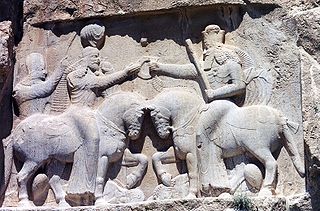
Ahura Mazda (right, with high crown) invests Ardashir I (left)
with the ring of kingship. (
Naqsh-e Rustam, 3rd c. CE)


Every day of my so-called exile took me further away from you.

How differently would everything have turned out had I, on the night on which you served Komodos poison, been on the Euphrates rather than in Mathura, whence it is closer to the Ganges than to the Hind! And, oh, how far it is from the banks of the Hind to Rome! And Alexandria, too, how far!

What sort of nonsense is this? Here we are in Alexandria now, both of us, but Alexandra tells us that our -- yours and mine -- child should only be conceived on the other side of the Hind. How generous, don't you think? One might have expected Alexandra to appoint for that purpose China. Or that land, dreamt up by Seneca, squeezed in the middle of the ocean, half way between Hispania and China. I should laugh. Which would be good: I have not laughed in a long time. Alas, I am told that it is not her, who says this, but you, speaking through Alexandra's mouth: we must flee!

Oh, you miserable Greek of half-breeds! Here I am, laboring my second day, trying to explain, in writing, as you wished, why it is not necessary that we flee, and how far have I gotten? I have not even managed to tell you yet how my father, beginning with the question about the elephant, set out to lead my tortured soul of a half-breed bastard towards that place, whence only one path was possible: towards absolute readiness to prove, at the cost of the so-called great sacrifices, even -- how much one can indeed rely on the so-called half-breed bastard, even at such times when one should rather trust that overhead monkey than any Arsakid truly deserving of that name.

I exaggerate. I was ready to make ultimate sacrifices, that is true. I knew that I was exposing myself to great dangers, yetI did not refuse the plea; this is also true. But how would it have been with that readiness of mine if here, among the Romans, you did not await me, Markia?

True, this doubt has only now passed through my mind. But this great two-day -- or rather two-night -- concentration on the task of writing to you in Greek with the help of a goose feather, this, I will say it, painful concentration seems to dig up from the dark places of my memory something which I had completely forgotten, long forgotten, perhaps as soon as the day after my conversation with my father in Nisa. It was not me who asked the question of myself, but he: would I be so ready to be given up as a Roman hostage, if you were not awaiting me here? While characterising Septymios Kaisar -- yes, now I remember it all very clearly -- he began, apparently for no special reason, to name all those Romans over whose dead bodies the lust for power took Septymios while guiding him ever closer towards that imperial purple which had fallen off the shoulders of Komodos. And there, somewhere, between Eklektos and Aimilios Laitos, he sneaked in your name; for no special reason, apparently. But mentioning it, he looked at me most meaningfully. And me? What did I do? you will ask. I can't remember.

It's unbelievable, I know, but I cannot remember.

Of course, I knew at that time that you were alive. For though my father, until the moment of the Roman capture of Ktesiphon, had continued to reject all pleas, regardless who made them, to recall me from exile, yet I had managed to smuggle into the West first -- as you know -- Alexandra, then Ardashir, then Babrios. And all three sent the same message: you were alive! But did I tell my father, when he named you among the dead, that you were in fact alive? Perhaps not, for this I should have remembered. But, surely, I must have rejected that nonsense somehow: I simply cannot believe that I would have been able to control myself, and to summon such powers of pretending, that my father might actually believe: "This does not seem to concern him at all."

So what happened then? What happened?

Whatever happened, my father must have been satisfied; his doubts must have been dispelled; and he thanked me most passionately for my readiness to serve him so selflessly in such a difficult moment of his reign. And I think that this time the passion was not pretended, and that there was no hidden intent in his suggestion that I should cross the Tigris on the back of that elephant, given me once by Vasishka-Vasudeva. But I resisted this suggestion; I was in the position to name terms and I named them. I warned him that Romans might see in my appointment as hostage a ruse, perhaps even ridicule; after all, I added with a smile, no one has ever made it a secret that I was the least favored of all the nephews of the Sun and the Moon; and that from the royal treasury of Ktesiphon (or Ragas) not a single coin has ever passed over the last thirty years to any temple treasury to defray the cost of prayers for my life and my health. And that therefore it was necessary to do everything in our power to dispel any Roman doubts as to whether the King of Kings cared at all for the life, health and comfort of his hostage. Of course, only a small group will come with me to Seleukia: the Karen girl, Samgila, Adrashir, Samasaryston with his niece, and as many servants and guards as my father will be pleased to give me; but there should be no more of them than -- say -- two dozen.

But I must cross the bridge dressed fabulously, indeed: ceremonially; I should be accompanied by five Karens, as many Mirs and as many Geopatrans, all of them with their body-guards, flying their clan banners; it would also be advisable that the kettle-drum carried before me should be drummed by the King of Elymais himself, the oldest and the stupidest of my half-brothers; and let Gokhiras of Persia walk right behind me, leading in hand my palfrey.

He'll refuse? Let him try! Does my father still have in his hands those three Mages who had agitated in Arbela for the stoning of the Christians? Let Gokhiras choose then: either he will agree to lead my horse, or those three will be walled-in alive as guilty of violating royal edicts concerning freedom of religion. And, believe me, Markia, my father agreed to it all. Of course, those three Mages were never seriously under threat (even though, had anyone deserved being walled-up alive, it was those three) because Gokhiras was really tortured by another fear: I had announced that I should release Ardashir of the word he had given me, that word which chains him to me like irons; and Gokhiras knew very well, that the moment Ardashir appears in Istakar, the Basrangs' rule over Persis will have at most a week in it.

Of course, the humiliation and rage of Gokhiras could have speared my back on the bridge (to the greater glory of Ormazd), but for this eventuality I had Ardashir, who, for that occasion, transformed himself from my hand-servant into the sword-bearer of the King of Persia. And, oh, would it have given Ardashir special pleasure to cut in half the King of Persia with that king's own sword!

24.11.09

The Word and The Flesh (5)

.
Vologases IV


How much I have to explain to you, dear Markia! How very much! And with what precision, how detailed precision! -- detailed in a manner better suited perhaps to the introductory year of one's schooling! Which is not, of course, your fault, but the fault of your world, that Wild West, that West which produced your mother and which consumed your father with its insatiable need to repeat constantly: "We are strong! Invincible! Alone!" When I read your historians and your geographers -- and by "your" I mean not just Romans, but also Greeks, who sold themselves to the Romans -- I can never stop being amazed by the intellectual laziness blowing from all those books. For how can one not term "laziness" that constant overuse of the epithet "barbarian" regarding all those whose life-style, customs, pleasures and ideas require a little effort in order to be understood?

I know, dear Markia, the words you uttered when you first learned about my existence: "Oh, what a pleasant diversion this barbarian princeling's imagination makes!" But what do you know -- and what would you say -- about... the Kushans? You know only that they wear pants which they tuck into tall boots and that the names of their rules usually end in -ishka; and you say "Oh, some barbarian of the sort common east of Euphrates". But these barbarians, my love, have managed to give flesh to the dreams of Eutidemides and Helioklides, and of all the Greek merchants from Seleukia on the Tigris to Marsilia: they managed to establish a customs border with China!

What is more: when Alexandra and I were in India, we spent two years in Taxila, with which surely you must be familiar from the history of Alexander, and out of which, two centuries after Alexander, Demetrios Eutidemides hoped to make the paragon of Greek-Indian spiritual and political unity. You will guess perhaps the exaltation with which I walked about that city of Demetrios: a double exaltation in fact, because after Greeks, we, Parthians ruled India from this city.

But -- it was not a harmonious doubling of exaltation: in Taxila, at the acropolis, I felt myself a thousandfold more Greek than Parthian. And I reasoned like a Greek: with truly Greek contempt for barbarians I looked down at the third Taxila, the Taxila of the Kushans. I laughed in the same way in which you, your mother, and Markos Imperator would have laughed at the atavistic power of nomadic inheritance: the fact that the Kushan rulers preferred to give up all the advantages -- of beauty and defensibility -- which the Eutidemide Taxila owed to its mountainous position; and preferred to build, at enormous cost, a wholly new city down below, so as not to have to part their feet -- and their gaze -- from the low, wide, flat plain.

I shared this observation with Alexandra's father. (He was then -- in vain -- trying to secure Kushan support for my father's dying -- as it then seemed -- rebellion against Vologases III; while it was through the latter king's mercy that I, instead of having died impaled on a stake, and having subsequently been eaten by vultures, crossed and recrossed India in the Eutydemid footsteps without a care in the world). The old fox, who had fooled for half a century Romans, Jews, Parthians, Siakas, Kushans and Chinese, listened to me with one eye slyly half-closed, and when I finished, asked: "And hat do you know about the art of fortification, son?" I admitted that I knew nothing about it. "Pity. Or maybe rather lucky: lucky -- for you. For your peace of mind, for your self-satisfaction. For if you knew anything about it, and took a careful look at the walls, towers and moats down below there, you would soon lose any desire to laugh at the atavist habits of nomadic blood. You say that Kushans do not understand how to employ the advantages of mountainous terrain? You are wrong, my dear. Rather say this: they can afford not to employ these advantages -- afford to see them as mere inconveniences, rather -- which neither Parthians nor Greeks could ever have afforded. Is that clear? I think not! Your mind is too occupied with the question whether Shakyamuni Gautama was or was not a god, too occupied, I say, to understand such simple things as these."

He exaggerated a bit -- as he always did when trying to characterize my mental type; and he did so (by right of being my step-father) at every opportunity. Luckily, he didn't have the opportunity often: after I married Rachela Eratona -- and you know from Alexandra that this happened very early -- I saw my step-father perhaps six, at most seven times over the space of eight years. Afterwards, I was no longer to see him, even if I wanted to, and I did often want to see him: though he was the most cunning devil I have ever known, yet he managed to miscalculate once: he decided to betray my father on the day which he judged to be the day of the rebellion's defeat, while, in fact, it was the day of breakthrough.

For me it was a day of change only to the extent that while up to that day I had been victim of the anger of Vologases III, after that day I became equally victim of an equal anger of Vologases... IV. And never ever after this day, or indeed never ever before this day, have I shed one tear of the sort one might expect an exile to shed: why, exile has its charms, very great charms! One is a martyr -- praise be to Christians, what a useful neologism this is! -- which means that whenever one says or does something displeasing to his hosts, they wink at each other with understanding, sigh and say: "Poor thing! Longing for lost fatherland has unhinged his mind!"

In fact, I did long for something. Not the fatherland, for where is my fatherland? Seleukia? Achaia? Kharakis? Hekatompylos? No. I longed for you.

23.11.09

The Word and The Flesh (4)

Auguste Jean Baptiste Vinchon, Propertius and Cynthia at Tivoli


It seems that I cannot pretend convincingly, though I would so much wish I could. And I know, and have long known, that -- though my mother never attempted to put any poison in the King of King's food, nor even as much as salt -- yet I am the fruit of one of those forty-three nights. The very same nights, dear Markia, which, far beyond distant mountains and seas, your mother passed reciting to herself breathlessly and repeatedly: Quandocumque igitur nostros mors claudet ocellos accipe quae serues funeris acta miei.

Perhaps now at last I can learn how this couplet continues? Perhaps the satisfaction of this curiosity alone might be worth taking the risk (with which Alexandra tries to frighten me day and night) that at last the Roman sword might fall upon my neck? How sad that this thought had not occurred to me then, in Nisa: I would not have had to throw into his face -- between his false eyebrows and his purple beard -- the complaint (interlaced with revolting sobs) that, in order to reach at last the one person who may love me for myself alone, I should be ready to go as a hostage even among the forked-tongued citizens of Iambulos' island (if such indeed exists). Or to those lands, which (as I learned reading with Numerianos some dreadfully dull play of Seneca) stretch somewhere between China and Lusitania.

Accipe, accipe!
What did your mother, and whatshisname -- Propertios -- command to those who were to follow their funeral cortege? Numerianos is prejudiced against this poet: he says that though throughout the entire four books of his elegies he addressed himself to some Kintia, he was in fact only interested in himself. Unlike, of course, Numerianos himself: no one will suspect him of preoccupation with himself since he always so readily yielded his apartment on the Kelian Hill to anyone to whom Didia Klara was at that moment prepared to say "Where you, Gaios, there I, Gaia." Yielded -- both the apartment and her, too; and now he yields her still (though without the apartment); indeed, he offers her (at her request, of course). He even offered me. Oh, no! Numerianos cannot be suspected of Propertios-like self-worship, while he pretends to worship a woman. Though, my father suspects, it is all the same for the rest of us.

"You want love?" he asked, interrupting my revolting sobs. "Are you sure? Personally, I suspect that you wander across the world looking for -- you know what? The most flattering mirror! And for this -- only this -- you are prepared to pay a huge price. A huge price. For instance: the destruction of the Majesty of the King of Kings".

21.11.09

The Word and The Flesh (3)

.

Ruins of the Parthian capital in Nisa, Turkmenistan (Central Asia).


You will perhaps say “Exaggeration!” – Alexandra said so yesterday. But you cannot say so, because saying so would amount to denying yourself: you would be going back on your own words: your reply (transmitted to me by Klaudios Iulianos ten years ago) to my proposal that you and I should correspond. Do you remember that reply? I will remind you: “I might in principle agree to this: half-breeds like us may correspond with each other in Greek without incurring ridicule. But – oh my distant, unknown friend, why, nearly my brother – Markia’s letters and letters to Markia will surely be intercepted. Let us not expose ourselves to derision then, let them not say that, again, half-barbarians dare abuse the divine tongue of Homer, Pindar and Plato. Let’s spare ourselves this humiliation.”

I wanted then to throw in the face of Klaudios Iulianos the words: and what about Lukianos of Samosata? And Markos Imperator? Neither was even partly Greek: neither had as much as a drop of Greek blood in him! But I was ashamed then to as much as look in the eyes of the commander of Dura and without saying a word I passed from under one sail (with the letters SPQR) under another: one decorated with a half-moon, a star and an anchor. As I leapt from boat to boat, I was pursued by the insistent, though friendly in its nature, and well-meaning advice: “Demand to be sent to Rome for talks regarding the return of the deserters from Roman auxiliary units!” Perhaps it was a sensible and friendly advice, but I did not follow it because I have always been against any talks on the fate of those Syrians who had fled from under the wings of the hated eagles into my father’s kingdom.

But perhaps that is why you are punishing me? For that omission? For that failure to seize the opportunity to meet you in Rome ten years ago already? Perhaps you believe that we are both too old now to create a worthy flesh for your mother’s and my father’s love-wish? That this child should have been conceived then, ten years ago, not now?

But that’s impossible! You could not punish me for that! I am as Parthian as you are Roman. I had my duties, duties of an Arsakid, and you – you had the duties of the favorite concubine Imperatoris Augustii. I had? You had? No! We have them still! Alexandra may not understand this, but you, Markia? It was your view that it was unworthy of the Roman Kaisar to perform in the amphitheater; it was my view that it was unworthy of the King of Kings to give up the deserters, for this reason, at the very least, that since the King of Kings holds himself to be the brother of Sun and Moon, his word, once given, cannot be changed just as the orbits of his heavenly brothers cannot be changed. And if I believe this – and I do, and Alexandra has known this for seventeen years – then it is simply reprehensible of her to try to convince me to flee; and worse than reprehensible to try to enlist you in the effort. My father has concluded peace with Septymios Kaisar, accepted such and such terms, and made me a living security for the fulfillment of those terms. How could I flee then?

Alexandra says: my father has intentionally sent me to my death. Nonsense! Not that he either loves me, or is in any way proud of me; quite the contrary: he has been ashamed by my existence ever since my birth; and indeed has at times wished me dead. But that is over now. Now he wants me to live as long as I possibly can. Mongrel children are an embarrassment to rulers and nations only in times of their presumed greatness; in defeat, rulers and nations draw such children close to their hearts, the more tenderly the more they believe the old tale concerning the half-breed’s natural tendency to betray. The wiser among rulers, though they may share in the belief, do not rest at merely exposing their breasts to the potential viper’s bite; they can look into the minds of half-breeds deeper than I can now look at the coin which I am to hand to Didia Klara tomorrow in payment for Theodotos. And in this matter, at least, my father belongs to the wiser kind; the more insightful kind; the kind who can see at once both sides of the coin. When he called me in for our farewell conversation under the turquoise-encrusted dome of his palace in Nisa, he did not need to remove from his memory the acrimonious cries – and warnings -- of my uncles at his decision to nominate me viceroy of Babylon during the civil war ten years previously. On the contrary: he eagerly inquired whether I still recalled them. And, to make doubly sure, he asked about the health of that elephant upon whose back the daughter of the Kaisar of Kushan had intended to give her body to me -- but she gave that body only much later to ants, to whom the subtle poets and insightful thinkers of the East married her when she’d gone there to bear them (as she thought) enlightenment and its fruit – liberation. That martyrdom – if I may use such a daring neologism – was also known to my father in that moment when his eyes, illumined by the moon and the torches, sparkled with tears – tears brighter than all the turquoises of Nisa! – tears of joy (especially prepared by skillful court doctors) to welcome me, a son who could finally be of some use!

I pretended, of course, that I did not grasp the connection between the question about the health of the elephant and the king my father’s whining complaint that ever since his beloved brother’s rebellion, no Arsakid worthy of the name could inspire in the breast of the King of Kings as much trust as he has for a monkey which he may allow to play in the coconut palm overhead. Or for a kitchen maid whom he might take into his bed only to get tired of her after forty three nights.

16.11.09

The word and the flesh (2)

.

Parthians, in the so-colled Sacrifice of Conon, a Parthian fresco,
in the Temple of Palmyrian Gods, Dura Europos.


Yes, I know: I should explain why I think so. And, two days ago, as I waited for your call, I had already prepared the whole argument in my mind hoping that, once we met, once we looked into each other´s eyes, I could lay it at your feet. You should not believe Alexandra when she says that the purpose of the first meeting I had proposed two days ago was only to conceive our first child. No. I did also intend to explain to you everything, or at least as much as time would allow. And I am certain that I would have convinced you about it all: that you and I owe a sacred duty to your father and my mother´s love wish; that my marriages with Rachel Eraton and Samgila were not betrayals of you; and, above all, that Alexandra´s notion that you and I should flee is nonsense.

It´s clear, though, that such a meeting of ours would not have been to Alexandra´s benefit; and thus she did all she could to prevent it. What´s more, fearing that I might discover your hiding place without her help, she convinced you to command me, by letter, that I should not attempt to see you until I have explained to you -- again by letter -- all that about me which you either do not understand or do not approve. And you do not approve, says your letter, a great deal; and you are puzzled by even more. These were your words, am I right?

This "am I right?", and the two sentences preceding it should bring you to the realization that I am still not certain whether the letter which I have received indeed comes from you. You might say perhaps that this suspicion belies what I had said earlier: that I believe that Alexandra never lies. And this would be a valid observation except that I had also added: that it is her custom to omit certain things from the truth. And thus, for example, how would I know whether this letter had not been accompanied by a message which was supposed to be transmitted to me orally? I did have the opportunity to assure myself that the letter was written by your hand (never mind how). And I recognized the seal: I have no doubt that the ring impressed in the wax was in fact the ring I had sent you ten years ago from the left bank of the Euphrates, just opposite Dura.

What´s more: Theodotos the Byzantine, whom you may remember, and whom I had purchased from Didia Klara two weeks ago, barely glanced at Alexandra´s feet as she returned from you but he exclaimed: this is my leather! Here, at the crossing of the straps -- a mark of my tannery!" And he began to cry, poor fellow, remembering what he had once been. I had to remind him that, supposedly, it is easier for the camel to pass through a the eye of a needle than for a rich man et caetera...

And yet, Markia, I am unable to dispel doubt, why, even anxiety. I am unable to believe that it is from you that this order comes: that I should arm myself - for a long time! - with a quill. That I should continue to maim -- maim? desecrate! -- the most glorious, most sacred language of your father and my mother.

13.11.09

The word and the flesh (1)


Parthian head, Louvre.

Forgive me, Markia, my love, but I do not believe that Christ has entered into a pact of mutual assistance with you.

But it does not follow from this disbelief that I make light of this revelation (made yesterday by you to me through the intermediation of Alexandra). On the contrary: whether such a pact does or does not exist is far less important than the fact that you believe in its existence, or at least once believed in its existence over the course of a certain period of eight days. This obliges me to reconsider my former view of the mystery of what happened on that New Year´s Eve nine years ago.

You know from Alexandra, that I have always doubted that any plot had really existed between you, Eklectos, Aimilios Laitos, Pertinax and Narkis. But you do not know -- because neither does Alexandra -- that I have always considered as pure invention the story of how you, supposedly, having served your imperial lover poison, and seeing that it seemed to take no effect, called out to Narkis (who was hiding behind a column): "Strangle him!" Yet now I am beginning to think that perhaps that report is true; indeed, that it must be true. And I think this because I think I now understand the entire thought process which guided you in the course of those eight days between the night on which the virgin birth of Mithra is celebrated in Rome and the Roman New Year´s Eve.

Equally understandable is now to me Alexandra´s strange eagerness to report to me your confession. Barely a week ago I would not have been surprised by it, thinking her eagerness and precision perfectly natural, but since I began to suspect (a week ago) that her husband did not die of natural causes, I have come to see her also in a different light from that in which I had seen her all these years since the day she had began to speak. Supposedly my most devoted companion, the most trusted recipient of my innermost thoughts, she proved capable of hiding from me the truth regarding the most fundamental of matters!

I do not suspect her of lying -- oh, no! She never distorts the truth -- she only omits to say things which, in her opinion -- might hurt me. Or so Ardashir, Samgila and Theodotos all say: all three are full of admiration -- worship even -- for Alexandra, that she treats me so gently and so very much tries to spare me any pain. Oh, to think of it! Ardashir, for so many years her staunchest enemy -- now admiring her! But what will happen to his admiration -- and that of the other two -- when I tell them that in this business -- the business of the great mystery: are you or are you not a regicide? -- Alexandra did not take the least care to spare my feelings? On the contrary: she told me the whole truth! How strange!

My mother had taught me not to be mystified but to look for that which is hidden behind the mystifying mask. And in this case, too, I have followed her advice: I have spent the whole night wondering what was behind Alexandra´s eagerness and -- precision. And now I think I know: it was, first of all (contra the triune admiration of my familae) the pure, unalloyed, irresistible and urgent need to cause me pain. And second: the far less pure desire to turn my attention away from a whole series of unusual circumstances surrounding the supposedly natural death of Achilles the Hermopolitan, my, after all -- how incongruously! -- brother in law. Finally, I think that she expected that by reporting to me your confession she will convince me to change my heretofore position regarding her suggestion that you and I should flee to the Far East. But in this she is mistaken: though I am now quite certain that you did indeed murder Kaisar Komodos, I repeat -- not "Flee!", but -- "Reveal yourself!" This idea that you and I should flee -- it is neither in your nor in my interest, and only to Alexandra´s benefit.

(I can only handle two paragraphs of this at a time).

1.10.09

Only Beatrice (1)

.
.
.

Teodor Parnicki

ONLY BEATRICE


Historical Novel
Warsaw 1977


Translated by
Abdullah Mordengo Piedrusinski


There is no heaven, no earth, no hell, no abyss
There is only Beatrice, and she – precisely – isn’t.

Jan Lechoń, Meeting


You give me the shiver of death
-- Not the empty shiver of sensuality --
And then you lead me away
To the isles of eternal happiness

Nikolai Gumiliev, Dante


I


“I have come. I have not broken the promise I had given. I am prepared to hear you out with all attention, worshipful fathers; and with great sympathy. I understand: you may not be inclined to believe in the sympathy; perhaps it would even be odd if you did. But, among all the many things which you have taught me at various times, you have also taught me the truth contained in the words of Christ, Our Savior: “You shall know them after their fruit.” Therefore note that – were I not honestly well disposed towards you – this hall would already be burning around you, above you and – with you. But I was able to impose upon your until yesterday faithful subjects an armistice, which shall last for the remainder of today, the whole tonight, and perhaps even until tomorrow noon. You smile ironically, father Bernard? You shouldn’t. This is war. Maybe not an ordinary war, but a war all the same. In wars fought by princes and counts, it often so happens to the garrison manning a fortress, when they are no longer able to resist, that the besieging forces break in and murder all defenders. You are in the same danger – precisely the same danger, even though no side here is an army of a king, prince, or count. Of course – not differently from any other war – the losing side here would also like to obtain the best possible terms upon which it might end the fight. Oftentimes, this is also the desire of the mediators; in this case, this is my role. With the difference that – if I drew the correct conclusion from my conversation which we had before daybreak – the arch-worshipful father Peter and I, your humble servant – you expect that I shall be able to save your lives without obtaining any commitments on your part in return; any commitments that is beyond merely the expression of willingness to forgive the unrighteous, godless – these are the arch-worshipful abbot’s words – rebels. I could of course discuss with your worshipfulnesses such a proposal, but I must make note, honestly and unambiguously: I could not make any guarantees to your worshipfulnesses that your lives could be spared on such terms; I could make some kind of efforts in that direction, I suppose, but without any promises as to their successful outcome.

“For the outcome would – very likely – be the opposite from the one intended; with the added result that the mad anger – quite justified, in my opinion – of your local subjects, who are now threatening you with death, might extend that danger to me, too. Yet, I would be willing to risk it – I have already said that I am guided here by a great sympathy for your worshipfulnesses. But in order for me to take that risk, it is necessary that you convince me during this armistice – and above all doubt – that, first, it is indeed necessary for you to continue to exist on earth in your current earthly form; and, second, why it is that I – yes, I – should risk my own life while trying to extend yours? Did you wish to speak, noble and worshipful father Andrew? I will be glad to hear your voice again. I have not heard it since the day when you put a dog’s muzzle on my face.”

“You wretch, you are guided by the feelings of ungratefulness, hate, and revenge towards us, not by any sort of sympathy. I was opposed to making any deals with you. Having now heard you speak, I am convinced even more thoroughly that I was right. You came here to torture and torment us; not with any thought of helping us. And no matter what we say, it will have no other end result than this: you will depart from here before daybreak laughing blasphemously, sacrilegiously, godlessly in the faces of the Lord’s martyrs; and you will gladly and contentedly watch this hall go up in flames about us, above us and – with us.

“Archworshipful father abbot, brother Bernard, and you, Urban, sweetest child, I beg you all: let us break off with this perverse man, the most unnatural of sons, this degenerate son. Let him depart from here immediately and may God himself judge him: it will be a terrible judgment!”

“Father Andrew: neither the archworshipful abbot, nor father Bernard seem to share in your opinion. As for Urban – his life, his health even – are not in the least danger. He will be able to depart from here along with me, regardless of the outcome of our talks, unless he himself chooses to share your fate. He chooses so now, I imagine; but I do hope that once he hears everything about which we shall talk here, that desire will leave him.”

Urban: “It shall not, dear brother Stanislaw”.

Andrew: “How dare you call this villain, this blasphemer, this messenger of hell – how dare you call him your brother?”

Bernard: ‘Brother Andrew, I beg of you: be careful with your words. I am not too pleased to have this man as my intercessor, either, but let us not forget: he did suffer many iniquities at our hands.”

Stanislaw: “I did not come to have my iniquities made whole. Nevertheless, you have spoken holy words, father Bernard. Worshipful Andrew ought to be careful with his words; but you have warned him too late. You did say, father Andrew, did you not: first “the most unnatural of unnatural sons” and then, much simpler: degenerate son. You aimed these words at me – in what sense? Metaphorical or literal? When saying so, did you mean me as a child of your monastery? Or rather – as your son of flesh and blood? Of course, I cannot be a son of flesh and blood of all of you. So am I perhaps – your son, worshipful Father Andrew?”

Urban: “Neither father Andrew’s; nor father Bernard’s; nor the archworshipful abbot’s…”

Stanislaw: “…and nor yours, of course. But only this last is clear and certain above all doubt, nothing more. I have intended to space out – quite widely – over the duration of the armistice various subjects which we must – must! – cover. And the time would have certainly come – I have originally expected it would come around midnight – to cover this topic, too: the identity of my father, my father in flesh and blood; but it has happened otherwise, thanks to Father Andrew. He hurried the arrival of that moment which I did not wish to hurry at all. My worshipful fathers! For some years now I have been convinced that one of you has fathered me, not quite thirty years ago, with the daughter of the Niałek miller.

Andrew: “I was not in Wieleń during the rule of the worshipful Nicholas; nor was I a member…”

“…Of the monastic complex of Obra. No. But you did come here from outside Poland twice. The first time when the Obra complex was ruled by the worshipful John, and the Wielen complex by its first abbot, Olibierus, or perhaps Henry; that is between the years one thousand two hundred seventy eight and eighty eight. And on the unforgettable night of the third day of the first week of Lent in the year ninety-six the worshipful Father Peter – today the arch-worshipful abbot – has deigned to inform me that I was then fourteen. From which it follows that I was born in the year eighty-two; perhaps eighty-one; and must therefore have been conceived in the first year of the rule of aforementioned Abbot John.

“But why are you so deeply moved, Father Andrew? Did I say that I suspect you of having fathered me? I said you could be my father; but are you more likely my father than either the arch-worshipful abbot Peter or Father Bernard? Forgive me, but you have just behaved like Achilles, the son of Peleus, when Odysseus, having struck his shield with his sword… Ah, but you know what happened then, don’t you? After all, I have heard this story from you, did I not? But then: I do not claim that you are my father, despite what could have been your inadvertent revelation a moment ago. For I happen to have found evidence that Father Bernard, when he arrived in Wielen at the side of the then Abbot Nicholas, was not in fact visiting Poland for the first time, though I do not yet know when exactly his first visit here – in Obra if not in Wielen – had taken place. But I will know it, no doubt, you will tell me, Father Bernard, will you not? No such difficulties attach to your eminent person, arch-worshipful Peter. You belonged to the Wieleń community from the very beginning. If you ever left, it was well after my birth, and never while Nicholas was abbot. Of course all three of you must be offended by now that I should bring up such filthy business – but can it really be possible that you do not understand – not one of the three of you – that I will probably lose my father within the next twenty four hours? It is a natural and noble thing to mourn for one’s father; but I must know for whom it is that I mourn. I will of course mourn for all three of you as my spiritual fathers; but only one of you as my father of flesh and blood. I wish you all well, of course, and I already said it. What’s more: I think I have the right to expect that you requite the sentiment.

Andrew: “If these cruel and sarcastic words have not been inspired – why, commanded -- by the ruler of hell himself, I’ll…”

Abbot Peter: “And now I, too, will repeat after Father Bernard: you must reckon with your words, Brother Andrew. But also you, Stanislaw. Or rather – if indeed you still remember our night time conversation, our last before your departure from here all those years ago, you must remember that I called you by a different name then. By what name did I call you?”

“Telemachos”.

“Telegonos.”

“No, you are mistaken. I am wholly certain: you called me Telemachos, not Telegonos”.

“Perhaps I am mistaken. Yet, I notice in you an unambiguous – and therefore dangerous – tendency to overestimate your memory, however impressive it may be; which memory I so greatly admire that to express this admiration I would first have to (if I do not want you to take me for your father in flesh and blood) convince you (not without difficulty, I imagine) as to the obvious truth: how wholly unimportant it is, compared to spiritual fatherhood, who begat you in flesh and blood, whether this individual, or this, or this…”

“For instance, the itinerant hurdy-gurdy player to whom you have once instructed me to give a penny; or, perhaps the opposite, one of the Piast princes…”

“Precisely. Either this, or that – it is not at all as important as it seems to you. For regardless whether it was the itinerant hurdy-gurdy player, or a Piast prince – that which you are has not been created by either one or the other. Neither could have done it even had they wanted to for the simple reason that neither had the ability to do so: neither the understanding nor the inclination. You know a lot about us; and we know a lot about you: not only that you whom we have here, in the Wieleń monastery, raised over the years, day by day, like a rare plant, and polished like a precious stone; but also about that distant you, roaming between Tartary and Cymbria. And that which we do know about you leads us – leads me at least – to be both proud of you and to fear for you. Yes, for you, not for us. Should the Lord of Heaven, our Creator and Savior at once, decide that we should stand before him in judgment within this day? What is more: should He desire that our road to Him should lead through martyrdom in flames? Well, let the name of the Lord be praised! More worthy men – more just, more holy – underwent just such a martyrdom traveling from this vale of tears into God’s presence. But what shall you do unto yourself if you do this unto us? What joy will that short moment give you? – for believe me, if it at all comes, it will be very brief indeed! The joy of having paid us back for real – not merely imagined wrongs? And believe me there were plenty more of the latter!”

“My arch-worshipful father! The death in flames which threatens you now would not go to avenge my wrongs, but to avenge for the wrongs you have dealt to your subjects!”

“Is that so indeed? I think you do not believe this yourself. Please do not say you do believe this, for if you were to say this, I would have to stop being proud of you.”

“Yet, I will say just so. When we two spoke this morning, one-on-one, in front of the house, what would I have said to you if I merely wanted to avenge my wrongs? Undoubtedly just this: you must all die. And therefore prepare yourself mentally for the fact that there is – there can be – no hope of survival for you. But what did I say? I said: if you wish to escape death in flames, you must agree to such and such demands of the peasants of Mochy. If you accepted these demands, what benefit would I have of it? Would your rebelled subjects reward me with gold? Or would they follow me unto the ends of earth in search of the Holy Grail? Surely, you do not think so.”

“We do not think so. Or at least I do not. I am not even inclined to think that you might, after burning us here, lead your colons somewhere far away, where they may escape the severe justice of the lay and church authorities. Though perhaps that would have been the smartest thing to try: become their leader, struggle through forests and marshes towards the coast, then the sea; buy – or hijack – a ship in Wolin, and sail far, far away, West, beyond England, Ireland, Iceland.

“No, you will not do it. Our peasants, well, the peasants will run away and hide in the forest perhaps; but you will remain here, above the smoldering ambers of this house, the ashes which had once been our flesh, to curse yourself and mourn for us bitterly. The prince’s – or the bishop’s – men will find you here in tears.”

“You are saying the very same thing which I have myself said here only recently: it is a noble thing to mourn one’s father. But so long as to give time for the prince’s – or bishop’s henchmen – to catch me? After all, it’s not like I would be mourning a worthy father rather than merely one who begat me in sin, with the Niałek miller’s daughter!”

“You are mistaken if you think that you are strong… No, no… do not interrupt now. Yes, you are strong but with a different strength than such as is born of hate or vengefulness…”

“Born of the hunger for justice, out of pity for wrongs done…”

“Whose wrongs? You will say not yours but the peasants’. A hunger for justice for the subjects of the monastery, not for yourself… Yes, it could be like that. Except it is not. Perhaps you yourself are not aware that it is not. Knowing you as well as I do, I am inclined to believe that you do believe yourself to be the avenger of the colons’ wrongs. But even if you had been an avenger of their wrongs, you are him no longer, you have ceased to be him. From the moment of your arrival here; from the moment in which you expressed your readiness to seek our salvation, even if we were to reject the peasants’ demands… But whence this sudden readiness to negotiate, only seemingly unexpected? Two explanations are possible: the first is that the peasants’ wrongs do not concern you at all, and that you are not at all eager to grapple with us for justice for them; and the second that considering us lost souls you want…”

“…to humiliate you and torture you, as worshipful Andrew said? Achieve that you will die cursing me?”

“On the contrary. Achieve that we will die admiring you…”

“That is not the case. But were it even the case, I could never achieve it. No one could.”

“Very probably. But you think that you just might achieve it.”

“So that I may then mourn you while cursing myself bitterly until the prince’s – or bishop’s – henchmen come? Nonsense! Your arch-worshipfulness said that you know me well. More nonsense! You do not know me at all! Nor can you know me. You said that you know a great deal about that me who roamed the great spaces between Tartary and Iceland. You do not know a hundredth part of it. That adolescent who left here, bid goodbye by your curses, in the night of the third day of the first week of Lent over thirteen years ago is no more. I have changed. You said that you were proud of me; or rather, proud of that plant you have grown, or that precious stone you have polished. Well, you have a right to that kind of pride… But do you deserve my gratitude? You had it. Plenty of it. But you still deserve a pay back. Am I not paying you back? And how generously! Here I am trying to save your life, even while risking my own; but since I am risking my own life, I must know… -- the miller’s daughter’s son will now speak to you! – that the bread I receive isn’t worth less than the price I am prepared to pay for it. This is simple – you will agree? – or at least clear?

“I repeat, you must convince me successively: first, that you deserve saving; and then: why I should do the saving while risking my own life!”

“Let us suppose that we did manage to convince you in some manner wholly satisfactory to you in respect to both the first and the second question. And let us suppose further: that you have saved us and, along with us, yourself. The Mochy peasants will receive from us forgiveness for their rebellion, but nothing else: they will have to pay their taxes in kind just as they were supposed to pay it all along (and ought to have paid before the rebellion broke out). And thus the wrongs of the peasants – as you see it – will continue unabated…”

“Ah, but you will retain the memory of the dangers which you have – practically miraculously – escaped. Your fear will remain – forever. You will be kinder to your peasants henceforth.”

“Indeed? You appear so wise, so well-raised, so well-polished – and yet you understand so little! Nothing feeds ruthlessness as well as fear… We will be far worse towards the Mochy peasants than towards any others; and the peasants will hate us even more than ever before… And they will often think to themselves: “why did we not burn them then?” And in so thinking they will also remember your intermediation; and remembering, what will they send you – near or far -- thanks? Blessings? No! Curses!”

“You appear to want the same thing father Andrew wants: that I go away already.”

“You are mistaken. Andrew does not want you to go. He merely allowed himself to speak in anger. Nor do I want you to go. But all of us here want one thing: that you avoid doing something which you will later be unable to undo; and will want to undo, badly but belatedly.”

“These are beautiful words but they do not advance the least bit the negotiations for the sake of which I have managed to arrange this truce. Arch-worshipful father, tell me, do you or do you not wish to continue living here, on earth? And if you do, please provide some argument why you should…”

“You appear here with two functions: as prosecutor and judge… But even if I were to accept to defend myself before this sort of tribunal – a tribunal which violates all rules of justice – you may want to try to afford it… if not exactly justice then – legality enough to fulfill the ancient requirement: that an accusation must precede defense. For how can the judged defend himself if he does not know wherein lies the accusation?”

“Fine.”

“But be careful. You must now set aside the wrongs of the Mochy peasants, and all monastery’s peasants in general. It is not they who want to know whether we deserve to continue our lives in flesh on earth; or whether you should be saving us. You do not wish to be a fair judge; but try at least to be a rational one.

“We have heard that you listened in Cologne, on the Rein, to the lectures of great masters of logic. Show us then how you have profited by those lectures: prove that you have not wasted your and your teachers’ time. Your accusation – if it were to reveal your ability to reason correctly – must aim to prove that we do not deserve to continue our life in flesh on earth; or, at the very least that even if we deserved to do so, then there is no reason why you should try – perhaps at risk of your own life – to save us.

“Personally, though I am very proud of you – how many times I have said it here already – I am not inclined to think that you can make such a proof; or rather that you could present such a proof without violating principal rules of correct implication. I may be mistaken in my expectations; but I say: try it, if you wish to see my defense in due course. Of course, if you do not try (which may suggest that you are not sure of your prosecutorial skills), such due course will not come. I have spoken. Or rather we have spoken, the abbot of the Monastery of the Cistercian Fathers in Wielen, and, by virtue of that fact, the shepherd of Mochy and the legal representative of Our Lord Jesus Christ.”

Andrew: “I object.”

“Our abbot’s “we” a moment ago was of course directed at Stanislaw here, but even more so at you, worshipful father. This mansion belongs to the Wieleń monastery; whether it stands or burns, there will be here only one legal authority: the will of the abbot.

“Stanislaw, we are ready to hear you. Oh, but wait. You have listened to lectures on the subject of correct implication, or, to say it in Greek, of logic; but, as far as I know, you have never studied law. That is a great pity since you must henceforth perform a judgment, even though your professional preparation for the task is no greater than that of a tailor (or roofer) who suddenly resolved to make shoes.

“Allow me to help you somewhat here, then, though without leading you to draw out of my willingness to help you the conclusion that this is yet one more proof of my fatherhood of you. Well then, you must begin your accusation as follows: it shall be shown in my argument above all doubt that such-and-such and so-and-so among the Cistersian monks (we know who they are) have committed criminal acts for which the laws of our kingdom foresee the penalty… but wait… what kingdom is this? It might seem that it is the kingdom of Poland… but by the command of which ruler of this kingdom are you here in the role of a prosecutor or judge?”

“I am here as a representative of all the peasants of the Obra province who have been attached to the property currently under the management – whether legal or illegal – of the Cistercian monks settled in two neighboring monasteries, in Obra and Wieleń. I am intentionally using the word “management” rather than “possession”: I have been taught that monks may not own any property, since they take the oath of eternal poverty.

“Of course, whether the lord exercises possession or management, the subjects of all degrees owe him their obedience. But is it unconditional? The church teaches us in the words of its greatest authorities – Pope Gregory VII, among others, and the doctor known as angelic – Thomas Aquinas – that in order to expect unconditional obedience, the ruler’s rule must also be wholly and unconditionally just. But should the rule prove unjust it is not only allowed; but it is required to refuse obedience because unjust rule is a tyranny; and the same church authorities teach that tyrannicide is not murder; and is therefore not a mortal sin; it may be at most an ordinary sin and, under certain circumstances it may even be a virtuous, deserving act. Mochy was ruled unjustly; they rose against tyranny; which is to say that if you do die here tomorrow in flames, your death will be an act of tyrannicide.”

Andrew: “Saint John the Evangelist, our Lord’s favorite student, wrote: “all power comes from God.”

Stanislaw: “Dear father, was that indeed John the Evangelist? I don’t think our arch-worshipful abbot would agree.”

“I don’t. You shame us, father vicar; and not for the first time today. And not the first time today Stanislaw, our beloved son, proves that we were not much mistaken years ago when we whispered to each other: this miller boy will one day grow up to be a great jewel and pride of our monastery.

“Jewel and pride intellectually – I must add; since hardly any one of us had expected that the boy whom we had taken in, and by taking him in had preferred him over all others; hardly any of us, I say, had expected that this boy would make us proud with virtues other than those of the intellect. It is true that I did fool myself for some time that I might be able to transform that boys’ – yours, Stanislaw, whom at some time I may have called Telemachos or Telegonos – that boys’ ever increasing tendency for self-love, which is to say, the most terrible sin of pride; transform it into its opposite, such as noble pride rooted in two things: the understanding that to possess great intellectual gifts is not a merit, as it is an unsolicited gift of God, of which it is well to be proud but with pride no greater than is proper to an undeservedly selected vessel; and, second, in constant meditation on the divine warning: to whom more is given, from him more will be expected. But when tested, that same Stanislaw showed above all doubt that God has not only gifted him, but also burdened him; which must not surprise us since being above all creatures, Divinity exceeds all teachers, whether of mathematics or music, in its love for harmony, and therefore with its dislike for self-loving youths who upset all harmony. Putting it differently, perhaps more clearly, I will say: tested, Stanislaw proved to be handicapped in spirit, and therefore also intellectually: he has no sense of duty, a sense which, we imagine, should characterize especially those who have received so much more than all others: an expectation that more will be expected of them; nor does he possess, the same test showed, another sense, closely connected with the aforementioned: self-respect; or what I have called earlier noble pride.”

Andrew: “Can there be anywhere on earth such a thing as self-respect – noble pride – of bastards?”

Bernard: “Allow me to put a word in, arch-worshipful abbot. Father Andrew’s interjections fill me with distaste; but your speech fills me with sadness. In different form you express the same injustice, or perhaps only insensitivity, or inability to understand the deeper aspects of human soul.”

Andrew: “Are you still in your old place – or are you already on your knees before the giver of life and death, Father Bernard? The wretches – the rebels, worthy of pity rather than anger – have boarded up the windows and my sight has always been weak… But, as a result, my hearing has always been keen… It is no surprise then that I catch in your voice a note of fear… Would you want to live in flesh, on earth, for ages and ages and ages?”

“I should like to leave my flesh at the moment appointed for it by Divine Will; and in company of just, or at least merciful, brothers. His arch-worshipfulness abbot has spoken at great length about Stanislaw’s pride; but has he never asked himself whether that pride has been no more than a shield, wrought from captured iron (metaphorically speaking) which he broke off constantly – and bravely – from spears and lances aimed at him by pseudo-friends, foster-fathers, spiritual fathers – indeed, his despisers and torturers. We took him in; but did we privilege him? Why, we had him for a puppy – metaphorically speaking, of course, until Father vicar put a dog’s muzzle on him; whether metaphorically or literally, he was for us no more than a puppy dog, sweet, and bright from birth; one plays with such dogs and teaches them all sorts of tricks; but when they begin to bore or tire us with their playfulness, we kick them. (And sometimes well before they begin to bore us, too). But we expect from such dogs – no, demand from them – that they should always remember the stroking hand, not the kicking foot. And how surprised we are when, kicked cruelly and often, a dog will suddenly jump up to our hand in order not to lick it but bite it!

“You also mentioned, your arch-worshipfulness, a trial of fate which Stanislaw failed thereby revealing a spiritual handicap, which is to say insufficient self-respect or noble-pride. Do you remember? I was opposed to such trials; as was Abbot Nicholas, who now rests in the lap of God, I expect, but then was both yours and mine abbot. But you insisted. Was your insistence then guided only by worthy motivations? Why, did you really select Stanislaw to undertake that a trial only because you thought it may lead to transform the youth’s supposed self-love into its opposite, noble pride, self-respect? Further: you say he failed the test; disappointed hopes placed in him. Did you ask him then – that night on which you sent him away – discarded him like a dog – that night which you can recall so very well since you speak of it so precisely: the night of the third day of the first week of Lent of the year so-and-so” – did you ask him: “Beloved son, we have placed such hopes in you, and you have disappointed us bitterly… Why?” You see, I did ask him, with these very words precisely. I ran after him for a long time, long after his mother, all in tears, had given up – because it was such a frosty night!”

“And what did he answer you?”

“He spoke softly, even tenderly, but his voice did not tremble; on the contrary, it was almost happy. He said: ‘Good father, the time comes when you will learn everything; you. Only you.’”

“And have you learned?”

“Your arch-worshipfulness has spoken. I received a letter from Prague in the year…”

Stanislaw: “Worshipful father! The time has not yet come to discuss that matter! But I am happy to hear that my letter from Prague reached you. I have long wanted to ask you about it; it was the first thing I wanted to ask when I arrived here at the doorstep of the monastery after ten years’ absence. But on my first day here I could not find you; and on the second the worshipful father Andrew, as you have already graciously observed, put a dog muzzle on my face. Which, of course...”

Andrew: “…creates hopes for one of us – father Bernard, of course – that he will escape Mochy with his flesh intact… My lords – noble, less noble, and those entirely devoid of nobility of any kind! -- time passes! It is completely dark already: not only inside, but also outside. Let us pay attention to the importance of the passage of time – if we cannot pay attention to self-respect. I am deeply convinced that I will not see the next night; and if therefore you are indeed Christians, allow me to prepare myself for my death. I wish for peace – nothing more, but nothing less. And if I have to pay for this right to peace the highest price, then I will pay it. It is my understanding that Stanislaw’s vengefulness – or, perhaps, as father Bernard’s words have shown us, a released dog’s madness – is really aimed only at one person: his father in flesh and blood. And if he has drawn all three of us into this trap, it is only because he does not know which one of us has begat him with the daughter of the Niałek miller. Once he knows, the trap for the remaining two will loosen. Listen, whatever your name (since you have been named Stanislaw, secretly by your mother and without permission from the monastic authorities), shall we make a deal? I will prove to you – in accordance with all the rules of precise and correct implication – that you are my bastard. It will not be pleasant for me to lower myself to the task of reasoning with a low-life like you – yet I will undertake this effort and I am sure its results will please you. But if you are pleased, will you assure me that the arch-worshipful abbot, the cowardly father Bernard, and the innocent child Urban will be able to leave this place unharmed? I do not doubt it, I have never doubted it for a moment, that this whole supposed peasant rebellion is really your work; not directly, but indirectly, of course: you have influence with your grandfather, and the cunning miller has influence over all the peasants in the possession of the Wieleń and Obra monasteries. You have caught us; not our peasants’ anger. So, if you want the death of your father of flesh and blood – his death in flames, no less – you will have that death, but only that death. Do you agree?”

Abbot Peter: “We order you, dear brother Andrew, to be silent. We are pleased of course by your readiness to sacrifice yourself for the sake of your brethren…”

Andrew: “I have already explained it: I am not guided by any sense of love; I merely long for some moments of peace before death… I need some moments of concentration to settle with God some earthly accounts…”

“We said: be silent! I warn you, I must speak to you more sharply – though I do not like doing so: you are behaving nobly, but with the nobility of a knight, not that of a monk. You are self-sacrificing, too, but with the self-sacrificing of a simpleton. And in this you are as proud as Stanislaw, but at the same time – unlike Stanislaw – foolish. Not in all things, but in that which is most important, because that which is most important is too complicated – it is insufficiently simple for you to grasp!

“You are right when you say that it was not the rebellion of our peasants’ which has trapped us here, in this trap, this ambush, this net – this most unusual net woven of fire. We agree with you, we the Wieleń abbot, your superior, as perhaps does father Bernard, too, that the rebellion here is the work of one individual and not, to use the language of Caesar, Cicero and Salust, of the oppressed people. Of course, without the people, this rebellion would not have become the success it has been; so the people have been fooled, fooled through the agency of a person of great authority among all the simpletons in the area, Stanislaw’s maternal grandfather, the miller; and they have been fooled into thinking that by threatening us – what is more, by threatening us with death – they may receive a commutation of the due labor and goods into payment in coin; and a rescission of the right of to judge criminals among our peasants back from the monastic to the secular authorities. They have been fooled because they do not know, though the miller knows it well, and his grandson, whom we have transformed into a great learned lord knows it even better – that even if we wanted to satisfy such demands, we could not, since, just as our colons are our subjects, we ourselves are subjects, indeed, slaves, of the set of rules which make up the law according to which our monastic order is ruled. And knowing as much, Stanislaw is in fact misleading the peasants; and more, since misleading the peasants is but a means to a further goal. You believe, father Andrew, that that goal is vengeance upon his father of flesh and blood; in thinking so, you reason further correctly: if the father reveals himself (which would amount to his accepting death), Stanislaw may let the other two (and the child Urban) slip out of here unharmed. But I deny it…”

Bernard: “And I join you in your denial. I believe – I have always believed – that Stanislaw’s greatest complaint against us has been that (since he assumed that one of us was his father) he’d never lived to see the day on which his father stepped forward to identify himself; for he reasoned thus: “Since he does not reveal himself – even secretly, to me alone – then I am not dear to him; worse: I must be repulsive to him.

“Which is to say, in other words, that he dearly – though secretly – wished for his father’s love; and if someone – I believe equally dearly myself – longs for his father’s love, then that proves that he loves his unknown father; and if he loves him, then it is impossible for him to be motivated by his disappointment, though the disappointment be year by year ever more bitter, to commit the crime of patricide, a crime which is more terrible than any other crime, except matricide. And thus I think that brother Andrew’s reasoning, however noble and selfless, is completely mistaken; I might agree with the supposition that Stanislaw may have been behind the peasants’ rebellion against us so as to force that among us who is his father to reveal himself; but he desires that revelation not in order to wreak revenge on his father, but – in order to save him.

“To save only his father.

“Surely, you remember, Stanislaw, the story about the wizard’s apprentice? The apprentice, while watching his master, learned the secret of how to compel evil spirits to perform works ordered by the human will; but only how to summon and order them to perform such works, but not how to dismiss them when their services were no longer required. I suppose it is with you just as it was with that apprentice: you were able, in order to serve your own ends, to transmute the resentment of the peasants’ into an open rebellion, but you would never be able to calm the rebellion you have caused: having learned how to call the evil spirits, you have forgotten to learn also how to dispel them. And therefore you know, if you are wise – and you are wise – that if we do not make concessions – and we cannot make concessions as the arch-worshipful abbot has shown to you very wisely only a moment ago – therefore you know that the rebellious peasants must – they have no choice – must murder the monks; or, to be precise, to burn us with this whole mansion. You could perhaps, in your overall impotence (so very clear to you, am I not right?), you could perhaps snatch a small part of the booty which the forces summoned by you, but now no longer obedient to you, will now take, since, after all, the killing of two or three can give as much animal pleasure to those bent on murder as the killing of three or four; especially if one tells them that among those about to be murdered such and such person was really in favor of making concessions, but was shouted down by the wolves among the others, among whom that person was but a gentle lamb. Which is all to say that – it must be obvious – what you really expect of our talk tonight – of the armistice, as you put it – is to discover the identity of your father; but with the purpose of saving him, not taking revenge upon him. That’s all for now.”

Abbot Peter: “You are very insightful, brother Bernard; certainly more so than brother Andrew; but you, too, are mistaken. I agree that, given a chance to save any one of us from the powers he has released upon us, but which he now cannot call back, Stanislaw would indeed do this: he would try to save that one of us as to whom he could now say without any shadow of doubt, or uncertainties, or fear: ‘I have found my father in flesh and blood.’

“But then again: having always wished Stanislaw well – too well, perhaps, for certainly a lot better than he has turned out to deserve – you have now taken your softness towards him decidedly too far: for it would most certainly not be love for his found father, but vengefulness towards him that would motivate Stanislaw to save only his father from among us all.

“Believe me! Love takes many forms; and so does vengefulness. We have talked so much together, brother Bernard, you and I, in the evenings in the monastery – over years and years – concerning all the most terrible dangers involved in hiding sin and crime under the mask of virtue! Do you remember? We even spoke about how even that which is the holiest can be employed by the arch-cunning Satan to mislead creatures of God which he selects as especially attractive to him and which, while being mortal are also sentient. You yourself have described how the incontrovertible proof – of great literary value, too – of Saint Anselm of Durovernum that the Holy Spirit comes from both Father and Son – a powerful proof against the Greek schismatics – was itself once subverted so as to give not brief pleasure to Satan; and since that could happen, who could claim that Satan cannot pull an even more daring subterfuge: to collect profits from Christ’s own instructions? “Man is not for Sabbath, but Sabbath for man”, said our Lord Savior; but how many opportunities for crime does this teaching create – as a result of Satanic whisperings – when it is put into practice by lazy men? The same must be true regarding other teachings of Our Lord Savior: gluttony and drunkenness spread behind the shield wrought from the gospel story of the miracle at Cana. Tell me, is it so, or is it not?”

Bernard: “You have spoken truthfully.”

Abbot Peter: “I am glad to hear this. And now you will be glad to hear this: the Lord said: “when a brother strikes you on the right cheek, turn to him the left”; which, we have been taught, is an injunction to gentleness, humility, and rewarding evil with good. But Satan is well capable of turning this teaching into a weapon not for the humble, but for the proud; the vengeful who are not inclined to forgive mercifully. This weapon is not intended for all; only the higher minds, of course, the higher minds among the proud, vengeful and merciless. I’ll say more, because the words “higher minds” are not sufficient; one should add “for shy, unwarlike characters, in other words – the bloodless – so as not to say…

Andrew: “…those with impotent testicles; or thoroughly lacking in honor…”

Stanislaw: “I will not rebuke you, eminent vicar, should I even care to, for we waste time here – seemingly fruitlessly, though perhaps only seemingly so – priceless and merciless time, every faster advancing towards tomorrow… all this considering of my worth, whether I have matured, whom I in fact serve, how to interpret my relationship to the rebellion of the Mochy peasants – surely, you must admit, it is exactly and no more than – and attempt at self-defense. Would I, once I have identified my father, abandon him to death in flames, or, on the contrary, try to save him from the same? Or again: by saving him, would I reveal my love for him or my feelings of vengefulness towards him? And if I intended revenge, would it be the sort especially pleasing to Satan, which lies in exposing our left cheek to a brother who strikes us on the right one, in order to punish him all the more cruelly with spiritual suffering, feelings of guilt and shame; more cruelly than striking him back, or indeed, killing him would have been?!

“Spending our time in this manner, our precious time measured not in days, but only hours till the expiration of the armistice – in fact you two – you arch-worshipful abbot, and you father Bernard – show how right is the third of you: if you can or will only engage your judge here in this manner– your judge representing here your oppressed people (despite all your arguments, I am such a judge) – then perhaps it would be better if you stopped talking to me at all leaving me in conviction that I am indeed father Andrew’s son in flesh and blood…”

Andrew: “How terribly you would be punishing me, oh Lord of Heaven, if it were to be the truth…”

Stanislaw: “How valuable this admission of yours: if by way of its form alone. But let’s set that aside. Having, as I do, a great number of well founded reasons to suspect that no other person but you, father Andrew, begat me with the daughter of the Niałek miller, I said: I will not rebuke you. But you, arch-worshipful abbot? You said a great deal to attack me, and would say a great deal more, too; but by doing so do you not undermine the dignity of your own extraordinary mind, polished by both philosophical and legal education? Were you not demanding yourself only a short while ago that, respecting the foundational principles of legality I should agree to hear your self-defense only after you have learned the content of the accusation against you? I agreed – and what followed? You were offering me help – as one who has completed legal studies – you proposed to help me formulate my accusation in agreement with the rules of law – but then you cut off your work on formulation quickly and passed on to defense. After all, your disagreement – supposedly a tacit disagreement – as the eminent vicar was kind enough to put it for us – well – well – weren’t you supposed to make peace with God?

“Yes, peace with God – Him who makes your appearance – after passing the fiery gates through which you shall pass to leave this earth – a passing ever more likely – thanks to your wasting of the precious time so generously granted you by your tribunal; ever more likely – if not by now unavoidable! Perhaps you desire to die already? Do you despise this chance of survival because – it comes from me? Or perhaps you do want to live on but do not believe that I have either the power or the desire to protect you from imminent death?

“Whichever one of these possibilities (dressed by me into the form of questions) corresponds to the truth, well, such a truth would not be contradictory to the purpose of your hearing out the accusations of your tribunal – yes, tribunal: tribunal of the people against the tyrants. Are you not able to copy me – once, just this once? I said: your every utterance strengthens my ability – it teaches me, enriches me, develops: take the arch-worshipful abbot’s mention of a term from the writings of Caesar, Cicero and Sallust: this term, precisely: the people – not in the sense which I have heretofore known – which was “the people of God” – the community of Christians – but in the sense of that collective whose interests are in direct opposition to the interests of all rulers and owners. How much I have gained by becoming acquainted with this term! Learn from me then – follow me! – and try to convince me that (no more than this really) that you deserve to continue living your life; or, if you prefer, that I should save that life. Do not waste your time on secondary question: how good is he who brings you this chance? Grab this chance! You are hereby accused that you have oppressed the people; well, present proof that, although you have oppressed them, yet you do not deserve the punishment appointed by the people rebelled against tyrannical rule. Yes, you have said already that according to the rules which make up the law code by which the international – inter-tribal? – Cistercian order is ruled, you have no power to promise to the people that you will change their duties in kind and labor into a cash payment; or that you will renounce the power to punish their crimes by life or death. I know that you do not have sufficient powers to promise such changes; but are you not able to promise the people’s tribunal that, once you have escaped the present straits alive, you will seek to obtain such powers? And more: that you will promote within the order the intellectual trend – later to be made practical – seeking to make such legal changes within the order as could improve the fate of those who subject to the order’s rule?

“Indeed, I tell you, you could easily swear as much. Yet you do not. Why not? Would such a movement serve no purpose? -- would it be impractical, unable to achieve any real changes? What of it? Your good faith – and out of it arising good will – would be sufficient that those who generously spared you would have no grounds to curse you, or jeer you: ‘they promised but in bad faith’! You believe yourself to be honest good monks, and therefore law-abiding, and precisely as such are unwilling to promise anything? But why should the receipt of copper, or silver, or, indeed, gold, not be preferable to forcing your peasants to perform labor in kind? And more: if one of your peasants should indeed commit a crime deserving the penalty of death, would it not be one hundred-fold more agreeable to you – to each and every one of you here – to send the criminal before the tribunal of the governor, the prince, or the king than to send him yourself into the hands of the executioner? I do not believe that you really prefer the former custom over these new ones – though they would indeed be new here (since they have long since been accepted as normal everywhere else). Would you really want me to think yourselves intellectually slothful as well as fools? Were I to think like this (or otherwise: were you to force me to think like this) – would you not think me forced to add another chapter to my list of accusations against you?”

Andrew: “What are the basic – the original – chapters of your accusation?”

“At last we have a sensible question! There are five basic, or original, headings of my accusation. They are: the violation of the vows of poverty, violation of the vow of chastity, violation of the vow of obedience; and further: forgery; and: a subversion of the teachings of the church, which is to say – heresy.

“Have you noticed? There are more headings of the accusation than there are accused! But I believe that, if not all three of you, then at least the arch-worshipful abbot himself has noticed that fact; and more: noticed the significance of this numerical disparity. One of you could be guilty of all these crimes, which means that the rest of you could be innocent. But this is unlikely; rather, it seems more likely that one of you has committed two of these crimes, another one also two, and the third only one; or perhaps two of you have committed one of these crimes each, which would mean that the third is accused here of the other three. But now: there is another possibility: that two of you, or perhaps all three, have committed one and the same crime, in addition to the crime which each committed separately.

“There was once here –if I am not mistaken – a blackboard somewhere here; and if it still is here, then there may well be some chalk. Then we would have before us, venerable fathers, an incredibly complex and fascinating exercise; a mathematical exercise, though it seems impossible to solve by mathematical means; or even geometric; though, luckily, when I was in the service of the ruler of Tartary (in the role of a chaplain of sorts, though not exactly chaplain’s) there was there in his service a certain Indian, very learned; he taught me a new branch of mathematics: the kind which using a special notation for the conception of void, allows one to find the solution for problems in which several known and unknown quantities are joined together by means of the four arithmetical functions; such a solution being rendered possible by the use of that special notation for no number; that is: for nothing; or: for less than one. (Indeed, numbers less than nothing, too).

“This seemed to me at first a kind of black magic – but in time I came to realize that it not was black magic; and this realization firmed up here, in Mochy: a certain peasant – a bee-keeper, shall we say – is obliged by virtue of his feudal duties to deliver to the monastery five barrels of honey; but he is free to keep all others, whether for his own consumption, or for sale. Now, were he able to collect enough honey to fill up seven barrels, we would say, according to this Indian branch of mathematics, that, in that particular mathematical relationship, he has two more than nothing; a positive number. But then let us say that the fruit of his labor comes out to three barrels; and the monastery refuses to lower his dues despite his desperate pleas; then how much shall we have in that mathematical notation? Two not above but below nothing, a negative number.

Andrew: “Black magic, or not, it is a pagan teaching, and therefore Satan’s: one more weapon in his struggle against Divine Majesty.”

Stanislaw: “I very much doubt whether you are right, father vicar. Killing is sometimes referred to as a-nihil-ation, am I not right? The peasant -- the vicar – had something here on earth; more of this, or less of this, or nothing at all other than life; but even if all he had was life, yet he had something. But when he loses the power to move and feel, then he has truly nothing; he once ruled, now he rules no more; he once suffered, now he no longer suffers. That would be an example of reducing a positive number to that number by which nothingness is denoted in India. Take yourself: if the peasants should set fire to this mansion at dawn, your journey towards nothingness will begin, in the sense that first you will suffer terribly in the flames, but then you will stop suffering, you will cease to be a thought, or feeling, or shape; you shall become dust, which is to say: nothing. Or, according to mathematics, that would be your end. But will that be your end? It is fit to show respect to our teachers by displaying from time to time before them the knowledge which we owe them; which is no more than what I am doing here now, arch-worshipful abbot, by presenting you with this proof of your teaching efforts expended upon my person – I will now pass from Latin to Tuscan –

…chi e’n quell foco che view si diviso
Di spora, che par suger della pira
Ov’ Eteocle col fratel fu misto?
Risposemi: la dentro si martira
Ulisse...

“And precisely! Foco, pira, martira! And who? Why, Ulisses, arch-worshipful father, that is to say the father of both Telemachos and Telegonos. Thus you have here a mathematical problem with both positive and negative numbers. The flames of the mansion burning above you, around you, with you – before you death, before nothingness, before the end… but then it turns out that death is not the end, and therefore not that number denoting a figure smaller than one, smaller than the smallest fraction of one, that is to say, nothing – that it is not the smallest number at all! Following it, another one will come, one bearing a negative sign; then two, then ten, then hundred, then thousand, then thousands of thousands, infinity, unto infinite time; for, after all, it is not Satan, but God’s own church that teaches us – you, worshipful fathers as well as me – that the sufferings of sinners will have no end in the flames of hell; that very hell of which the Tuscan (whom I had just quoted) says that it was formed by “la divina potestate, la somma sapienza e’l primo amore”. Will you deny this, arch-worshipful fathers? You cannot, and since you cannot, then you should be able to say to yourselves: the next Saturday – which is tomorrow – will be a great mathematician and he will undertake to solve a mathematical problem involving a number whose name is Fire; that number will appear in the problem as both positive and negative; except that where that value is positive, that value might be, let us say, one hundred; but where the negative sign appears, it will also be one hundred, but multiplied by thousands of thousands; indeed, by the infinity of the fires of hell…”

Bernard: “You are threatening us, but we are not afraid… And do you know why we are not afraid? Or at least – I? Everything you say lacks any power to convince. Do you understand?”

Stanislaw: “That is your business whether you are afraid or not. For now, as an example, and for greater clarity, I spoke about problems which you must solve, not I. But I am interested in that other problem: three accused, five crimes – five numbers and three unknowns. That is not an easy problem to solve, I repeat. It can be solved, perhaps, but solving it would take the whole night. Does that make sense? Would it not be better – for me as well as for you (a thousand fold better for you) – if you, who are aware of the facts, would simply state them here out of your own free will? Which one of you has violated the vow of chastity? And which – the vow of obedience? And which – poverty? Who committed an act of forgery, and who committed the crime of heresy? Or otherwise: shall we say that it was you, Father Bernard, who forged the document proving (falsely) the perpetual right of the Obra monastery to the services and income of the mill in Nialek? And you, father Andrew, who seduced the daughter of the Niałek miller? Come on, admit it, and having once admitted it, try to convince me that these acts were not crimes. If you can, the people’s tribunal will release you from responsibility.”

Bernard: “And also from punishment?”

Abbot Peter: “People’s tribunal! You have heard in Cologne lectures on the art of correct drawing of implications, yet here you talk only pure nonsense; worse, you cast it, like Pelion casting rocks at Ossa. First, where is the people here? Second: what do the peasants of Mochy care for monks’ infractions against some or other vows; or their forgeries; or heresy? Third: had any of us indeed committed such a crime – or any of these crimes, or any other crimes – only the Church could judge us: the authorities of the order, bishops, archbichops, the Pope. No other tribunal on earth, no provincial, nor princely, nor royal, nor imperial could; all the less – a people’s tribunal! Let’s stop this play, this nonsensical, silly play. Yes, we may die here – by fire if it comes to that; we do wish to live longer because we are mere mortal men, and every man wants to live the longest he can, if – and this is a very significant if – if his continuing life is not tantamount to the betrayal of God, which would mean the sentence of eternal tortures of hell. You have us in your power. I doubt – along with the remaining brothers – that your power is as much life-saving as it is death-dealing. Yet, let us assume that indeed, you can – if you chose to – cause it that the rebelled peasants will not burn us; if so, then we must give you something: you, not the peasants. What do you want?

“The truth.”

“About what?”

“I have already said it: I want to know which one of you has broken his vow of chastity; which – the vow of poverty; which – obedience; which one of you has committed the forgery, and which fell into heresy.”

“Why must you know this?”

“Because I am your tribunal.”

“Again, in circles! We do not recognize this tribunal’s legality.”

“You will die in flames!”

“We will die. And may our blood…”

“There won’t be any blood.”

Bernard: “Please, allow me to speak now, arch-worshipful father and lord. When we kick a dog he usually knows – and we usually know – why he is dealt that kick: he did something which we consider wrong, and for this we punish him; unless that is, being by nature cruel, we enjoy torturing dogs even when they have done nothing wrong. But the dog almost never knows why we play with him; and why we play in this manner and not another. It seems clear to me that Stanislaw, the millers boy, is playing with us, just like we usually do in the monastery with dogs; and as we did, many years ago, with the miller boy himself, who was so capable of pleasing us with all kinds of charms; so much better than any dog. Do you remember how we ordered him to play the lute and sing or recite poetry in all kinds of languages? We heard in his version fragments of Christian the French, Rambald the Provancal, and Wolfram the Thuringian…”

Stanislaw: “You said it, father Bernard! To sing such songs, to recite such poems – in a monastery! – is a violation of the vow of obedience. The rule of the Cistersian order clearly forbids such pleasures!”

Abbot Peter: “These were indeed violations, but minor ones. Ordinary sins, not mortal ones”.

Bernard: “My dear son! We taught you so much; and you have learned so many more things – incomparably more – after you have parted from us so many years ago. You could not therefore claim that you do not know that atonement, repentance, and confession blot out sins. They blot out even mortal sins – and how much more easily they blot out ordinary ones! If that is meant to be in your opinion a violation of the vow of obedience, then – believe me – this fault no longer exists! Yes, such a crime did weigh upon my conscience: I have taught a certain little miller boy not only the singing of psalms and Eucharistic hymns, but also love songs, though never – and you, having such a good memory will admit as much, will you not – never indecent ones. Yes, I did have such a sin on my conscience once, but – no more! I have confessed these sins. Not otherwise does anyone who ever violates any of the monastic vows – whether of obedience, or some other ones – or who somehow disrespected the Majesty of God; and he thereby re-acquires the salvation-giving Mercy: by confessing his sins, receiving absolution. And what God, acting through the sacramental powers of the Church, forgave – you now dare to drag out in public again, as if before some tribunal; this is a sinful self-will, blasphemous and sacrilegious, and if it is such then it is a thousand-fold more threatening to you with that world of infinitely large numbers, as you say, than it is to us (negative numbers – eternal sufferings of hell)…”

Stanislaw: “You named: atonement, repentance, confession. You forgot: satisfaction of wrongs”.

Bernard: “Forgive me, but that business is solely between me and my confessors. It is, in other words, a sacred secret. Whatever it is that they imposed upon me by virtue of satisfaction of wrongs, I have fulfilled. But what that was is not your business. Or anyone’s. Nobody’s.”

Stanislaw: “It seems that you are mistaken. You mentioned my excellent memory, and therefore do not be surprised that I remember: and I remember that the noble and arch-worshipful Nicholas once spoke at table – I served at the table that night – of the importance of seeking to understand with our human mind the minds of other natures, whether lower than our own, or our equal, that is human, or superior to ours, that is, Divine. Under the influence of that speech, I have decided to kill one of the monastery hens in order to study the shape of its skeleton. And though I was then suddenly seized by pity and stopped whipping her with that stick, she died all the same. I often dreamt about her later: she appeared to me as a skeleton, but a huge one, the size of a calf, sometimes as big as an ox. These dreams stopped when I confessed my crime before you – before you, father Bernard. But do you remember? You rebuked me severely not on account of my cruelty towards that hen, but for the sin of theft of monastic property. You refused me absolution until I make up for my sin. You ordered me to go and find another hen just like it; to find it anywhere; and then bring it into the monastery’s coop. Of course, I decided to go to Niałek, to my grandfather and mother, but since I had many duties in the sacristy at that time, I was unable to get permission to leave the monastery – for what was perhaps two weeks. And that is when the skeleton of the hen grew up in my dreams to the size of an ox. And later, at the mill, I was unable to find a hen that looked exactly the same as the other one. But my grandfather saved me: he bought from someone – in Widzim, I think – paying in silver! – a hen just like it; I returned to the monastery and threw her among the hundreds of others in the coop; and then you gave me absolution; and I have never since dreamt about a hen skeleton; even an ordinary-sized one.

“If I speak about it now, it is in order to…”

Abbot Peter: “We understand; and we thank you. You have here (in order to instruct us, that is, you think, for our benefit) revealed – precisely described, perhaps I should say, betrayed -- though this was not your intention – you have betrayed the secret motives as to why you are here with us now; and why you speak to us in this and not some other manner. Your presumed judgment over us now is just like whacking that hen was then. It comes from the same motives. Having appointed yourself a researcher of human (no longer hen-) nature, you seek to establish what lies in us, under our skin; and for that purpose you are prepared to resort to killing us. But look out! Just as the causes are the same, so the ends will be no different. First, when the rebelled peasants begin to set fire to this house, you will suddenly, bitterly regret our fate; but that regret will come too late: we will burn all the same, even if you should propose to withdraw your investigation; just as the hen died even though you said to yourself: “I should not have wanted to seek the truth about the shape of the skeleton of birds through the act of killing this hen.” Further, just as you dreamt a gigantic, terrifying hen skeleton, so you will dream ours…”

“Until the moment when I receive my absolution!”

“And who would grant you – or anyone – absolution for such a terrible crime?!”