Tanizaki's life doubles up on itself, in the shape of the letter U. He started out as a Westernizing Young Turk -- from Tokyo, too: through which all foreign ignorance and diseases enter -- the fish rots from the head, don't you know. But he ended up as a back-to-our-(Japanese)-roots cultural conservative -- and even moved to Kyoto -- the delicious Hana no Kyoto, the cultural capital, away from the Tokyo head-rot.
How very moving, say the critics -- a Damascus like conversion. They point to Some Prefer Nettles as the inflection point. They point to the Bunraku in it as the beginning of Tanizaki's interest in Japanese traditional arts.
Too bad about the Bunraku in it, though: I could have written those bits. Why, I could have written them better: to write them better would not have been very hard.
For instance, Tanizaki's discussion of the art form (through the father-in-law's lips) proposes that puppets are to be appreciated in proportion to their life-likeness. Thus, he argues that western marionettes are inferior to Bunraku because they are not as lifelike as Bunraku. (Tanizaki must not have seen good western marionettes).
But any seasoned puppet-theater connoisseur knows that a puppet's excellence lies precisely in its puppet-likeness; that is to say, in the ways in which it explores puppethood; in all the wonderful and surprising ways, in other words, in which puppets are unlike men. Indeed, this is puppet theater's whole -- and only -- aesthetic rationale -- to be unlike the life it depicts. It would have no business existing otherwise (since live actors will always be more lifelike than puppets). Was it Grotowski? Theater which pretends to be life is not a theater, it is a pretense.
Nettles' other traditional bit -- Tanizaki's comparisons between the Osaka and Tokyo singing styles -- is mere obfuscation, too. But let us not be harsh: it is extraordinarily difficult to think about music even for those who understand something of its structure. (It may seem to the speaker to be weighty and meaningful to say, as Tanizaki does, that a certain song sounds vulgar but, in fact, what needs to be observed is that it is unusually low-pitched, for instance).
And so, while I had hoped that Nettles might be an interesting discussion of Bunraku, set, like stones in a bracelet, in any old narrative, treated as a mere excuse for taking up Bunraku, Nettles' best bits turn out -- disappointingly -- the central love story, after all. But these bits read autobiographical, and autobiographical in the worst of all autobiographical ways: they read like the autobiography of a writer whose greatest claim to interest was that -- he was one; which isn't much interest really. (How interesting is a guy who sits all day at his desk, writing?) The autobiography is dull and the character uninteresting. Sorry.
Perhaps the problem lies in Tanizaki's productivity. Perhaps he was too busy writing to have any time left to experience, learn and digest; as a result, there is not enough content in the words. Try to do less, young man, they should teach at the school of creative writing. (Do they?) "Do not try to write thirty novels in your lifetime, young man; only God and Thomas Mann could write more than one good novel in their lifetimes, and both are dead."
Why, when one studies a foreign language, it is safe to assume that one needs to do at least four hours of homework for every hour of classwork; when one writes about art, the ratio has got to be even greater: one needs to spend a year at a minimum studying an art-form before one can hope to write an intelligent page about it; if then.
I would dearly have loved to read a good novel about some traditional art of Japan, but Tanizaki's isn't it. Kawabata's Old Capital is far more successful in this regard. Perhaps because it is Kawabata's last novel: he'd had fifty years of art appreciation behind him at the time of writing. He'd done his homework.
We should be glad of Tanizaki's U-turn, of course: he spent the last 25 years of his life rewriting Genji Monogatari into modern Japanese (the tenth century classic is too archaic for anyone to read today). This is, arguably his greatest contribution to civilization. But it does him little credit that his U-turn simply tracked state policy: Tanizaki westernized when the government policy called for westernization; and he began to go "native" just as the state propaganda turned nationalist. I am not saying he was slavishly following party-line, but he certainly wasn't going against the grain. Kawabata's (and Mishima's) Japaneseness is more convincing: they embraced it against the (again) westernizing policies of the post-war state.
To me, Nettles' only convincing section was Tanizaki's discussion of how Japanese cities rapidly uglified during modernization. This isn't a Japanese phenomenon alone: cities uglify everywhere equally, as if following some universal law of nature: all corpses rot, all cities develop. Development, it seems, necessitates ugliness. (De Soto, a Peruvian economist, explains why: they grow too fast to stay pretty. He promises hope: what are today relatively pretty parts of central London were as recently as 1840 god-awful slums. Just wait 170 years, it'll get better, it might seem. Why even Tokyo might look OK by the year 2080).
It occurs to me that the longing for the past which men like Tanizaki and Kawabata experienced was perhaps not the longing for national roots or authenticity but a flight from the ugliness of development.
Why should development be ugly? Why was the past so much prettier?
One could think up a million ad hoc theories. But -- are they? Were they? Is it possible that what survives of the past comes down to us as it were through a sieve, filtered; only the good survives, the bad having been eliminated and recycled? Has the past, so to speak, been censored for us by our ancestors?
Perhaps. If so, I wish we were censoring the present more actively.
Showing posts with label culture. Show all posts
Showing posts with label culture. Show all posts
22.1.10


29.8.09
Un conte de Noel
or
The wretched tiresomeness of the anglos
There are numerous films with this title, both French and English.
Invariably, the English movies are about the same things as the French ones: betrayal, disloyalty, sexual dalliance, parents’ failure to love their children (and the reverse), failure to live up to standards of friendship; and so forth. In short: moral failure all along the line; which is to say, well, life.
But – and this is my point here -- also invariably, the English language films are dark, sick, depressing – Scandinavian – while the French films – though they can be profound – manage to be lighthearted and – well, generally quite funny.
(Profundity, it turns out, contra my anglo friends, has no need of moral reproach).
The anglo productions are invariably steeped in the five thousand year old sauce of divine moralization: even the famous sexual revolution has not cured the anglos of their leviticus moralizing zeal: the rules remain, they have merely been tweaked (“dally all you want before you’re married, but once you marry, well, then have eyes only for daddy” – how does one who has dallied all her life do that?); while the French – well, the French seem to make do – with all the heartache it entails but without the divine retribution and without the moral disgust.
Here is to the French. (Herdade grande, red, 2006; and well before noon, too; but, hey, it's afternoon somewhere in the world, no?)
BBC7 is mostly lower-middle-brow. But it sometimes rises above itself to produce something quite good. Last month it was Wharton’s Reef. Good, excellent, wonderful, insightful, wise – well written and well acted, too boot. But, oh, so bloody Anglo-Saxon, so damn – well – sick.
My reaction to this literature is like my reaction to Dostoevsky: instant, deeply felt, uncontrollable revulsion.
(I am a Crime and Punishment tosser, i.e. one of those who have pitched it out the window with disgust… in fact, I suppose, I am a serial-tosser since I repeated the same – Heimlich? -- maneuver with Brothers Karamazov twenty years later. It is a kind of monoethlon: how far anf fast can you pitch your Dosoevsky?)
Yet, surprisingly – or not surprisingly, if you know their literature – the anglos love Dostoevsky.
There is something about the feelings of moral disgust that stimulates the anglos; they appear like that madman who having accidentally stepped into a piece of dog poop in the street, turned round, retraced his steps and, re-locating the poopismo, trod it again; and again; and again.
One assumes – with delight.
(Not my kind of party).
Invariably, the English movies are about the same things as the French ones: betrayal, disloyalty, sexual dalliance, parents’ failure to love their children (and the reverse), failure to live up to standards of friendship; and so forth. In short: moral failure all along the line; which is to say, well, life.
But – and this is my point here -- also invariably, the English language films are dark, sick, depressing – Scandinavian – while the French films – though they can be profound – manage to be lighthearted and – well, generally quite funny.
(Profundity, it turns out, contra my anglo friends, has no need of moral reproach).
The anglo productions are invariably steeped in the five thousand year old sauce of divine moralization: even the famous sexual revolution has not cured the anglos of their leviticus moralizing zeal: the rules remain, they have merely been tweaked (“dally all you want before you’re married, but once you marry, well, then have eyes only for daddy” – how does one who has dallied all her life do that?); while the French – well, the French seem to make do – with all the heartache it entails but without the divine retribution and without the moral disgust.
Here is to the French. (Herdade grande, red, 2006; and well before noon, too; but, hey, it's afternoon somewhere in the world, no?)
*
BBC7 is mostly lower-middle-brow. But it sometimes rises above itself to produce something quite good. Last month it was Wharton’s Reef. Good, excellent, wonderful, insightful, wise – well written and well acted, too boot. But, oh, so bloody Anglo-Saxon, so damn – well – sick.
My reaction to this literature is like my reaction to Dostoevsky: instant, deeply felt, uncontrollable revulsion.
(I am a Crime and Punishment tosser, i.e. one of those who have pitched it out the window with disgust… in fact, I suppose, I am a serial-tosser since I repeated the same – Heimlich? -- maneuver with Brothers Karamazov twenty years later. It is a kind of monoethlon: how far anf fast can you pitch your Dosoevsky?)
Yet, surprisingly – or not surprisingly, if you know their literature – the anglos love Dostoevsky.
There is something about the feelings of moral disgust that stimulates the anglos; they appear like that madman who having accidentally stepped into a piece of dog poop in the street, turned round, retraced his steps and, re-locating the poopismo, trod it again; and again; and again.
One assumes – with delight.
(Not my kind of party).
27.8.09
Reading Canetti
or:
Same Old Same Old, part 2
What can we do with the people from our past, with all those we have known? They keep turning up, more and more of them, a kind of transmigration, not of souls but of faces, and not in the hereafter but here. Years ago I was so astounded by their turning up in totally new places, with different ages, jobs, languages, that I was determined to write down every occurrence of this phenomenon. But I did so only rarely, and they have gotten more and more numerous. Now they are proliferating so fast that I could never record them all.
What is it about these constantly recurring people? Is there really only a limited number of possible faces? Or can our memories be organized only with the help of such resemblances?
Canetti writes about this experience often -- that a totally new person we meet is just like someone else we have known elsewhere; sometimes the similarity is so striking that we refuse to believe that it can possibly not be the same person. (And it s not just faces: it is gestures, grimaces, the timbre of the voice – the works). The intuition is not false: those who see more faces – the well travelled, the elderly have it more frequently – as the number of faces they have seen accumulates.
Canetti asks his questions right – first, he asks: is it possible that there is only a limited number of human faces? Had he been familiar with evolutionary psychology it would have been obvious to him that yes, of course, it is: the human gene pool is vast but limited; even accounting for all possible permutations of all possible genes – 1 x 2 x 3 x 4 etc. -- (but note that not all possible permutations are viable) -- given 6 billion of us on earth, there are bound to be repeats; a little math shows that there are probably far more repeats out there than we intuit possible.
Canetti’s second question is also relevant: I suppose he is right in guessing that our brain capacity to remember faces is limited; were it not we’d probably spot a lot more of the repeats than we do.
*
But Canetti opens the paragraph with a sentence which could be interpreted differently; and which, so interpreted, seems to me a much more interesting philosophical question. For, if you stop to think about it, indeed, what shall we do with all the people we have ever known – all the women we have slept with, say – who have gone, disappeared among the other 6 billion, never to come back, never to be recovered?Yet, they live on in our memory; and we never quite cease interacting with that memory; we hear their voices; imagine what they might say. We pick shoes, for instance, and we think, she’d like this one better than that. How odd: these people -- for all intents and purposes as good as dead -- they continue to affect us deeply decades after they have disappeared.
It seems like a one way interaction, too, and as such a little unfair – we can’t talk back to them without – well, visibly talking to ourselves, it would seem. But perhaps not? Perhaps we affect them, too, in the same manner in which they affect us, affect them, so to speak, unbeknownst to us?
And if we do, how strange to know that there is something we do without having the least inkling of it.
And another thing: if we do affect them in some way, it is probably all wrong. I mean: my girlfriends, when they were still around, usually guessed things about me wrong – in their expectations of what I would like or say they usually erred in most surprising ways. I’d tease them saying “I am like no other man you have ever known” (which was probably true, actually, given that I came from a place which was a lot like the other side of the moon).
So what chance that, if they continue to interact with my memory, they do it all wrong? What chance they imagine me choosing a pair of shoes I never would?
*
Reading Notes from Hampstead is not entirely a waste of time: bon mots – books of maximes -- epigrams – have seemed more interesting to me lately than either novels or books written to make a point (say, How Great Empires Fall) -- in part because the epigrams' succinctness makes them not entirely transparent: the thought they seek to express being incomplete works a bit like a Rorschach test -- and stimulates my own thoughts in new directions, directions unforeseen by the author. And these directions I often find a lot more interesting than being guided exactly through that author's thought process.
Canetti works this way for me: the thoughts he stimulates in me seem to me a lot more interesting than his own.
Indeed, I seem to myself a lot more interesting than most famous intellectuals of our day. Not that this is their failure: perhaps being not too intellectual is what it takes to become a famous one. (Certainly, one cannot be too demanding of one's thought processes if one is to prepared to opinionate on TV).
I long to read the books of the unfamous intellectuals.
3.7.09
r/K nations or the national character and the expatriate experience
August 12 marks a private anniversary of sorts: thirty years -- what words should I use -- in exile? abroad? on the road? Thirty years, seven countries, five languages, three continents. Dozens and dozens of classical art forms.
An irresistible desire overcomes one from time to time, usually at night, to try to synthesize that enormous mountain of half-digested information collected more or less haphazardly over the years. The desire is always best resisted, but when it isn't, the results, though certainly useless analytically (no one has a brain big enough to synthesize properly), are not necessarily entirely uninteresting. At the very least they offer something curious to quibble about with friends after a couple drinks.
For instance: that all nations can be divided (tongue-in-cheek) into two types: the r nations and the K nations 1.
Let the K nations be those like Japan, Thailand, Turkey and Portugal: where people are polite, considerate, reasonably welcoming and helpful towards strangers, but with a certain measure of reserve, a comforting distance. One lives in such places with great comfort and with very little bother; but also with no local friends: the natives are impenetrable; all efforts at establishing close friendships are gently but firmly rebuffed. Out of necessity, expats in such places turn towards each other and the expat life is good, social, interesting.
And then there are the r nations: like India, Taiwan, and Bali, where the natives have no sense of propriety and crowd upon strangers overwhelming them with sociable, warm, generous hospitality, instant friendships, searching questions (what on earth are you doing here, yar?), uninvited droppings-by to inquire about Aunty's health, outrageous gifts calling for a revanche, causing in the process all sorts of sticky pleasures and -- problems (should I be paying for this? what do they want of me, really? but I do not want to go see cinema at 1 am!). In such countries expat life is downright hostile, every foreign resident seeing himself as a sort of Marco Polo smoothly entering his exotic milieu and rudely shaken to see that another has entered it also, and just as smoothly.
Where does Poland fit into all this? I am not sure: I never seem to go there feeling foreign enough; but foreigners seem to like being there for its welcoming social life, so perhaps it is an r nation.
Where the United States fits into all this, I am not sure. Perhaps nowhere. The United States is the New World, by design and intention, and it does not fit the old world mold in any way I know.
1 The reference is to the r/K selection theory. It is meant to be facetious.
An irresistible desire overcomes one from time to time, usually at night, to try to synthesize that enormous mountain of half-digested information collected more or less haphazardly over the years. The desire is always best resisted, but when it isn't, the results, though certainly useless analytically (no one has a brain big enough to synthesize properly), are not necessarily entirely uninteresting. At the very least they offer something curious to quibble about with friends after a couple drinks.
For instance: that all nations can be divided (tongue-in-cheek) into two types: the r nations and the K nations 1.
Let the K nations be those like Japan, Thailand, Turkey and Portugal: where people are polite, considerate, reasonably welcoming and helpful towards strangers, but with a certain measure of reserve, a comforting distance. One lives in such places with great comfort and with very little bother; but also with no local friends: the natives are impenetrable; all efforts at establishing close friendships are gently but firmly rebuffed. Out of necessity, expats in such places turn towards each other and the expat life is good, social, interesting.
And then there are the r nations: like India, Taiwan, and Bali, where the natives have no sense of propriety and crowd upon strangers overwhelming them with sociable, warm, generous hospitality, instant friendships, searching questions (what on earth are you doing here, yar?), uninvited droppings-by to inquire about Aunty's health, outrageous gifts calling for a revanche, causing in the process all sorts of sticky pleasures and -- problems (should I be paying for this? what do they want of me, really? but I do not want to go see cinema at 1 am!). In such countries expat life is downright hostile, every foreign resident seeing himself as a sort of Marco Polo smoothly entering his exotic milieu and rudely shaken to see that another has entered it also, and just as smoothly.
Where does Poland fit into all this? I am not sure: I never seem to go there feeling foreign enough; but foreigners seem to like being there for its welcoming social life, so perhaps it is an r nation.
Where the United States fits into all this, I am not sure. Perhaps nowhere. The United States is the New World, by design and intention, and it does not fit the old world mold in any way I know.
____________
1 The reference is to the r/K selection theory. It is meant to be facetious.
25.6.09
Çintamęty
.

Right at the formation of the Polish national state, the indoctrination began: in 1920 both Semadenis -- husband and wife -- then still boyfriend and girlfriend -- wrote their Baccalauréat thesis on the subject: Does Poland belong to Western European civilization or Central European civilization? They both answered correctly (and passed): Western. In their case it's no surprise: they were Lutherans of German and Swiss origins. How else could they answer? But the answer was de rigeur for all, it would seem, not only recent immigrants form the West.
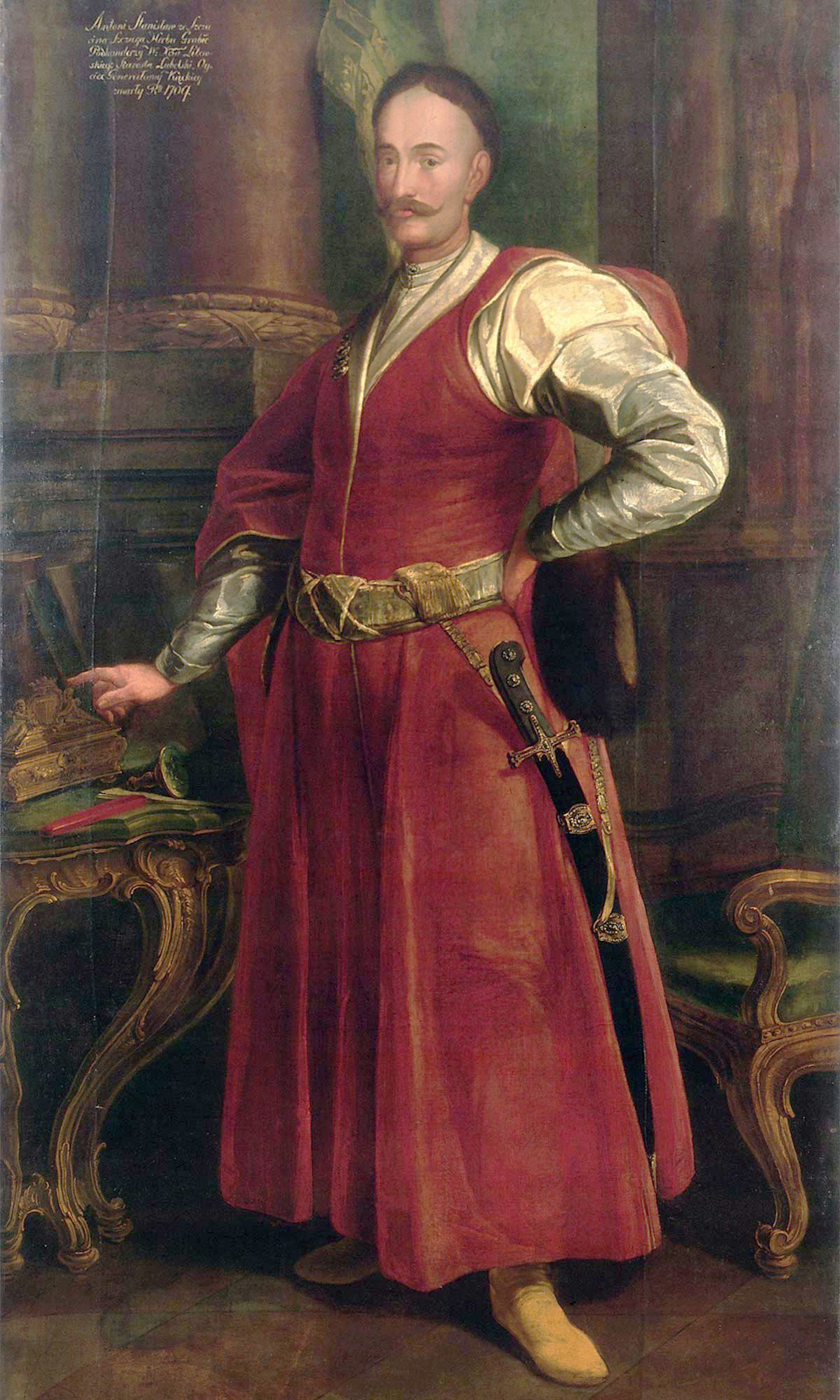
The indoctrination job has been done well in Poland: formerly close ties of Poland to the East -- Turkey in particular -- have been programatically wiped out from Polish collective memory. Yet the proof of the connection lies everywhere; at the linguistic level the most basic items bear Turkish names: pierogi (the national dish); palto (coat: can't live without one); torba (bag); wisnia (national fruit). The national dress -- kontusz -- was defended in the 18th century against the effeminate French fashion as truly Polish; it was, of course, Turkish (by way of Hungary). As was the hairstyle, the obligatory drooping mustache and the saber. (The saber is still obligatory: I own one).
Simply put, the Polish eternally western nature is -- a fraud. But never mind that: why waste my time fighting the nation-building indoctrination in Poland? All nation building indoctrination is equally stupid, whether in Poland or in India or Lapland; and I could never fight it all: who am I, a lone voice, against a sea of nonsense? Let them do their foolishness as they please.
But digging up layers of Turkishness in Poland is fun. It's not unlike archeology.
Here is one of my more entertaining recent digs:
Last November I passed through Kęty, or Kąty, in Upper Silesia. The name -- literally "corners" -- used to carry the connotation of "boonies" or "sticks", which Kęty was and still is. No offense: I am partial to sticks. Now, Kęty's coat of arms, proudly displayed at all city entrances, looks like this.
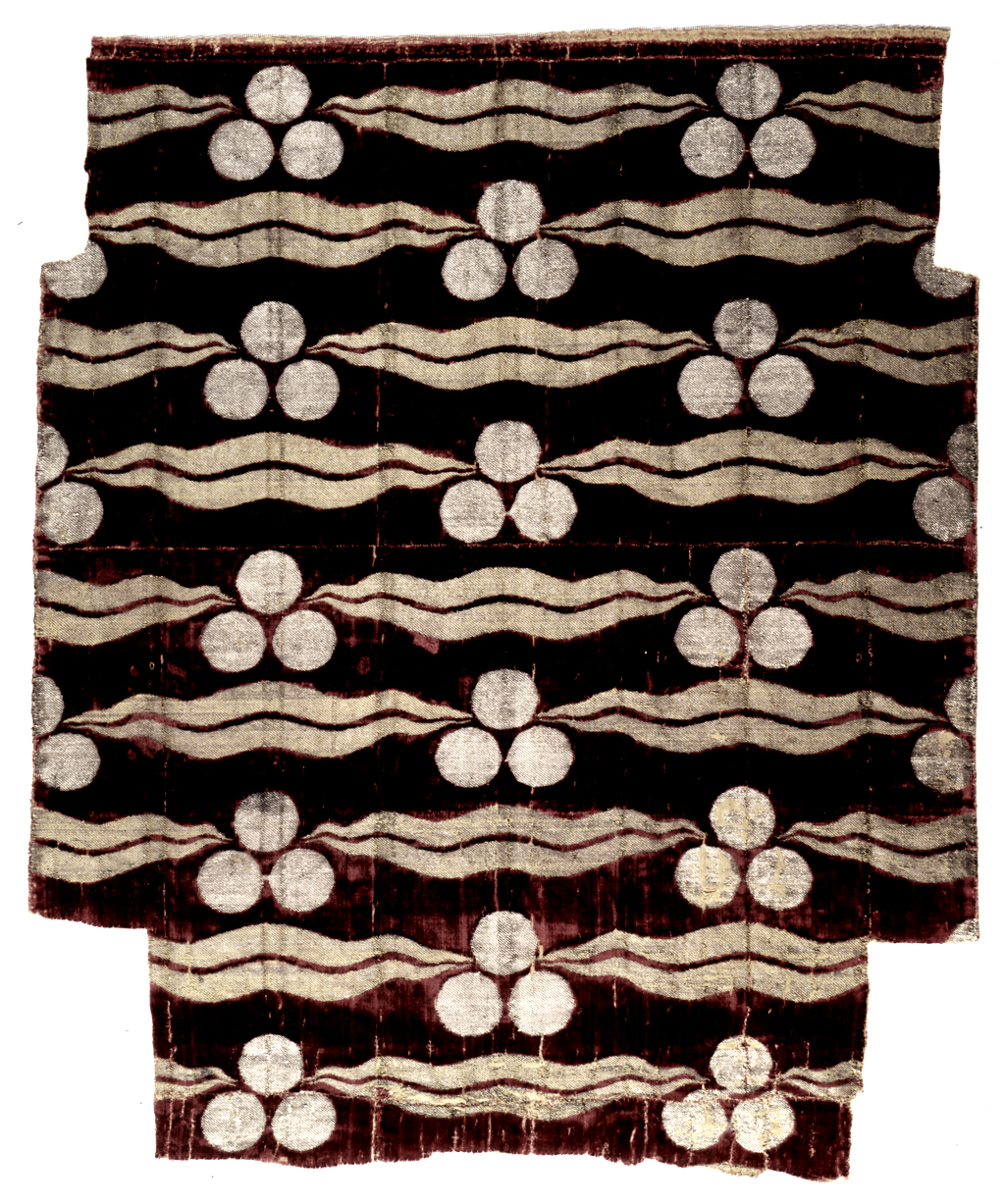
I laughed out loud. The right field is pure Chintamani (Çintamani), of course: three balls in pyramidal arrangement and two wavy lines. (Here is an example).
Chintamani was one of the principal elements of Turkish figurative design -- in textiles, in Iznik pottery, wall tiles, etc. It's origin lies in a banner the Ottoman rulers had adopted: three balls of Timur-e-Lang plus two stripes of Rustam's tiger-skin.
A friend who was traveling with me dug up the facts: sometime in the thirteenth century a prince of Silesia hunted somewhere in the sticks and finding an eagle's nest with three eggs in it close by a stream, decided to found a town there. (And why not). Hence the three balls (eggs) and two stripes (stream).
Hence, not Turkish but Polish?
Well, the source of the coat of arms may not be Turkish; but it is hard to believe that whoever drew this coat of arms -- with that particular arrangement of balls, and the two parallel wavy lines (in other coats of arms streams are represented with three lines) had not seen the Chintamani. I am sure he did. Perhaps he even owned a Turkish chintamani velvet.
Taken in a charge on a Turkish camp, of course.
A word about Chintamani:
It was just Rustam's two tiger stripes until Timur suddenly turned up: check out this link: you will see a portrait of Osman I, the founder of the Turkish state in Anatolia wearing a half-Chintamani, as it were: a tiger-stripe pattern kurta, gold on blue1. No balls.
Now, here is the thing: Osman predated Timur; at his time the Turks had not yet had the opportunity to learn the -- er -- shall we say -- burning significance of the three balls.
Now look at the illustration at the top of this post. Ipek, Imperial Ottoman Silks and Velvets calls it "a striking pattern in an unusual color combination". One wonders if the editors had seen the Osman portrait.
1 By the way, the word kurta lives in Polish as "kurtka", i.e. "small kurta", i.e. "jacket", and has nothing to do with German kurtz, though no doubt, the Semadenis' Baccalauréat thesis would have had you believe otherwise.
I should also mention here, I suppose, that the name Semadeni is originally Italian, or rather, to be precise, Savoyard, not Swiss; so much for the native Swiss Germanness of the Semadenis, I suppose.

Pair of sleeves (kolluk), 16th century, Topkapi.
Right at the formation of the Polish national state, the indoctrination began: in 1920 both Semadenis -- husband and wife -- then still boyfriend and girlfriend -- wrote their Baccalauréat thesis on the subject: Does Poland belong to Western European civilization or Central European civilization? They both answered correctly (and passed): Western. In their case it's no surprise: they were Lutherans of German and Swiss origins. How else could they answer? But the answer was de rigeur for all, it would seem, not only recent immigrants form the West.
The indoctrination job has been done well in Poland: formerly close ties of Poland to the East -- Turkey in particular -- have been programatically wiped out from Polish collective memory. Yet the proof of the connection lies everywhere; at the linguistic level the most basic items bear Turkish names: pierogi (the national dish); palto (coat: can't live without one); torba (bag); wisnia (national fruit). The national dress -- kontusz -- was defended in the 18th century against the effeminate French fashion as truly Polish; it was, of course, Turkish (by way of Hungary). As was the hairstyle, the obligatory drooping mustache and the saber. (The saber is still obligatory: I own one).
Simply put, the Polish eternally western nature is -- a fraud. But never mind that: why waste my time fighting the nation-building indoctrination in Poland? All nation building indoctrination is equally stupid, whether in Poland or in India or Lapland; and I could never fight it all: who am I, a lone voice, against a sea of nonsense? Let them do their foolishness as they please.
But digging up layers of Turkishness in Poland is fun. It's not unlike archeology.
Here is one of my more entertaining recent digs:
Last November I passed through Kęty, or Kąty, in Upper Silesia. The name -- literally "corners" -- used to carry the connotation of "boonies" or "sticks", which Kęty was and still is. No offense: I am partial to sticks. Now, Kęty's coat of arms, proudly displayed at all city entrances, looks like this.
I laughed out loud. The right field is pure Chintamani (Çintamani), of course: three balls in pyramidal arrangement and two wavy lines. (Here is an example).
Chintamani was one of the principal elements of Turkish figurative design -- in textiles, in Iznik pottery, wall tiles, etc. It's origin lies in a banner the Ottoman rulers had adopted: three balls of Timur-e-Lang plus two stripes of Rustam's tiger-skin.
A friend who was traveling with me dug up the facts: sometime in the thirteenth century a prince of Silesia hunted somewhere in the sticks and finding an eagle's nest with three eggs in it close by a stream, decided to found a town there. (And why not). Hence the three balls (eggs) and two stripes (stream).
Hence, not Turkish but Polish?
Well, the source of the coat of arms may not be Turkish; but it is hard to believe that whoever drew this coat of arms -- with that particular arrangement of balls, and the two parallel wavy lines (in other coats of arms streams are represented with three lines) had not seen the Chintamani. I am sure he did. Perhaps he even owned a Turkish chintamani velvet.
Taken in a charge on a Turkish camp, of course.
*
A word about Chintamani:
It was just Rustam's two tiger stripes until Timur suddenly turned up: check out this link: you will see a portrait of Osman I, the founder of the Turkish state in Anatolia wearing a half-Chintamani, as it were: a tiger-stripe pattern kurta, gold on blue1. No balls.
Now, here is the thing: Osman predated Timur; at his time the Turks had not yet had the opportunity to learn the -- er -- shall we say -- burning significance of the three balls.
Now look at the illustration at the top of this post. Ipek, Imperial Ottoman Silks and Velvets calls it "a striking pattern in an unusual color combination". One wonders if the editors had seen the Osman portrait.
_____________
1 By the way, the word kurta lives in Polish as "kurtka", i.e. "small kurta", i.e. "jacket", and has nothing to do with German kurtz, though no doubt, the Semadenis' Baccalauréat thesis would have had you believe otherwise.
I should also mention here, I suppose, that the name Semadeni is originally Italian, or rather, to be precise, Savoyard, not Swiss; so much for the native Swiss Germanness of the Semadenis, I suppose.
4.6.09
In which he descends (briefly) into hell
(and makes his own illustration)
Every great classic must obligatorily contain a chapter in which the hero travels out to the limit of the known world and peers beyond. (If it doesn't, it fails; ask Camoes and Mickiewicz why they are not taught in the Dead White Men courses in America).
The epic chapter of my life took place this morning.
I went to a certain suburb to look for shoes in a certain large shopping mall. This expedition necessitated a departure from the quaint city center, with its seven hills, its aqueducts, its triumphant arches, its mosaicked side-walks, its cute wooden trams and the levitating clouds of blooming jacaranda everywhere, its tiny retail shops and minuscule family owned eateries, its mainly pedestrian traffic -- and into the wholesale mass-market world of modernity.
The impression this created was so overwhelming that upon returning I immediately set out on a massive substance abuse program, carefully blending uppers and downers for that so very much needed knock-out blow.
Over there there had been broad freeways down which endless chains of motor vehicles tore with a roar; and square honey-comb towers -- factories for living -- in which people somehow managed to live cheek-by-jowl without going on a wild shooting spree too oft; gigantic shopping malls, convoluted architecturally, full of absolutely worthless, shockingly ugly stuff; and proferring in their feederies (deemed "restaurants") what looked like mold-injected, polymer-based artificially colored sugar pulp. Everything was fast and noisy and there was not a single pretty thing upon which to rest one's soul.
A huge tower full of apartments with head-bashing low ceilings (but central vacuum-cleaning, I am sure) was being marketed at a site overlooking a major snarling freeway traffic exchange. "Lux living" said the copy, but it should have said "Luxury living easy to get away from" (that is -- if you buy this place, you needn't really be here).
A hard thought struck me: goodness gracious, people live like that.
My god, I thought to myself, these suburbs have grown in the last fifty years; but how did they grow? Where must one come from to find this kind of life sufficiently bearable to choose it over wherever it is one comes from?
*
Later, a glance at the real-estate magazine revealed a puzzling fact: the housing there, in the middle of all that, is hardly less expensive than it is here; 20-30% discount on average over this -- which is, I grant you, a theme-park life, but a cute theme park life all the same, agreeable in the extreme, easy on the senses, and pretty well laid back.
Which means that the quality/price curve is here extremely shallow -- as it is in the rest of the world: as one travels down the curve, one gives up a tremendous amount of quality to gain a little in price advantage -- an apartment which costs 10% less to rent is a lot worse than its 10% more expensive brother.
But try to go up from the middle and the opposite seems true: to generate a 10% improvement in quality from here -- the place where I am -- one must be prepared to double the price one pays. The price-to-quality curve seems therefore to look like this:

Where the axis cross is the "middle" of the market (me, and almost certainly -- you). If we go down from here (look for a cheaper apartment, for instance), any saving will come at a huge cost to quality; but going up from here we pay through our nose for even a small improvement.
I am not sure why the curve should look like this, though suspect it has something to do with income distribution.
*
How steeply prices rise as one tries to go up from the middle was confirmed for me in the afternoon when I visited an oriental carpet dealer -- in my own quaint and laid-back neighborhood of course (my much abused soul had needed to look at pretty things to recover from the morning's rude shock). The friendly Iranian man took me through the back, up some regal stairs and into a cavernous apartment hung and laid with delicious carpets (it was like entering the Ali-Baba cave). And there they were, beautiful, restful and silent: mamluks, tekkes, herazes, sardes, qoms reposing in total and absolute silence, not rushing anywhere, not making a sound. There I sat on a snow-white silk qom, all 40,000 euros of it, and slowly my soul calmed down.
13.5.09
On the importance of good promotion
Many have puzzled why French classical tragedy (Corneille and Racine) has not traveled abroad as well as the English Shakespeare has. Various fanciful explanations have been proposed for this problem1 – such as that French tragedy is cut off from archaic or vernacular roots (French poetry being “inward looking”), that it is too rhetorical (all talk and no action), too grandiloquent (pompous), too set in the political realities of the moment, and so forth.
These are classic historicist explanations (in the Karl Popper sense): they cannot be tested. Indeed, some can't even be understood. (From which it follows that the guys in literary studies do not read enough analytical philosophy).
But these theories have something else in common: they use the seed-and-soil model of culture – make a seed appropriate to the soil, then throw it and it will grow into a tree.
It's wrong. (And typical of an academic who has not sold a thing in the real world in his life).
The authors forget the parable of the seed -- the essential third element of agriculture -- agriculture itself: domesticated plants don’t grow unless someone tills, rakes and waters the ground. (The seed of wheat is not robust enough to break dry ground unaided). Similarly, culture does not succeed on its own: it requires cultivation. And it seems just possible that French drama has never had in England the sort of enthusiastic and influential promoters that Shakespeare has had in France.
The promotion, or its success, need not have much to do with the quality of the art itself.
Consider that perhaps the most enthusiastic and influential promoter of Shakespeare in France was Voltaire who was, he reported, just amazed by what he saw in London. But Voltaire hardly spoke any English, so it isn’t clear that he knew what he was talking about; and in any case in his Letters From England were chiefly written for the purpose of knocking things French. Voltaire needed things foreign to praise -- with which to club the French: for what he wanted to accomplish, he could as easily have written Letters From Peking. Indeed, practically every sentence he wrote about Shakespeare and his superiority over French drama is so abstract, vague and -- well, historicist -- that he might as well have written it about Kungqu.
Similarly, those who seek causes for the success of even mediocre American film in its qualities may also be mistaken: they simply do not realize the power of the distribution machinery or the mammoth size of the promotional budget with which American films go out into the world. Typically, a film's promotional budget is greater than its production budget, and usually is increased if the initial sales are promising.
Human beings being essentially mimicking machines, in order to make its mark, a work of art needs good promotion far more than it needs quality of design -- as the latterly success of ugly fixtures and uncomfortable furniture clearly shows.
(I'd say the analytical value of Steiner's Death of Tragedy has been about zero, so far).
----
1It is a pseudo problem anyway: English tragedy has not traveled; Shakespeare has.
These are classic historicist explanations (in the Karl Popper sense): they cannot be tested. Indeed, some can't even be understood. (From which it follows that the guys in literary studies do not read enough analytical philosophy).
But these theories have something else in common: they use the seed-and-soil model of culture – make a seed appropriate to the soil, then throw it and it will grow into a tree.
It's wrong. (And typical of an academic who has not sold a thing in the real world in his life).
The authors forget the parable of the seed -- the essential third element of agriculture -- agriculture itself: domesticated plants don’t grow unless someone tills, rakes and waters the ground. (The seed of wheat is not robust enough to break dry ground unaided). Similarly, culture does not succeed on its own: it requires cultivation. And it seems just possible that French drama has never had in England the sort of enthusiastic and influential promoters that Shakespeare has had in France.
The promotion, or its success, need not have much to do with the quality of the art itself.
Consider that perhaps the most enthusiastic and influential promoter of Shakespeare in France was Voltaire who was, he reported, just amazed by what he saw in London. But Voltaire hardly spoke any English, so it isn’t clear that he knew what he was talking about; and in any case in his Letters From England were chiefly written for the purpose of knocking things French. Voltaire needed things foreign to praise -- with which to club the French: for what he wanted to accomplish, he could as easily have written Letters From Peking. Indeed, practically every sentence he wrote about Shakespeare and his superiority over French drama is so abstract, vague and -- well, historicist -- that he might as well have written it about Kungqu.
Similarly, those who seek causes for the success of even mediocre American film in its qualities may also be mistaken: they simply do not realize the power of the distribution machinery or the mammoth size of the promotional budget with which American films go out into the world. Typically, a film's promotional budget is greater than its production budget, and usually is increased if the initial sales are promising.
Human beings being essentially mimicking machines, in order to make its mark, a work of art needs good promotion far more than it needs quality of design -- as the latterly success of ugly fixtures and uncomfortable furniture clearly shows.
(I'd say the analytical value of Steiner's Death of Tragedy has been about zero, so far).
----
1It is a pseudo problem anyway: English tragedy has not traveled; Shakespeare has.
11.5.09
Crap luxury
So I went to see a luxury apartment for sale today. The place was 65 sq m and the asking price was 350K. (Yes, that would be 5.4K a meter, you are not misreading this).
The visit depressed me for the rest of the afternoon.
It depressed me because what was on offer would cost 70K down plus 1100 a month in interest; and was about 4K per meter more (yes, 3.5 x more) than some of the used, non-luxury apartments just next door; yet there was nothing luxury about it at all. The flooring was man-made fiber carpet; and the cabinetry was flimsy, hollow-sounding faux wood -- there was neither teak nor marble anywhere in sight. And while the place was packed with useless gizmos -- central vacuum, central heating, electric operated shutters, built-in centrally operated sound system, frames for LCD displays everywhere; yet, the rooms were small, the ceilings low (and made even lower by hung ceiling installed to receive the must-have recessed lights that are all the rage), the terrace was too small to eat on, and the noise from the traffic outside made double pane windows necessary, which in turn necessitated climatization.
Climatization! In this city!
To make things worse, everything was in the square style: glass table tops and stainless steel furniture and harsh-lights -- whoever lives there will no doubt eat of square white (or black) plates using inconvenient but very sharp utensils. It was all cold, angular, sharp-edged and calculated for discomfort - knobs with which to stabs one's fingers, etc. The concept appears to be one of Emergency Room.
Yet, the building was nearly all sold out: I was looking at the last two units available. People are buying this stuff; and paying real, hard-earned money for it. And clearly believe that central vacuum is luxury. And then move in and start feeling funny; and can't figure out why: they seem to have everything yet something seems lacking in their lives.
Comfort.
The visit depressed me for the rest of the afternoon.
It depressed me because what was on offer would cost 70K down plus 1100 a month in interest; and was about 4K per meter more (yes, 3.5 x more) than some of the used, non-luxury apartments just next door; yet there was nothing luxury about it at all. The flooring was man-made fiber carpet; and the cabinetry was flimsy, hollow-sounding faux wood -- there was neither teak nor marble anywhere in sight. And while the place was packed with useless gizmos -- central vacuum, central heating, electric operated shutters, built-in centrally operated sound system, frames for LCD displays everywhere; yet, the rooms were small, the ceilings low (and made even lower by hung ceiling installed to receive the must-have recessed lights that are all the rage), the terrace was too small to eat on, and the noise from the traffic outside made double pane windows necessary, which in turn necessitated climatization.
Climatization! In this city!
To make things worse, everything was in the square style: glass table tops and stainless steel furniture and harsh-lights -- whoever lives there will no doubt eat of square white (or black) plates using inconvenient but very sharp utensils. It was all cold, angular, sharp-edged and calculated for discomfort - knobs with which to stabs one's fingers, etc. The concept appears to be one of Emergency Room.
Yet, the building was nearly all sold out: I was looking at the last two units available. People are buying this stuff; and paying real, hard-earned money for it. And clearly believe that central vacuum is luxury. And then move in and start feeling funny; and can't figure out why: they seem to have everything yet something seems lacking in their lives.
Comfort.
10.5.09
What remains
At the Medeiros-Almedia this morning I happened to glance down and notice a Tekke Turkman. It looked more or less like this:

Tekke were Turkmen nomads, famous for their horses. Their carpets all feature the pattern of flattened roughly octagonal ellipsoids arranged in four parallel rows running the length of the piece. Sometimes they alternate with 8-pointed stars.
A recent issue of Hali magazine started out by asking where the abstract patterns seen in Persian carpets might come from and argued rather well that these ellipsoids, known in Turkish as göl, may derive from the bronze talismans of BMAC.
B-what? you might well ask.
BMAC, it turns out, stands for the Bactria-Margiana Archeological Complex, which was an advanced, settled, agricultural, possibly literary bronze-age civilization on the Oxus. It thrived between 2200 and 1700 B.C. but was subsequently lost. It was unearthed by a Russian archeologist, Victor Sarianidi, in the 70's and 80's and represents a discovery similar in scale, antiquity and mystery to the Mohenjo-Daro find on the Indus. The news of this new discovery did not begin to filter into the West until the fall of the Soviet Empire.
BMAC talismans were widely produced and it has been suggested that they may have been worn as magical protection. The author of the Hali article thinks the göl may be representations of these amulets.
If so, they represent a cultural survival from BMAC. Other remnants of the BMAC may include the Vedic soma cult, several aspects of Zoroastrianism, including the architectonic arrangement of the Zoroastrian temples of fire, and small figurines including the figure of "Scarface" -- snake-scaled man with a vicious gush across his right cheek -- like this one, in the Louvre:

"Scarfaces", says the Louvre, are
To me, the most interesting aspect of Scarface is that only four complete specimen of him survive while there are hundreds of thousands of Tekke Turkmen carpets. What survives seems so unpredictable. (What will remain behind when we are gone? Golden arches?)
And another thing: how much one can see by simply looking down; most people, when they do look down -- if they look down -- see only a worn-out carpet; but if you look carefully, it turns out that there lies at your feet a great civilization dead three thousand years!

Tekke were Turkmen nomads, famous for their horses. Their carpets all feature the pattern of flattened roughly octagonal ellipsoids arranged in four parallel rows running the length of the piece. Sometimes they alternate with 8-pointed stars.
A recent issue of Hali magazine started out by asking where the abstract patterns seen in Persian carpets might come from and argued rather well that these ellipsoids, known in Turkish as göl, may derive from the bronze talismans of BMAC.
B-what? you might well ask.
BMAC, it turns out, stands for the Bactria-Margiana Archeological Complex, which was an advanced, settled, agricultural, possibly literary bronze-age civilization on the Oxus. It thrived between 2200 and 1700 B.C. but was subsequently lost. It was unearthed by a Russian archeologist, Victor Sarianidi, in the 70's and 80's and represents a discovery similar in scale, antiquity and mystery to the Mohenjo-Daro find on the Indus. The news of this new discovery did not begin to filter into the West until the fall of the Soviet Empire.
BMAC talismans were widely produced and it has been suggested that they may have been worn as magical protection. The author of the Hali article thinks the göl may be representations of these amulets.
If so, they represent a cultural survival from BMAC. Other remnants of the BMAC may include the Vedic soma cult, several aspects of Zoroastrianism, including the architectonic arrangement of the Zoroastrian temples of fire, and small figurines including the figure of "Scarface" -- snake-scaled man with a vicious gush across his right cheek -- like this one, in the Louvre:

"Scarfaces", says the Louvre, are
anthropomorphic dragon-snakes belonging to the mythology of central Asia, where they incarnated the hostile forces of the underworld. Their power was controlled not by killing them but by reducing them to silence by a slash across the right cheek. Thus dominated, they could become benevolent.No source given for this interesting report. (Here is the Louvre's write up for you to make up your mind).
To me, the most interesting aspect of Scarface is that only four complete specimen of him survive while there are hundreds of thousands of Tekke Turkmen carpets. What survives seems so unpredictable. (What will remain behind when we are gone? Golden arches?)
And another thing: how much one can see by simply looking down; most people, when they do look down -- if they look down -- see only a worn-out carpet; but if you look carefully, it turns out that there lies at your feet a great civilization dead three thousand years!
6.5.09
Seeking the opinions of others
1
If you believe in evolution, you must also believe that significant genetic variety within the human species. (Evolution proceeds by individual mutation followed by breeding competition: every species subject to evolution is full of competing mutations).
2
And if you accept that changes in brain structure lead to changes in intellectual capacity (e.g. dogs and humans differ in intellectual capacity because their brains differ); and that the human brain has evolved and is subject to further evolution; then it follows that there must exist a plurality of different human brain mutations with different intellectual capacities: in short, different kinds of minds. (And since most of these mutations will have been around for a while and have had time to breed, we should expect that some individual mutations exist within very large numbers of brains; ergo, while the eye sees such doubtful categories as Poles and Portuguese, blacks and whites, men and women, we could perhaps with some justice speak of different brain populations; which probably do not overlap with any of the former categories).
3
This has two important and seemingly contradictory consequences regarding how we should treat the opinions of others.
4
In cases of objective knowledge – is buying GM stock a good move? -- we are well advised to consult the opinion of others because their brains may see something – some important clues or some subtle causal relations between clues and facts – which ours do not. In such cases, it is most useful to consult those with brains as different from ours as possible because we are hoping to look at a particular problem from a different vantage point in the hope of discovering something previously invisible. We are trying to borrow their cognitive system to look at the outside world.
5
In cases of subjective knowledge consulting with others is not entirely useless, because we do not have perfect introspective vision (i.e. we do not always know how we feel or why); in such instances learning about the feelings of others who find themselves in our circumstances can shed important light on our own problems. (This includes matters of taste: observing how others furnish their living rooms, for example, can be a rich source of good ideas).
But in such instances, we need to consult with those whose brains are as similar to ours as we can find because the question how a totally different brain might work in our particular circumstances, while amusing, is, practically speaking, useless.
So far, OK?
29.4.09
That living the life of the mind is a kind of trail-blazing
The Waldzell chapter of Glasperlenspiel contrasts Castalia (i.e the academia), in the person of Joseph Knecht, with the outside ("real") world, in the person of his friend Plinio.
In doing so it addresses a problem which often occupies the academics -- namely, the notion that their life, insulated as it is from the problems of the real world, is, by virtue of its irrelevance to the world, also somehow irrelevant per se.
This seems to be the major theme of GPS.
(It's worth noting, I suppose, that the real world does not really have a problem with academia's irrelevance and is happy to let it exist, irrelevant or not; the problem lies really in academia's mind. It is academics who are sometimes unhappy to be left alone to their doings; and who want these doings to be not just fun but also important; and it is they who imagine that the chief obstacle to its importance lies in its irrelevance).
The standard defense of academia against this (suicidal) attack proposes that academia is in fact useful to the outside world because basic research is needed to lay foundations for specific solutions to specific problems, educating large bodies of men is bound to produce at least some who are socially useful, etc.
Laudably, Hesse does not attempt this defense: such defense is self-defeating because it starts out by conceding that the life of the mind is only useful to the extent that it serves practical applications. It thereby automatically sets the life of the mind in a subservient position.
Hesse's intuition is like mine: that sooner or later all of humanity's immediate problems -- health, poverty, injustice, prejudice -- will be solved. And when they are solved, well, what then shall we do? We could decide to play computer games, of course; spit and catch; make love till we drop; or we could decide to dedicate ourselves to the pursuit if high-brow culture. A person who does so today is not really wasting his time, therefore: he is showing the way.
Now, I have solved all of my problems -- health, poverty, injustice have no more hold on me; I am therefore like that happy man of the future whose problems will all have been solved by the social activists of today. What I do with my time -- cultivate my mind -- is what that happy man of the future might choose to do with his: I read books, watch opera, visit museums, digest what I consume, think. To me this seems a life worth living.
But my life is not merely my life: considered and described, it represents a kind of roadmap for others. Just the sort of roadmap I so much wish others had left me.
In doing so it addresses a problem which often occupies the academics -- namely, the notion that their life, insulated as it is from the problems of the real world, is, by virtue of its irrelevance to the world, also somehow irrelevant per se.
This seems to be the major theme of GPS.
(It's worth noting, I suppose, that the real world does not really have a problem with academia's irrelevance and is happy to let it exist, irrelevant or not; the problem lies really in academia's mind. It is academics who are sometimes unhappy to be left alone to their doings; and who want these doings to be not just fun but also important; and it is they who imagine that the chief obstacle to its importance lies in its irrelevance).
The standard defense of academia against this (suicidal) attack proposes that academia is in fact useful to the outside world because basic research is needed to lay foundations for specific solutions to specific problems, educating large bodies of men is bound to produce at least some who are socially useful, etc.
Laudably, Hesse does not attempt this defense: such defense is self-defeating because it starts out by conceding that the life of the mind is only useful to the extent that it serves practical applications. It thereby automatically sets the life of the mind in a subservient position.
Hesse's intuition is like mine: that sooner or later all of humanity's immediate problems -- health, poverty, injustice, prejudice -- will be solved. And when they are solved, well, what then shall we do? We could decide to play computer games, of course; spit and catch; make love till we drop; or we could decide to dedicate ourselves to the pursuit if high-brow culture. A person who does so today is not really wasting his time, therefore: he is showing the way.
Now, I have solved all of my problems -- health, poverty, injustice have no more hold on me; I am therefore like that happy man of the future whose problems will all have been solved by the social activists of today. What I do with my time -- cultivate my mind -- is what that happy man of the future might choose to do with his: I read books, watch opera, visit museums, digest what I consume, think. To me this seems a life worth living.
But my life is not merely my life: considered and described, it represents a kind of roadmap for others. Just the sort of roadmap I so much wish others had left me.
22.4.09
Cultural Frustration and Heinrich Hesse
I feel underserved by nearly all the contemporary cultural production I come across. It all seems to fall into one of three categories:
A. Escapist: typically on the “they killed him but he ran away” model. This is often entertaining, sometimes very well done, and certainly has its place in the lives of many people. But it usually fails to keep my interest for long. (I really couldn't care less who done it, and remember nothing whatever of Star Wars).
B. Engaged art: this sets out to publicize the plight of various disadvantaged. (Most Scandinavian film and drama falls in this category). It is often worthy and sometimes also well done but if one is not so disadvantaged himself, the whole business fails to speak to him personally. (Take The Elephantman, for instance: how tragic to suffer from elephantiasis! -- but what does it have to do with me?)
C. Dummy Realism: This “tells it like it is”, but it takes as its topic the very ordinary – lower-middle-brain, to employ sociological terminology -- criminals, bakers, undertakers, working girls, frustrated suburban housewives, advertising canvassers walking aimlessly about Dublin while talking to themselves, etc. The reason for this is perhaps that writers are not, by and large, a brilliant lot (what possible incentive can there be for writing this stuff for hours and hours each day?); and it is impossible to write convincingly about people more intelligent than oneself. So writers, wisely, write "down". (As in "girls marry up, boys marry down"). And that's alright, but why do I have to read down?
This is why I enjoy reading Hesse: his heroes -- like Knecht of The Glass Bead Game -- are upper-middle brain and neither disadvantaged nor politically engaged; they are thus free to direct all of their considerable brain power to the pure task of cultivation of that brain power; which is a life-style anyone with a brain and the freedom to pursue it well might. It is, in other words, a life we all could live if we only could live it; perhaps even the life we will all live one day, all our disadvantages have been removed and all our brains powered-up by way of a special chip. The project is not without its problems -- but they are not explored in art; and that is too bad because, certainly, to me at least, such art would be a lot more interesting than A-C above.
But while I praise highly Hesse's gumption to go after a good topic, I praise his execution less enthusiastically. His description of the sculptor's creative process in Goldmund and Narcissus is a pious fabrication; his description of meditation in Glasperlenspiel, also. Perhaps Hesse, too, was too busy writing books to find out properly about the things he was writing about.
The old dictum regarding pornography comes to mind: the reason why it is so bad is because those doing it have no time to write it, and those writing it have never done it. Good literature has the odds stacked up against it.
A. Escapist: typically on the “they killed him but he ran away” model. This is often entertaining, sometimes very well done, and certainly has its place in the lives of many people. But it usually fails to keep my interest for long. (I really couldn't care less who done it, and remember nothing whatever of Star Wars).
B. Engaged art: this sets out to publicize the plight of various disadvantaged. (Most Scandinavian film and drama falls in this category). It is often worthy and sometimes also well done but if one is not so disadvantaged himself, the whole business fails to speak to him personally. (Take The Elephantman, for instance: how tragic to suffer from elephantiasis! -- but what does it have to do with me?)
C. Dummy Realism: This “tells it like it is”, but it takes as its topic the very ordinary – lower-middle-brain, to employ sociological terminology -- criminals, bakers, undertakers, working girls, frustrated suburban housewives, advertising canvassers walking aimlessly about Dublin while talking to themselves, etc. The reason for this is perhaps that writers are not, by and large, a brilliant lot (what possible incentive can there be for writing this stuff for hours and hours each day?); and it is impossible to write convincingly about people more intelligent than oneself. So writers, wisely, write "down". (As in "girls marry up, boys marry down"). And that's alright, but why do I have to read down?
This is why I enjoy reading Hesse: his heroes -- like Knecht of The Glass Bead Game -- are upper-middle brain and neither disadvantaged nor politically engaged; they are thus free to direct all of their considerable brain power to the pure task of cultivation of that brain power; which is a life-style anyone with a brain and the freedom to pursue it well might. It is, in other words, a life we all could live if we only could live it; perhaps even the life we will all live one day, all our disadvantages have been removed and all our brains powered-up by way of a special chip. The project is not without its problems -- but they are not explored in art; and that is too bad because, certainly, to me at least, such art would be a lot more interesting than A-C above.
But while I praise highly Hesse's gumption to go after a good topic, I praise his execution less enthusiastically. His description of the sculptor's creative process in Goldmund and Narcissus is a pious fabrication; his description of meditation in Glasperlenspiel, also. Perhaps Hesse, too, was too busy writing books to find out properly about the things he was writing about.
The old dictum regarding pornography comes to mind: the reason why it is so bad is because those doing it have no time to write it, and those writing it have never done it. Good literature has the odds stacked up against it.
7.4.09
Cultural tourism
Philippe Jaroussky is not perhaps the most interesting singer of our time, but certainly has one of its most beautiful voices: he is a counter-tenor singing in soprano, a rare thing. But unless you listen to Radio France, you won't hear him much at all.
This recording by him is of Marc-André Dalbavie's Sonnets by Louise Labé. It is very beautiful. Dalbavie, my exact contemporary, composes in a thoroughly modern idiom, one closer to Arvo Paart and Gorecki, but more radical then either, without yet wandering off into the incomprehensible. Radio France carried his piano concerto recently: it was really quite good.
Louise Labé was a French Renaissance poetess, a commoner, possibly a cross-dresser or courtesan, or both: an interesting and mysterious figure in her own right -- she is said to have competed in jousts. But then Mireille Huchon, a French scholar, has recently proposed that she had not in fact existed but was merely an imaginary creation by a group of Lyonnais poets, an invention capitalizing on the period's literary fascination with the classical poet Sappho and on a publication, in 1533, of poems attributed to Petrarch's "Laura" (Laura de Sade; the poems were in fact the work of a descendant of Laura). In 1542 Clément Marot, she says, seeking a French equivalent of Petrarch's praise of "Laura", proposed to the Lyonnais circle that they "louer Louise" (praise Louise).
Here is how he praised her:
This recording by him is of Marc-André Dalbavie's Sonnets by Louise Labé. It is very beautiful. Dalbavie, my exact contemporary, composes in a thoroughly modern idiom, one closer to Arvo Paart and Gorecki, but more radical then either, without yet wandering off into the incomprehensible. Radio France carried his piano concerto recently: it was really quite good.
Louise Labé was a French Renaissance poetess, a commoner, possibly a cross-dresser or courtesan, or both: an interesting and mysterious figure in her own right -- she is said to have competed in jousts. But then Mireille Huchon, a French scholar, has recently proposed that she had not in fact existed but was merely an imaginary creation by a group of Lyonnais poets, an invention capitalizing on the period's literary fascination with the classical poet Sappho and on a publication, in 1533, of poems attributed to Petrarch's "Laura" (Laura de Sade; the poems were in fact the work of a descendant of Laura). In 1542 Clément Marot, she says, seeking a French equivalent of Petrarch's praise of "Laura", proposed to the Lyonnais circle that they "louer Louise" (praise Louise).
Here is how he praised her:
Estreines, à dame Louïze Labé
- Louïze est tant gracieuse et tant belle,
- Louïze à tout est tant bien avenante,
- Louïze ha l'oeil de si vive estincelle,
- Louïze ha face au corps tant convenante,
- De si beau port, si belle et si luisante,
- Louïze ha voix que la Musique avoue,
- Louïze ha main qui tant bien au lut joue,
- Louïze ha tant ce qu'en toutes on prise,
- Que je ne puis que Louïze ne loue,
- Et si ne puis assez louer Louïze.
Sonnet VIII
Je vis, je meurs; je me brûle et me noie ;
J'ai chaud extrême en endurant froidure :
La vie m'est et trop molle et trop dure.
J'ai grands ennuis entremêlés de joie.Tout à un coup je ris et je larmoie,
Et en plaisir maint grief tourment j'endure ;
Mon bien s'en va, et à jamais il dure ;
Tout en un coup je sèche et je verdoie.Ainsi Amour inconstamment me mène ;
Et, quand je pense avoir plus de douleur,
Sans y penser je me trouve hors de peine.Puis, quand je crois ma joie être certaine,
Et être au haut de mon désiré heur,
Il me remet en mon premier malheur.
*
How nice. One discovery leads to another; there is no end in sight; there are too many facts for anyone to master in his lifetime. While this means that, sadly, synthesis is impossible; which is to say that we will never be able to say anything definitive or final; yet it also means -- endless pleasure. History of culture is like a gigantic rich cake in which we can burrow like worms day and night till our dying day without tiring, or boring, or exhausting the sustenance.
Look, barely have I done with this morning's adventure of tracking down Louise Labé (by way of Jaroussky and Dalbavie) and, lo!, up pops this article on Qianlong's French etchings.
Qianlong, says Melikian, was a cultural tourist: an expert connoisseur of Chinese art an culture, he was also a quintessential Manchu: a hunter and a warrior; and his intellectual and artistic interests extended to xiyangxue, that is us, "Western Studies".
(He was altogether more broad-minded, it would seem, that Umberto Eco).
I am a cultural tourist, too.
Subscribe to:
Posts (Atom)

 Posts
Posts